










Centum plans new BTS facility for in-house system testing
Key highlights
- Centum said it has no short-term production-capacity bottleneck against the Rs 1,950 crore order book cited in the call.
- An analyst cited nearly Rs 950 crore of BTS orders within the Rs 1,950 crore total order book.
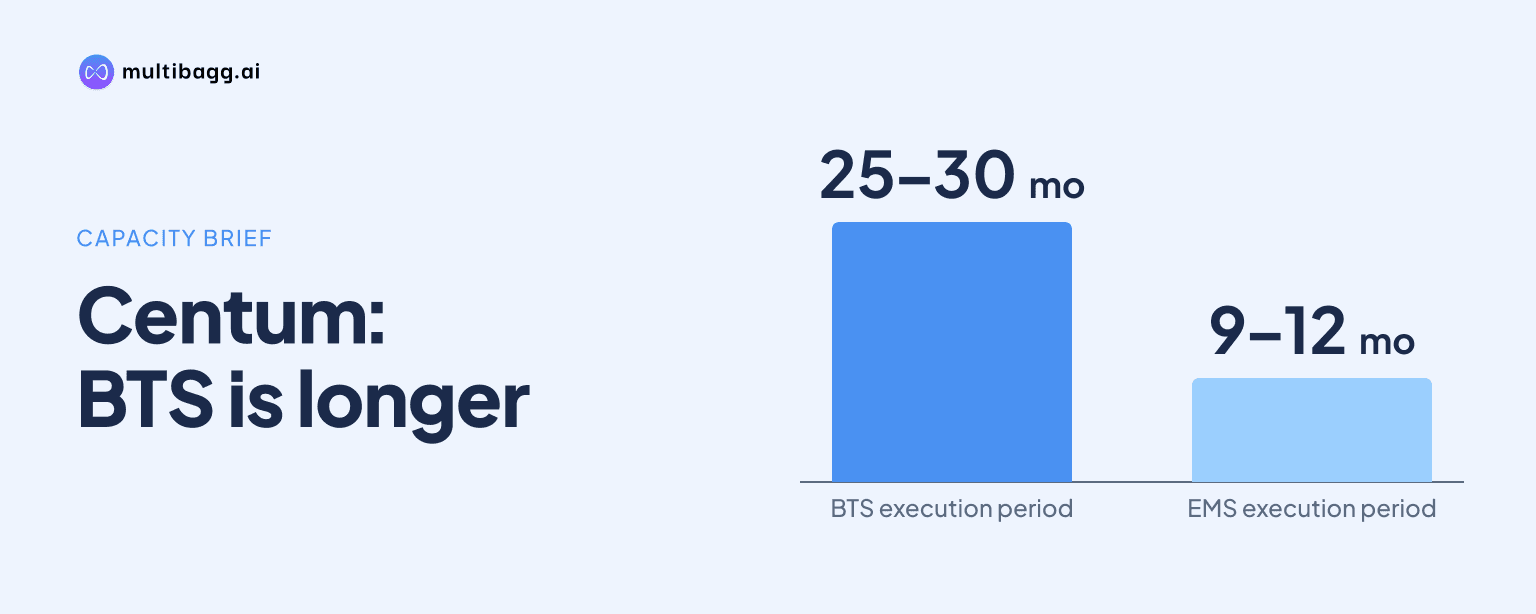
- BTS work was compared with a 25-30-month execution period, versus 9-12 months for EMS.
- Centum received about Rs 51 crore of air-navigation-system orders from GRSE in the first half.
powered by IRIS
During the earnings call, Centum said it plans a new BTS facility with dedicated in-house test infrastructure and larger-system space, although it reported no immediate production constraint against the Rs 1,950 crore order book cited in the discussion. Management positioned the investment as a system-level capability expansion rather than a near-term volume addition.
Know Centum Electronics inside out
Results, valuation, peers and who's buying, in one view.
Does Centum have enough BTS production capacity?
Yes, Centum said it has no short-term production-capacity bottleneck for executing the BTS orders under discussion. An analyst referred to a total order book of Rs 1,950 crore, with nearly Rs 950 crore in the BTS segment, and management said the planned facility was not required to address an immediate manufacturing constraint. The distinction matters because BTS work combines engineering, design and production requirements.
Centum said it has added, and continues to add, specialised engineering capability through highly qualified and skilled engineers. Management described this as necessary to execute the design element of new systems and programmes, separately from its existing physical production capacity. The proposed BTS investment is therefore directed toward system-level infrastructure rather than conventional manufacturing capacity alone.
Management said the relevant orders would generally execute over a two- to two-and-a-half-year timeframe. Revenue will consequently ramp over that period rather than be recognised in equal portions each year. Centum declined to provide specific quarterly or annual revenue figures linked to the Rs 1,950 crore order book.
What will Centum's new BTS facility add?
Centum said the new BTS facility will add dedicated test infrastructure for specialist work that currently requires third parties or outside facilities. Bringing selected testing in house is intended to support system-level capability, while the facility will also provide more space for larger systems. Management linked both features to systems for which Centum is bidding through tenders and requests for quotation.
The stated plan has two operational purposes: internalising some test activity and accommodating larger system programmes. Centum did not disclose a capital-expenditure amount, site, construction schedule or commissioning date. It also did not say all external testing would end, only that certain activities now performed outside the company could be brought in house.
The BTS segment has recent order activity that supports the focus on system capability. Management said Centum received about Rs 51 crore of air-navigation-system orders in the first half from GRSE. It also described further navigation-system opportunities as a healthy pipeline, which indicates potential work rather than confirmed orders.
Got a follow-up? Ask IRIS
When will Centum's BTS order book become revenue?
Centum said BTS orders discussed on the call generally take two to two-and-a-half years to execute, compared with the nine-to-12-month EMS execution period cited in the discussion. The longer BTS cycle means its order book should not be treated as revenue that converts evenly over two financial years. Management said delivery is a ramp-up process, with some work in the current year and further growth expected in the following year.
Management said it has visibility for 25% to 30% growth in both EMS and BTS over the next couple of years, while declining to give annual or quarterly guidance. It added that BTS could deliver a faster growth rate over that period. This was management's stated outlook and not a timetable for recognising individual orders.
Centum also rejected the view that BTS growth in the second quarter represented spillover from the first quarter. Management attributed the performance to higher order-book activity and execution, while cautioning that the business can show significant quarterly variation. It said it expected the second half to remain strong and to grow relative to the first half.
Why is Centum bringing system testing in house?
Centum is planning in-house testing because its larger system-level programmes need dedicated infrastructure and more physical space. Management said it currently relies on third parties or outside facilities for some test work, and the new BTS facility is meant to reduce that dependence for selected activities. The company did not quantify expected cost savings, margin benefits or revenue from the internalised tests.
The facility plan accompanies Centum's effort to move from subsystem work toward larger systems. Management said it was delivering subsystem orders in radar and electronic warfare and was in the final stages of seeking repeat production contracts for products it had designed. It also said completed system programmes could be sold outside India in two to three years, after key programmes are first sold in India.
Management said BTS margins should remain in the 20% to 22% range, including projects with a high material share and lower margins. At the company level, it said it was working toward a 12.5% to 13% margin range, with an aim to reach 13% next year and ultimately 14% to 15% over the next three to four years. Those margin objectives were management targets, not forecasts tied specifically to the new facility.
Conclusion
Centum's planned BTS facility is a capability-led expansion rather than an emergency response to limited production capacity. The company said existing production can execute the Rs 1,950 crore order book under discussion, while dedicated testing infrastructure and larger-system space could reduce selected external dependencies and support bids for system-level programmes over the 25-to-30-month BTS execution cycle.
The next items to watch are Centum's disclosure of the facility's capital cost, location and commissioning schedule, none of which management provided on the call. Progress on larger BTS tenders, repeat radar and electronic-warfare contracts, and the stated 25% to 30% growth outlook over the next couple of years will indicate how quickly the additional system capability is put to use.