










Centum sees semiconductor EMS run rate reach $50 million
Key highlights
- Centum expects semiconductor-equipment EMS to reach a $45 million-$50 million annual run rate within about two years.
- Centum's revised semiconductor EMS opportunity exceeds its original $25 million-$30 million annual estimate.
- Centum reported FY27 first-half standalone revenue of Rs 517 crore, up 32% year on year.
- Customer prepayments covered about 50% of Centum's net inventory at September 2026-end.
powered by IRIS
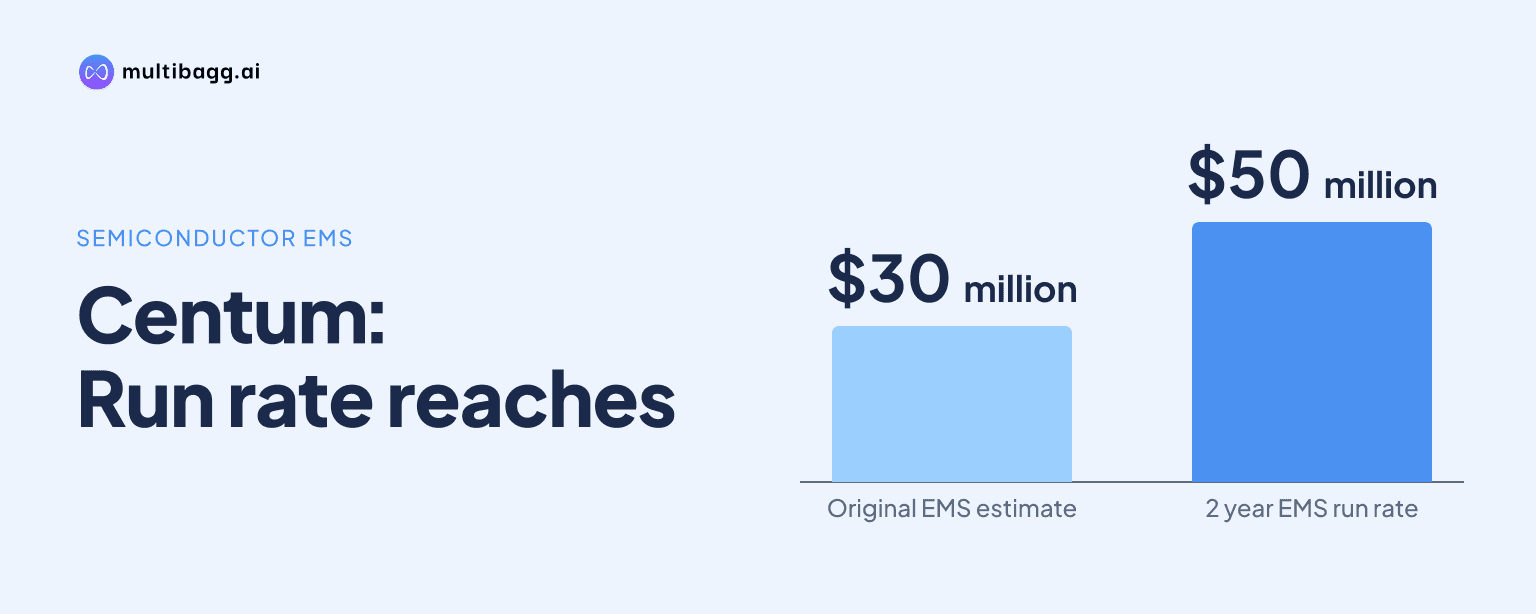
Centum expects its semiconductor-equipment electronic manufacturing services (EMS) opportunity to reach a $45 million-$50 million annual run rate within about two years, above its original $25 million-$30 million estimate. Management attributed the increase to quarterly demand growth for qualified products and the addition of new product lines in the segment.
Know Centum Electronics inside out
Results, valuation, peers and who's buying, in one view.
How large could Centum's semiconductor-equipment EMS business become?
Centum expects semiconductor-equipment EMS to reach a $45 million-$50 million annual run rate in about two years. Management described this as visibility into the opportunity rather than formal annual guidance, and said the segment is growing aggressively beyond the $25 million-$30 million annual run-rate opportunity it initially estimated.
The revised range is $20 million higher than both the low and high ends of Centum's earlier estimate. An analyst said Centum delivered about Rs 100 crore for semiconductor applications in the prior year and about Rs 85 crore to Rs 90 crore in the first half of FY27, but management did not independently confirm these figures or disclose a separate FY27 revenue target for semiconductor equipment.
What is driving Centum's higher semiconductor EMS outlook?
Centum said demand for products already qualified for semiconductor equipment is the principal driver of the higher outlook. Management said requirements for those products were increasing almost every quarter, while new lines and products were being added to the semiconductor-equipment portfolio.
Supply conditions are also affecting how Centum supports the demand increase. Management said artificial intelligence and data-centre infrastructure build-outs have drawn component capacity away from other applications, contributing to higher prices and longer lead times. It cited bare printed circuit board lead times of 40 to 50 weeks, versus a usual eight to 12 weeks, and identified memory devices as another area of shortage.
Centum said it buys components in advance where available to cover expected requirements, including demand over the next 12 months. Its inventory increased because of business growth and supply constraints, but customer prepayments covered about 50% of net inventory at the end of September 2026. That coverage links part of the inventory build to customer funding, although component availability and logistics delays remain execution factors.
How does semiconductor EMS fit into Centum's FY27 results?
Centum's semiconductor-equipment opportunity is part of its wider EMS activity, not a separately reported revenue segment in the call. Standalone revenue from operations was Rs 312 crore in the second quarter of FY27, up about 52% year on year, and first-half standalone revenue was Rs 517 crore, up 32% year on year.
Standalone earnings before interest, tax, depreciation and amortisation (EBITDA) were Rs 40 crore in the quarter, up 63% year on year, with a 12.69% margin. First-half EBITDA rose 25% to Rs 63 crore and profit after tax rose 28% to Rs 36 crore, but Centum did not specify semiconductor equipment's contribution to revenue, profit or margins.
Management retained a medium-term revenue-growth objective of 25% to 30% while declining to provide quarterly or annual guidance. It also said the second half of FY27 should be strong and expected growth in the build-to-specification (BTS) business compared with the first half, alongside demand across EMS customer programmes.
Got a follow-up? Ask IRIS
What other EMS programmes could expand Centum's business?
Centum expects three newer EMS customer engagements to each become at least a $10 million annual engagement when ramped over the next two to three years. These programmes are separate from the semiconductor-equipment opportunity, but indicate the other customer additions management is pursuing in transportation, industrial equipment and defence.
The transportation customer is a global tier-1 original equipment manufacturer supplying braking-system and platform-door-controller applications for metro and mainline networks. Centum said it was selected as the customer's first EMS partner in India after the customer decided to localise electronics that had previously been largely imported and integrated into its systems.
The industrial engagement is with a German original equipment manufacturer in metrology and measurement tools that is establishing a large Indian plant. The defence programme involves a Middle East customer and a drone application where Centum participated at the design stage and has begun receiving serial-production orders. Management said it would seek to expand the industrial relationship beyond its initial product area.
How will Centum support growth in EMS and BTS?
Centum said it has no short-term production-capacity bottleneck for BTS orders, which typically execute over two to two-and-a-half years. It is adding engineering personnel for system-design work and is planning a BTS facility with system-level capability, dedicated test infrastructure and room for larger systems.
Borrowings rose by about Rs 11.5 crore to Rs 134 crore at the end of September 2026 because of working-capital needs, while cash balances were about Rs 127 crore, including about Rs 49 crore of restricted cash. Centum also had about Rs 53 crore of qualified institutional placement proceeds remaining at September-end, although management said about Rs 50.7 crore earmarked for general corporate purposes had no specific near-term use.
On November 4, 2026, Centum's board approved, subject to shareholder approval, a proposal to increase borrowing authorisation from Rs 500 crore to Rs 1,000 crore. Management said the measure was primarily intended to provide additional non-fund-based limits for anticipated BTS order-book growth, as existing sanctioned limits of about Rs 490 crore were nearly utilised.
Conclusion
Centum's $45 million-$50 million semiconductor-equipment EMS run-rate outlook represents a higher opportunity than its original $25 million-$30 million estimate. Management tied the change to rising orders for qualified products and new product additions, while overall first-half FY27 standalone revenue rose 32% to Rs 517 crore.
The next disclosed indicators are semiconductor product-line ramps, component availability and the conversion of demand into orders. Investors can also monitor customer prepayments covering about 50% of net inventory, progress on the planned BTS facility, and shareholder action on the proposed Rs 1,000 crore borrowing authorisation.