










Centum BTS Growth Outpaces EMS but Extends Capital Cycle
Key highlights
- Centum BTS revenue grew 84% year on year in Q2-FY27, versus 41% for EMS/DLM.
- Centum discloses BTS working-capital cycles of 225 to 350 days, compared with 85 to 110 days for EMS.
- BTS represented 30% of H1-FY27 revenue, while EMS represented 70%.
- Centum’s BTS order book rose 68% year on year at the end of Q2-FY27.
powered by IRIS
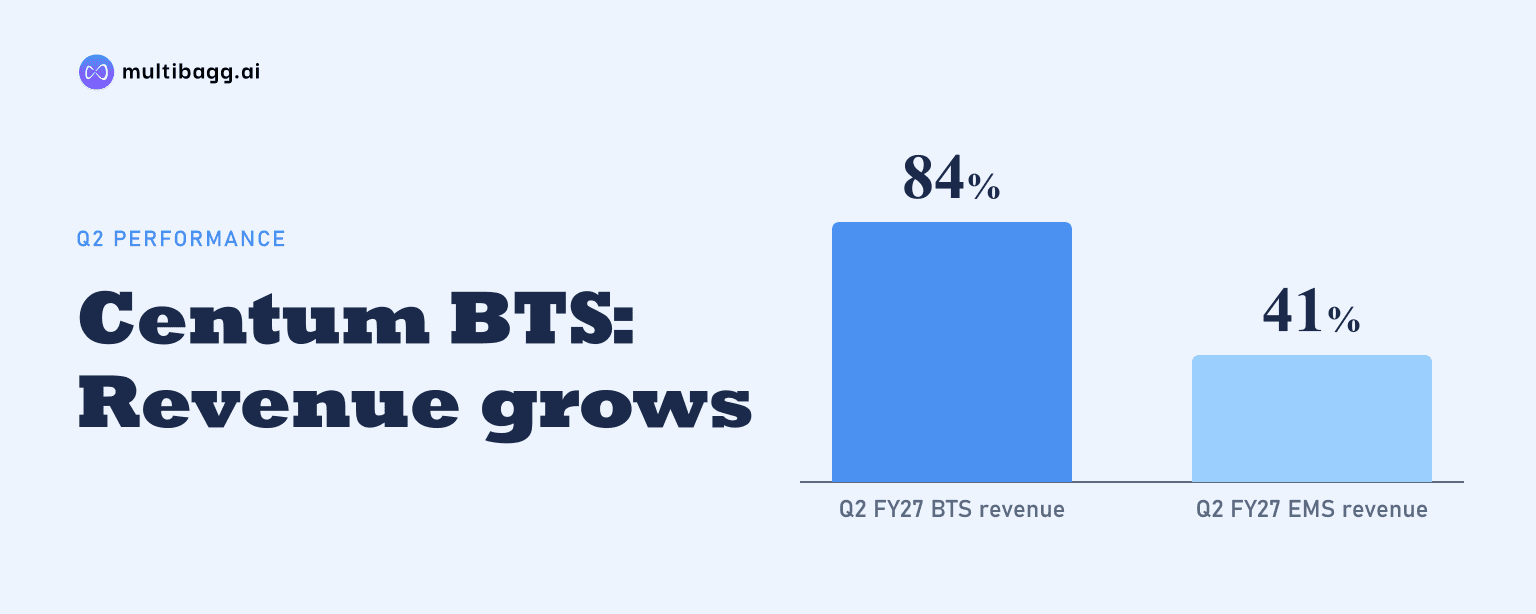
Centum’s Build-to-Specification (BTS) revenue grew 84% year on year in Q2-FY27, ahead of 41% for Electronic Manufacturing Services (EMS)/DLM, while BTS has a disclosed working-capital cycle of 225 to 350 days. The presentation positions EMS as the larger cash-generating business that supports BTS’s longer programme and funding requirements.
Know Centum Electronics inside out
Results, valuation, peers and who's buying, in one view.
How do Centum’s BTS and EMS models differ?
Centum describes BTS as its value engine for strategic defence, aerospace and space programmes, with a benchmark margin of more than 20%, a project lifecycle of two to 2.5 years and working-capital days of 225 to 350. The presentation also describes BTS programmes as having margins of 18% to more than 20%, but neither range is a reported BTS segment margin for Q2-FY27 or H1-FY27.
Centum describes EMS as its cash engine, with a benchmark margin of 9% to 10%, a six-to-nine-month project lifecycle and 85 to 110 working-capital days. EMS accounts for the majority of revenue and provides the cash flows that Centum says fund BTS’s longer project and working-capital cycles. BTS can therefore require capital for up to 240 more days than EMS when comparing the upper ends of the disclosed ranges.
BTS is focused on strategic programmes where Centum says it is moving towards complete systems for defence and strategic sectors, while EMS covers high-reliability and high-complexity manufacturing. Centum’s H1-FY27 revenue mix was 30% BTS and 70% EMS, showing that the shorter-cycle EMS operation remains the larger business vertical.
Is Centum BTS growing faster than EMS?
Yes. Centum reported BTS revenue growth of 84% year on year and 84% quarter on quarter in Q2-FY27, compared with 41% year on year and 43% quarter on quarter for EMS/DLM. In H1-FY27, BTS revenue rose 39% year on year, also ahead of the 32% increase reported for EMS/DLM.
Centum attributed BTS growth in H1-FY27 to deliveries on key defence and space programmes, whereas EMS/DLM growth came from ramp-up in key customer deliveries. The comparison indicates that BTS was the faster-growing vertical in both the quarter and first half, although the presentation does not disclose segment revenue in rupees for either business.
BTS order-book growth also exceeded that of EMS/DLM at the end of Q2-FY27. Centum said BTS order book was 68% higher year on year, versus 30% for EMS/DLM, and cited an export order of Rs 30.5 crore for advanced electronics systems and a follow-on advanced naval navigation system order of about Rs 51.5 crore. It also reported design milestones on the indigenous active electronically scanned array, or AESA, Radar UH-M programme.
The larger EMS base remains central to the combined model. Centum reported standalone operational revenue of Rs 516.8 crore in H1-FY27, after Rs 973.1 crore in FY26, Rs 776.1 crore in FY25 and Rs 632.8 crore in FY24. The H1-FY27 70% EMS share supports management’s description of that segment as the business funding longer BTS execution cycles.
Got a follow-up? Ask IRIS
What does a 350-day BTS capital cycle mean for Centum?
A 350-day BTS cycle means Centum may need to keep capital committed for substantially longer than in EMS, whose disclosed range is 85 to 110 days. BTS projects also run for two to 2.5 years, compared with six to nine months for EMS, so the presentation explicitly links EMS cash flows to the funding of longer BTS projects.
Centum reported group net working capital of 136 days at the end of September 2026, an improvement of six days. That reported group measure is below BTS’s 225-to-350-day business-model range and above EMS’s 85-to-110-day range, but Centum does not allocate the 136 days between the two verticals.
Receivable days sales outstanding, or DSO, improved by nine days to 106 days following a September collection drive, according to Centum. Inventory increased because of business growth and supply-chain constraints, although customer prepayments covered about 50% of net inventory. These disclosures identify the mechanisms affecting working capital but do not quantify BTS-specific inventory or receivables.
Centum said debt increased by Rs 11.5 crore to Rs 133.5 crore because of higher working capital at September 2026. Cash, including about Rs 49 crore of restricted cash, was Rs 127 crore, while the qualified institutional placement balance at the end of September 2026 was about Rs 53 crore. The presentation does not assign the debt, cash or placement proceeds to BTS or EMS.
Which programmes support Centum’s BTS expansion plan?
Centum’s BTS India plan focuses on localising critical technologies and supplying complete systems for defence and strategic sectors. Its listed focus areas include multi-function radar and radar subsystems, satellite constellations for intelligence, surveillance and reconnaissance applications, avionics and electronic-warfare systems for fighter aircraft and helicopters, the T-90 tank, and drone payloads and communications electronics.
Centum says it intends to support this plan through strategic collaborations, system-level expertise, partnerships with global aerospace and defence original equipment manufacturers, and work with IITs, NITs, IISc and startups. The presentation lists capabilities including MIL and space-grade compliance, IPC Class 3, traceability, printed circuit board assembly, box-build, line-replaceable units and systems integration.
Centum reported that more than 200 of its subsystems and modules were onboard the GSLV-F17 and GISAT-1A, also called EOS-05, mission. It also cites average relationships of 10 to 15 years with top customer groups and says approximately 80% of manufactured products are single sourced. Another presentation page says 70% of products are single sourced, and the presentation does not reconcile those two measures.
Conclusion
Centum’s business model combines a 70% EMS revenue base in H1-FY27 with a 30% BTS business that grew faster, rising 84% year on year in Q2-FY27 against 41% for EMS/DLM. The trade-off is the disclosed BTS operating profile: more than 20% benchmark margin, two-to-2.5-year project lifecycles and working-capital requirements of up to 350 days.
The next point to watch is whether programme deliveries, customer prepayments and collections maintain the balance between BTS growth and group funding needs. Centum reported 136 net working-capital days at September 2026, a six-day improvement, and its disclosed BTS plan covers radar, satellite, avionics, tank and drone programmes, but it provides no timetable or numerical revenue target for those initiatives.