










Centum’s Rs 30 crore BTS export order targets repeat sales
Key highlights
- Centum’s BTS export order is worth Rs 30 crore and covers a naval electronic-warfare subsystem.
- Management expects repeat orders because the subsystem technology can also be used on land and airborne platforms.
- Management cited Indian defence exports of around Rs 38,000 crore, against a national target of about Rs 50,000 crore.
- Centum said it had not previously undertaken BTS exports in a significant way, unlike its established EMS defence exports.
powered by IRIS
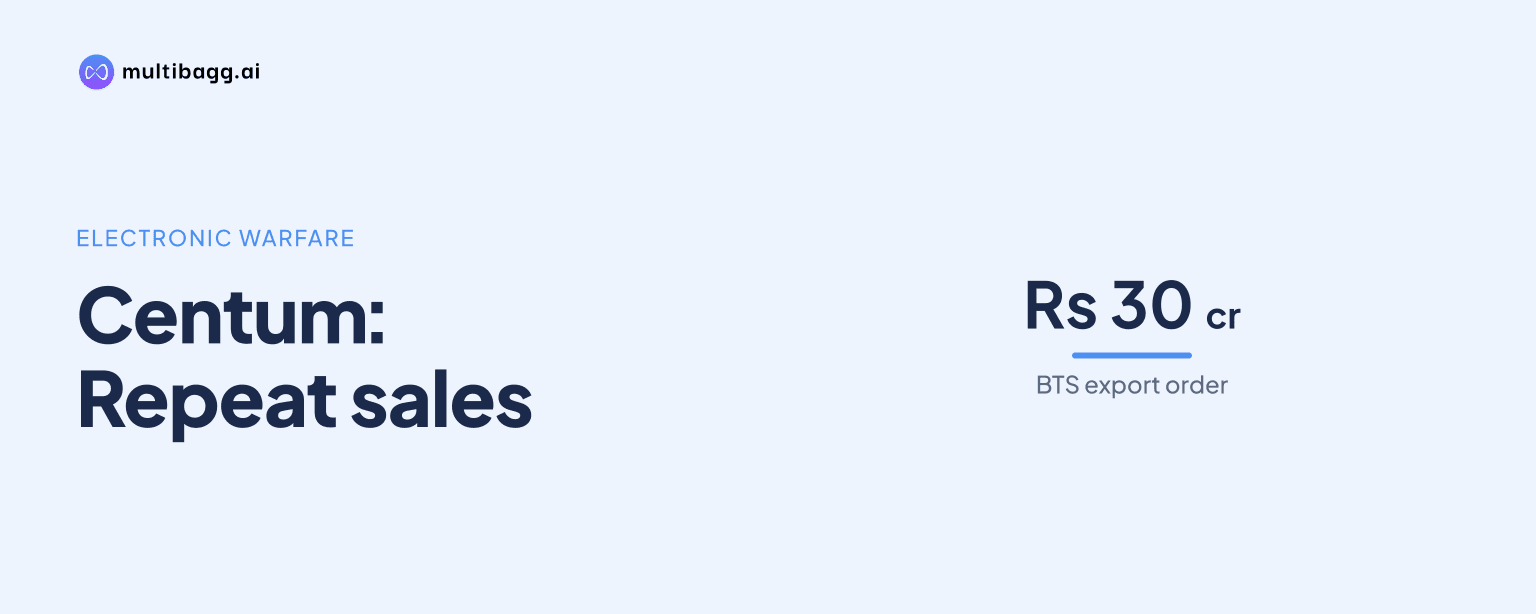
Centum’s Rs 30 crore build-to-specification, or BTS, export order supplies a naval electronic-warfare subsystem to a global original equipment manufacturer, and management expects repeat sales because its core technology can also serve land and airborne platforms. Management called the order a landmark for Centum because it has not previously undertaken BTS exports in a significant way.
Know Centum Electronics inside out
Results, valuation, peers and who's buying, in one view.
What does Centum’s Rs 30 crore BTS export order supply?
Centum is supplying a critical core subsystem for an electronic intelligence, or ELINT, application within an electronic-warfare system for naval use. Management identified the customer only as a global original equipment manufacturer, or OEM, and did not disclose its name, destination country, delivery schedule, number of systems or production location for the Rs 30 crore order.
The order is for a Centum BTS product rather than a build-to-print manufacturing assignment. Management described BTS as a product business intended for defence and space customers, while electronic manufacturing services, or EMS, includes contract manufacturing and design-led manufacturing opportunities for strategic customers.
Centum did not provide a BTS-specific export market estimate when asked about the total addressable market and the potential impact of execution on margins. Management instead cited the broader Indian defence-export market, which includes BTS, build-to-print work and products ranging from electronics to mechanical systems.
Why does Centum expect repeat sales from this subsystem?
Centum expects repeat orders from the same OEM because the subsystem’s core technology can be used beyond the naval platform in the initial order. Management said the technology can be deployed in land and airborne applications, giving the Rs 30 crore naval programme potential relevance across more than one type of defence platform.
Management also said the technology could support opportunities with other customers. It described the subsystem as using the latest cutting-edge technology in its domain, but did not disclose a forecast for repeat-order value, order frequency, number of prospective customers or the revenue contribution from follow-on programmes.
The Rs 30 crore order is therefore the disclosed contract value, while larger engagements remain an expectation expressed by management. Centum did not say whether land or airborne applications would require redesign, qualification, export approvals or a separate procurement cycle before they could generate additional orders.
How does the order change Centum’s defence export mix?
Centum’s Rs 30 crore programme extends its defence exports into BTS products, whereas management said defence exports were already a sizable share of EMS revenue. The company distinguished this product sale from its established EMS activity, where it supplies manufacturing services and pursues design-led manufacturing projects.
In design-led manufacturing, or DLM, Centum works with existing EMS customers on products that it can design and subsequently manufacture. Management cited a railway programme discussed in the prior quarter and said it is exploring similar opportunities across defence, aerospace and semiconductor customers.
Management said India’s defence exports had increased from around Rs 1,000 crore to Rs 1,500 crore in 2015-16 to about Rs 38,000 crore currently, against a national target of about Rs 50,000 crore. Those figures cover the wider defence-export ecosystem and are not a forecast for Centum’s BTS revenue or market share.
The comparison shows that Centum’s Rs 30 crore order is small relative to the national export figures cited by management, but it differs from the company’s previous EMS export activity because it is a Centum BTS subsystem. Management has not disclosed the share of EMS revenue represented by defence exports or the value that may recur from this OEM relationship.
Got a follow-up? Ask IRIS
What platforms can Centum’s technology serve?
Centum said the core technology in the naval electronic-warfare subsystem can be used across naval, land and airborne platforms. That stated reuse potential is the mechanism behind management’s expectation of repeat business, as the technology may be relevant to multiple electronic-warfare applications rather than only the initial naval deployment.
The company did not disclose whether the land and airborne opportunities involve the same global OEM, other OEMs or end users. It also did not identify tenders, development contracts, qualification milestones or named programmes associated with those possible applications.
Centum’s broader systems plans include defence, space and satellite work, but these are separate from the Rs 30 crore naval export order. Management said it plans to establish an assembly, integration and test facility for full satellites at a new plant and is in early discussions with end users about possible turnkey solutions.
Management said full-satellite and payload opportunities could run into thousands of crores, while also describing the timing of related decisions as unclear. The BTS naval subsystem is consequently the more concrete disclosed export programme, because it carries a stated Rs 30 crore order value and a defined electronic-warfare application.
What remains undisclosed about Centum’s export order?
Centum has not disclosed the OEM’s identity, the destination market, delivery timing, margin, payment terms or the number of naval systems covered by the Rs 30 crore order. It also has not provided the lifetime value of the relationship or a timetable for the repeat orders that management expects.
Management gave no BTS-specific revenue target or market-size estimate. The Rs 50,000 crore national defence-export target and current Rs 38,000 crore level combine BTS, build-to-print and other categories, so they cannot be used to calculate Centum’s addressable revenue from electronic-warfare subsystems.
Another unresolved issue is the speed at which the reusable technology can convert into land and airborne orders. Management named those two platform categories but did not disclose active customer programmes, awarded development work or dates for any procurement decision.
Conclusion
Centum’s Rs 30 crore order marks a disclosed BTS export sale of a critical electronic-warfare subsystem, adding a product-based export route alongside defence-related EMS activity. The naval use case gives the order an initial platform, while the stated land and airborne uses explain why management sees scope for repeat purchases and wider customer engagement.
The next development to watch is whether Centum reports repeat orders from the global OEM or identifies contracts for land and airborne uses of the technology. Management also cited a defence systems opportunity pipeline for the next two to three years and plans for a full-satellite assembly, integration and test facility, but has not disclosed conversion values, dates or order milestones for those initiatives.