










Centum targets 14%-15% EBITDA margin within next four years
Key highlights
- Centum aims for EBITDA margin of 14%-15% within three to four years, compared with a current 12.5%-13% range.
- Overseas subsidiaries were deconsolidated from Q1, making consolidated accounts effectively reflect Centum's standalone business.
- An analyst cited a total order book of about Rs 1,950 crore, including nearly Rs 950 crore of BTS work.
- Bare printed circuit board lead times rose to 40-50 weeks from roughly 8-12 weeks, according to management.
powered by IRIS
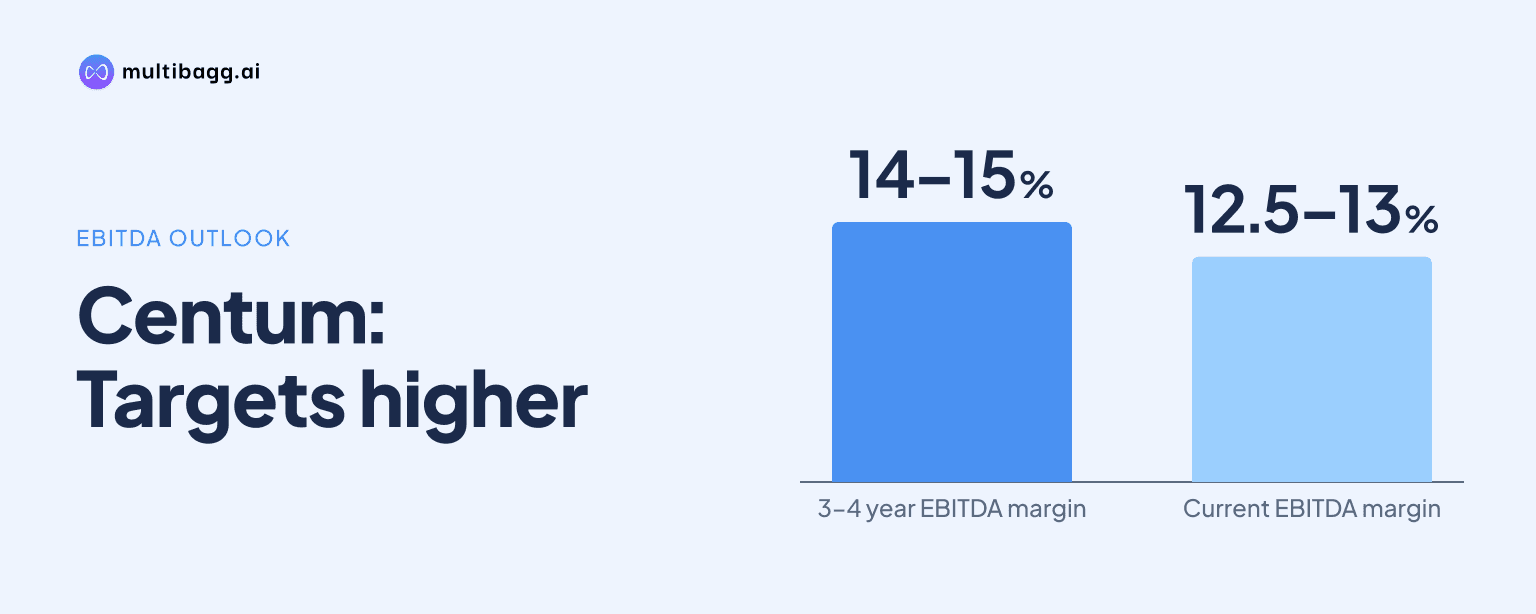
In Q1 of the current financial year, Centum said it was maintaining a 12.5%-13% earnings before interest, tax, depreciation and amortisation margin and aims to reach 14%-15% within three to four years, after overseas subsidiaries were deconsolidated.
Know Centum Electronics inside out
Results, valuation, peers and who's buying, in one view.
What EBITDA margin path has Centum set?
Centum aims to reach an EBITDA margin of 13% next year and 14%-15% within the following three to four years, management said. The current maintained range is 12.5%-13%, and management did not provide specific quarterly or annual margin guidance beyond that stated progression.
The longer-term target is 1.5 to 2.5 percentage points above the lower end of the current 12.5%-13% range. Management linked the outlook to a revenue growth plan of about 25%-30% compounded annually, saying growth could be closer to 30%, but it did not present the reporting change alone as the reason for margin expansion.
Why do Centum's consolidated accounts now reflect standalone operations?
Centum said its subsidiaries were deconsolidated with effect from Q1 of the current financial year. Management said the remaining stepped-down United Kingdom entity is only a special-purpose vehicle, or SPV, with possible bank charges and other minor expenses.
For practical analysis of the profit and loss account and balance sheet, management said Centum's standalone accounts can be treated as representative of its consolidated accounts. An analyst had asked whether removing the discontinued overseas-operation drag would align consolidated margin with the roughly 13% standalone performance; management agreed with the accounting premise but did not issue a separate one- or two-year consolidated-margin forecast.
What will support Centum's margin expansion plan?
Centum identified electronic manufacturing services, or EMS, and build-to-specification, or BTS, as the main engines of its 25%-30% growth plan. Management said BTS could grow faster over the next couple of years as orders ramp, although it did not give a quarterly or annual revenue-conversion schedule.
An analyst cited a total order book of about Rs 1,950 crore, including nearly Rs 950 crore of BTS work. Management said BTS orders are generally executed over about two to 2.5 years, rather than equally across periods, with some revenue this year and further growth next year; the analyst contrasted this with an EMS execution cycle of about nine to 12 months.
Centum is also developing design-led manufacturing within EMS, under which it can design a product before moving into production rather than only manufacture a customer-designed product. Management said it is pursuing this approach with existing customers in railway, defence, aerospace and semiconductor applications and described it as a way to expand EMS margins.
Management also discussed three new customer additions in transportation, industrial machinery and defence, each expected to ramp over two to three years. The transportation programme involves a global tier-one original equipment manufacturer localising electronics used in braking systems and platform-door controllers, while the defence programme involves drone equipment that has entered serial production.
Got a follow-up? Ask IRIS
What investment is Centum making for BTS growth?
Centum said it has no short-term production-capacity bottleneck in executing current BTS orders, but is undertaking a capital-expenditure plan for a new BTS-focused facility. Management said the facility would add system-level capability, dedicated test infrastructure and larger space for systems covered by tenders and requests for quotation.
The plan is intended to bring certain testing activities in-house rather than relying on third parties, while supporting larger systems. Management said Centum has also added engineering capacity, including skilled engineers, because newer systems and programmes require design execution as well as production capability.
Centum said about Rs 35 crore of qualified institutional placement, or QIP, proceeds allocated to capital expenditure had been almost fully used, with the balance expected to be used in the current quarter. Another Rs 50.7 crore allocated for general corporate purposes was being retained as reserve cash, with no specific near-term use identified.
International BTS opportunities remain at an early stage. Management said Centum has a subsystem-level engagement with a Middle Eastern customer and is in advanced discussions with a European customer, but it did not quantify either opportunity; sales of completed systems outside India were described as being two to three years away and dependent on first selling the products in India.
What execution issues could affect Centum's margin plan?
Centum said component availability and logistics remain operating considerations. Management said bare printed circuit board lead times, usually about eight to 12 weeks or less, had extended to 40 to 50 weeks, while memory devices were also difficult to secure because of data-centre demand.
Management attributed these constraints partly to artificial intelligence and data-centre infrastructure build-outs drawing supplier capacity toward those applications. It also cited conflicts in the Middle East and Europe as contributors to logistics delays, and said Centum was seeking supplier priority and stocking available devices to meet expected demand over the next 12 months.
An analyst cited inventory of about Rs 540 crore for the half-year period under discussion. Management said about 50% of Centum's net inventory at company level was covered by customer advances or prepayments, and said inventory should be assessed together with that payment coverage.
Data-centre demand is also a stated driver of Centum's semiconductor opportunity. Management said the main momentum was with an anchor customer, while power, industrial and energy-grid programmes won during the prior six months were in prototype and qualification stages; discussions with other semiconductor customers remained preliminary.
Conclusion
Centum's deconsolidation of overseas subsidiaries in Q1 means management considers its consolidated accounts, for practical purposes, to reflect the standalone business. Its stated financial path is to maintain the 12.5%-13% EBITDA margin range, aim for 13% next year and then move toward 14%-15% through revenue growth, BTS execution and more design-led work.
The next disclosed markers are the aim to reach 13% margin next year, the BTS order ramp over about two to 2.5 years and use of the remaining capital-expenditure allocation in the current quarter. Investors will also be able to track whether the new BTS facility advances system-level capability and whether component lead times, including the 40-50 weeks cited for bare printed circuit boards, ease or persist.