










Centum BTS order book more than doubles to Rs 958.7 crore
Key highlights
- Centum’s BTS order book rose from Rs 427.8 crore in FY24 to Rs 958.7 crore in H1-FY27.
- Centum reported BTS revenue of Rs 277 crore in FY26 and Rs 156.8 crore in H1-FY27.
- Centum’s H1-FY27 EMS order book was Rs 993.5 crore, compared with Rs 958.7 crore for BTS.
- Centum lists missile guidance, radar, satellite subsystems and railway information systems in BTS.
powered by IRIS
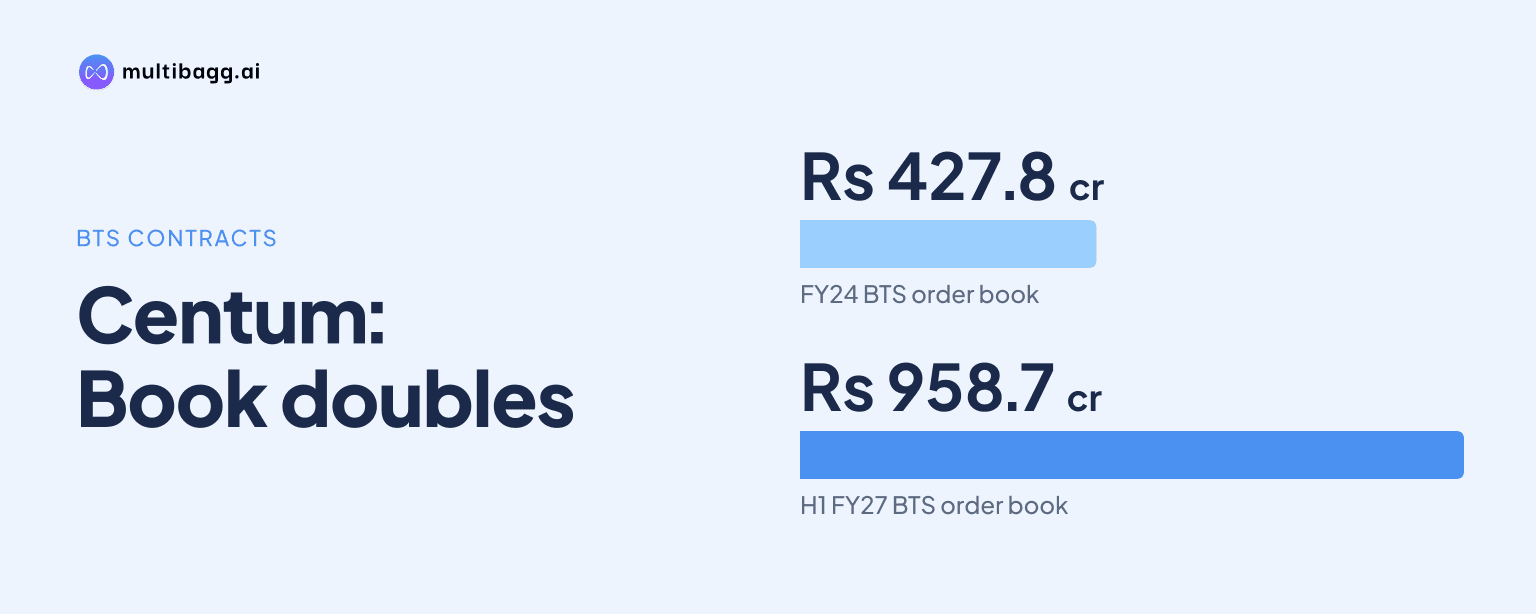
Centum’s Build-to-Specification (BTS) order book more than doubled from Rs 427.8 crore in FY24 to Rs 958.7 crore in the first half of financial year 2027 (H1-FY27), as reported in its presentation. The disclosed BTS portfolio spans defence, space and railway electronics and is associated with multi-year programme cycles.
Know Centum Electronics inside out
Results, valuation, peers and who's buying, in one view.
How quickly has Centum’s BTS order book grown?
Centum’s BTS order book increased by Rs 530.9 crore from Rs 427.8 crore in FY24 to Rs 958.7 crore in H1-FY27. The order book rose to Rs 675.3 crore in FY25 and Rs 864.2 crore in FY26, before increasing by a further Rs 94.5 crore in H1-FY27. The H1-FY27 balance was 2.24 times the FY24 level.
Centum’s BTS revenue also increased through the completed FY24 to FY26 periods, rising from Rs 134.3 crore in FY24 to Rs 201.8 crore in FY25 and Rs 277 crore in FY26. BTS revenue was Rs 156.8 crore in H1-FY27. The presentation identifies BTS as a 30% revenue-contribution vertical with multi-year programme cycles, while Electronics Manufacturing Services (EMS) has a stated conversion cycle of six to nine months.
What does Centum’s BTS order book cover?
Centum’s BTS work covers space, defence and railway electronics, although the presentation does not disclose an order-book value for each application. Its space offerings include earth-observation satellite subsystems, electronic-warfare payloads for pitch, yaw and roll, and small-satellite and payload integration. These applications form part of the Rs 958.7 crore BTS order book reported for H1-FY27.
Centum lists missile control and guidance, radar subsystems, and tank electronics including power units and relay regulators under defence. Its railway range includes public-address and intercom systems as well as passenger-information systems. This portfolio differs from high-volume production alone because the presentation defines BTS as mission-critical work in defence, radar and space systems with multi-year programme cycles.
Centum says BTS assignments move from system architecture and design through prototyping, qualification, manufacturing and lifecycle support. Its stated system-level design capability includes hardware, software, field-programmable gate arrays (FPGAs) and system architecture. Qualification and certification support is described for specialised aerospace, defence, space and industrial applications.
Got a follow-up? Ask IRIS
How does Centum’s BTS business compare with EMS?
Centum’s BTS order book of Rs 958.7 crore in H1-FY27 was Rs 34.8 crore below the Rs 993.5 crore EMS order book. BTS accounted for the smaller stated revenue contribution at 30%, compared with 70% for EMS. BTS increased in every reported period from FY24 through H1-FY27, while the EMS order book fell in FY25 before rising in the following periods.
Centum describes BTS as engineering-led work that converts customer concepts and specifications into qualified electronic systems. EMS converts customer designs and specifications into production-ready electronic products and subsystems. In FY26, EMS revenue was Rs 696.1 crore, compared with BTS revenue of Rs 277 crore, reflecting the larger stated revenue role of EMS.
The EMS order book moved from Rs 690 crore in FY24 to Rs 665.7 crore in FY25, then rose to Rs 780.6 crore in FY26 and Rs 993.5 crore in H1-FY27. BTS moved from Rs 427.8 crore to Rs 675.3 crore, Rs 864.2 crore and Rs 958.7 crore across the same reported periods. The comparison shows that BTS backlog expansion occurred alongside, rather than instead of, a larger EMS revenue base.
Which capabilities underpin Centum’s BTS programme work?
Centum identifies engineering-led development, system-level design, mission-critical solutions, qualification and certification, and accelerated innovation as BTS capabilities. The presentation places these capabilities across aerospace, defence, space and industrial applications. It also states that in-house design and engineering are embedded in both BTS and EMS for product development, certification and qualification support.
Centum’s wider mission-critical electronics capability covers radio frequency, digital, power, software and microelectronics, with integrated design, manufacturing and testing. The presentation identifies radar, electronic warfare, avionics and satellite subsystems as aerospace, defence and space use cases. It also cites specialised processes including printed circuit board assembly, box-build, line-replaceable units and systems integration.
Centum reports average relationships of 10 to 15 years with its top customer groups and says it is the single-source supplier for approximately 80% of manufactured products. In EMS, it states that 70% of products are single sourced and that exports accounted for 53% of FY26 revenue. The presentation attributes partner selection in these segments to reliability, qualification pedigree and platform trust, rather than cost alone.
Conclusion
Centum’s H1-FY27 BTS order book of Rs 958.7 crore represents a Rs 530.9 crore increase from FY24, while BTS revenue rose from Rs 134.3 crore in FY24 to Rs 277 crore in FY26. The disclosed programme range covers missile guidance, radar, satellite subsystems and railway information systems, supported by design, qualification, manufacturing and lifecycle capabilities.
The next point to watch is conversion of the Rs 958.7 crore BTS order book into revenue through the multi-year programme cycles identified for the vertical. Centum also cites modernisation across radar, electronic warfare and missile platforms, alongside rising activity in satellite payloads and mission electronics, as BTS industry growth drivers.