










Centum targets potential Rs 500 crore HAL radar production
Key highlights
- Centum’s HAL AESA radar Phase 1 design-and-development order is valued at Rs 66 crore.
- The HAL radar programme includes a potential Rs 500 crore Phase 2 production opportunity.
- Centum has a Rs 29.4 crore GRSE order for advanced naval navigation systems.
- Centum reports customer indications of about Rs 350 crore for a three-satellite surveillance constellation.
powered by IRIS
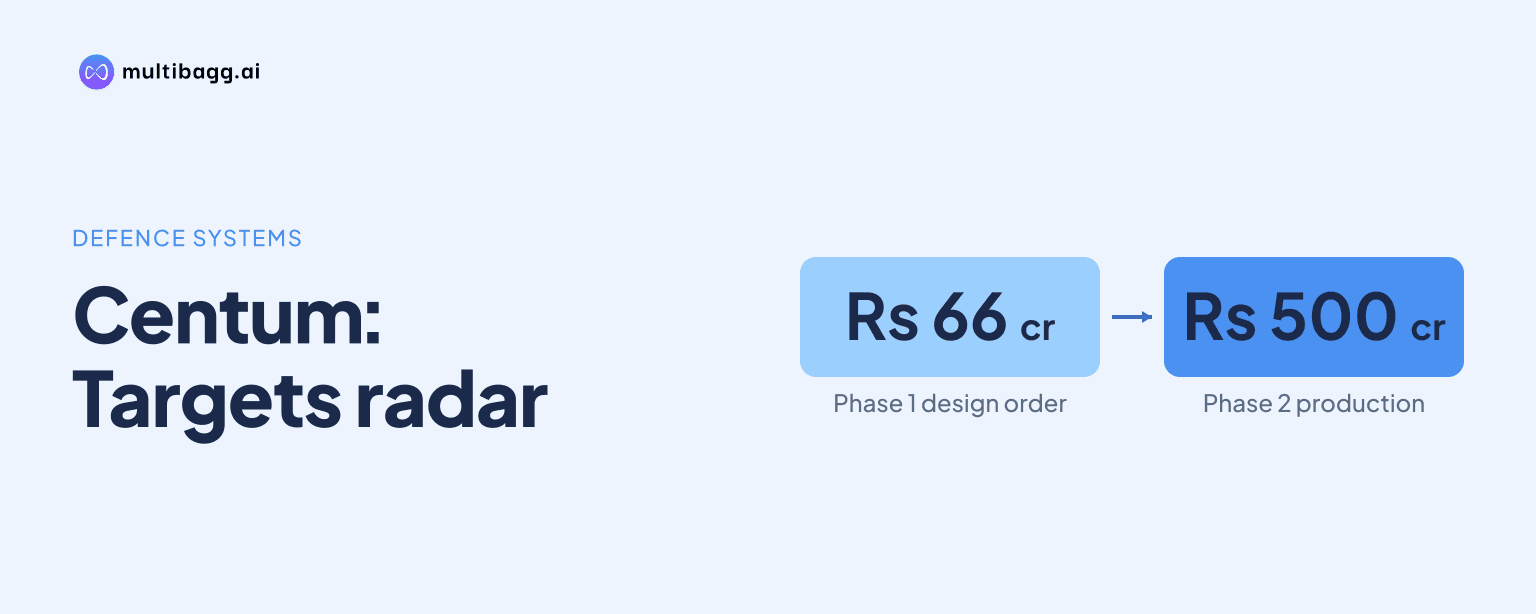
Centum is executing a Rs 66 crore Phase 1 order to design and develop an indigenous active electronically scanned array (AESA) radar for Hindustan Aeronautics Limited (HAL), with a potential Rs 500 crore Phase 2 production opportunity. The programme supports Centum’s stated move from electronic sub-systems to complete mission-critical systems.
Know Centum Electronics inside out
Results, valuation, peers and who's buying, in one view.
What is Centum’s HAL radar order?
Centum’s HAL engagement consists of a Rs 66 crore Phase 1 order for the design and development of an indigenous AESA radar system for HAL’s Utility Helicopter-Maritime platform. The presentation identifies a potential Rs 500 crore Phase 2 production opportunity, but describes it as a potential opportunity rather than a confirmed production award.
The potential Phase 2 value is about 7.6 times the Rs 66 crore Phase 1 order. Centum places the radar work within a system-delivery model covering system design, integration and development, testing and validation, delivery, and lifecycle support, compared with its earlier supply of radar sub-systems, electronic communication units and electronic-warfare payloads.
How does Centum’s BEL collaboration support system work?
Centum’s memorandum of understanding (MoU) with Bharat Electronics Limited (BEL) covers joint development and manufacturing of electronic warfare, radar and secure military communication systems for the Indian Armed Forces. The presentation does not disclose an order value, programme timetable or revenue allocation for the MoU.
The collaboration corresponds with Centum’s Build-to-Specification (BTS) segment, which has a stated benchmark margin of more than 20%, project lifecycles of 2 to 2.5 years, and working-capital days of 225 to 350. By comparison, Electronic Manufacturing Services (EMS) has benchmark margins of 9% to 10%, project lifecycles of 6 to 9 months, and working-capital days of 85 to 110.
Centum lists multi-function radar, avionics, electronic-warfare systems for fighter aircraft and helicopters, satellite constellations, T-90 tank work, and drone payloads among BTS India focus areas. The BEL arrangement is therefore aligned with Centum’s disclosed plan to build system-level expertise through strategic collaborations, although the source does not identify a specific programme arising from the partnership.
What naval and space work has Centum disclosed?
Centum has a Rs 29.4 crore order from Garden Reach Shipbuilders & Engineers Limited (GRSE) to supply advanced naval navigation systems for frontline warships. The GRSE work is described as an order in maritime defence electronics, unlike the HAL Phase 2 amount, which remains a potential production opportunity.
In space, Centum reports customer indications for a three-satellite constellation valued at about Rs 350 crore under the Space Based Surveillance Program. The presentation also says Centum is delivering the three-satellite constellation and notes potential follow-on constellation opportunities, while leaving the contractual status, value and timing of follow-on work unspecified.
The stated satellite-constellation value is about 11.9 times the Rs 29.4 crore GRSE order. Centum includes satellite constellations for intelligence, surveillance and reconnaissance (ISR), along with communications payloads and electronics for drones, within its BTS India focus areas.
Got a follow-up? Ask IRIS
How does full-system delivery affect Centum’s business model?
Centum says its full-system model combines design, development, integration, delivery, testing, validation and lifecycle support for complex missions. The Rs 66 crore HAL radar development order illustrates this approach because Centum is designing and developing a radar system, rather than being described solely as a supplier of a radar sub-system.
The model operates alongside Centum’s BTS and EMS segments. The presentation describes EMS as the majority of revenue and a source of stable, predictable cash flows, while BTS projects have longer 2-to-2.5-year lifecycles and working-capital requirements of 225 to 350 days, compared with 6 to 9 months and 85 to 110 days for EMS.
Centum reports that 70% of its products are single sourced and that exports contributed 53% of revenue in FY26. These figures describe its operating base across defence, aerospace, industrial, energy, automotive, transportation and space, rather than the value or profitability of the HAL, GRSE, BEL or satellite programmes.
What is Centum planning next in defence and space?
Centum’s stated BTS India priorities include multi-function radar and radar sub-systems, satellite constellations for ISR, avionics and electronic-warfare systems for fighters and helicopters, T-90 tank work, and drone payloads and communications electronics. These are focus areas rather than forecasts of awarded revenue or confirmations of future contracts.
Centum says its key actions include strategic collaborations, partnerships with global aerospace and defence original equipment manufacturers, and relationships with Indian Institutes of Technology, National Institutes of Technology and the Indian Institute of Science. The presentation also shows India’s defence production increasing from Rs 1,54,100 crore in FY25 to an estimated Rs 3,00,000 crore in FY29E, where FY29E denotes an estimate.
India’s defence exports are shown rising from Rs 38,400 crore in FY25 to Rs 50,000 crore in FY29E, while the Indian space market is shown increasing from USD 12 billion in 2025 to USD 44 billion in 2033. Centum presents these industry figures as context for its system-level strategy, not as company revenue guidance.
Conclusion
Centum’s Rs 66 crore HAL development order, potential Rs 500 crore HAL production phase, Rs 29.4 crore GRSE navigation-systems order and about Rs 350 crore satellite customer indication span different stages of engagement. Together, they support the company’s stated shift from supplying modules and electronics toward designing, integrating and supporting full systems in defence, maritime and space applications.
The main event to watch is whether the potential Rs 500 crore HAL Phase 2 opportunity becomes a production award after Phase 1 development. Other disclosed items to monitor are delivery of the Rs 29.4 crore GRSE order, progress on the three-satellite programme and whether the BEL MoU results in identified programmes or disclosed order values.