










Centum EMS order book reaches Rs 993.5 crore in H1 FY27
Key highlights
- Centum’s EMS order book rose to Rs 993.5 crore in H1-FY27 from Rs 780.6 crore in FY26.
- Customers with relationships exceeding 10 years contributed 70% of Centum’s stated revenue mix.
- Centum said 70% of its products were single sourced.
- EMS represented 70% of revenue contribution, while BTS represented 30%.
powered by IRIS
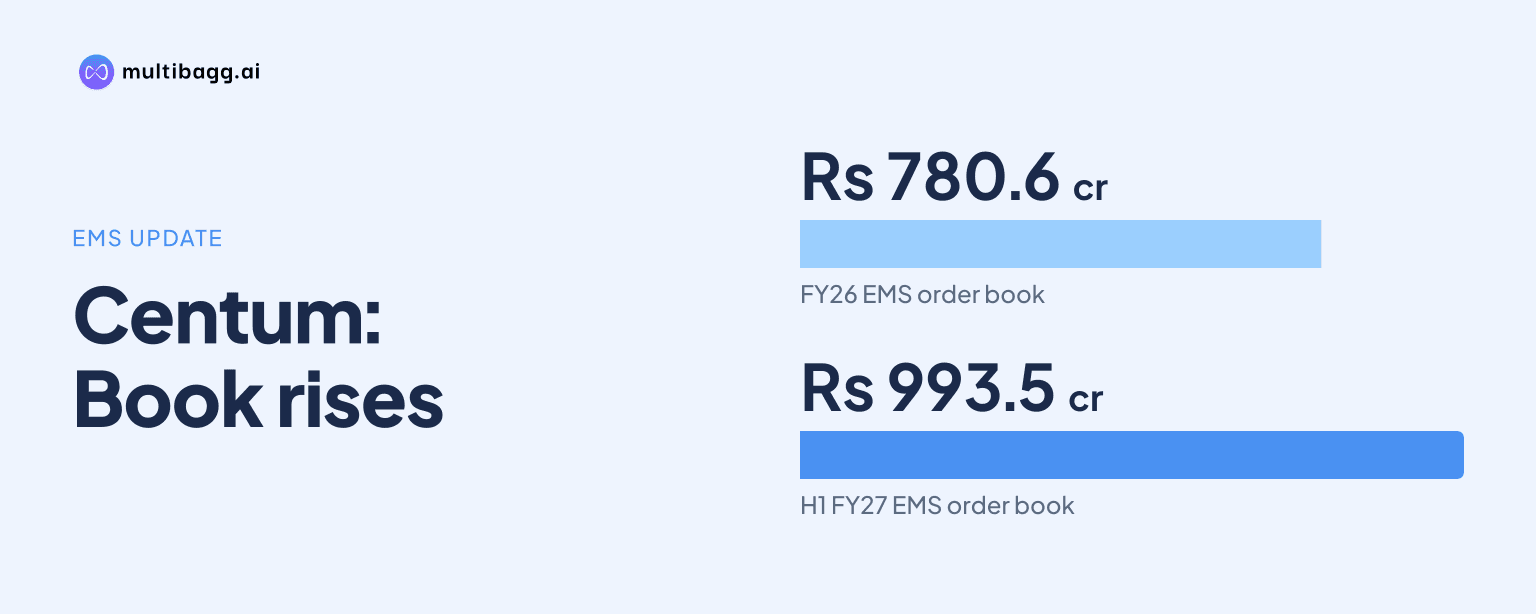
Centum’s Electronics Manufacturing Services order book reached Rs 993.5 crore in H1-FY27, rising Rs 212.9 crore from Rs 780.6 crore in FY26, while 70% of its products were single sourced. The segment combines a larger production backlog with customer relationships that contributed 70% of revenue from accounts held for more than 10 years.
Know Centum Electronics inside out
Results, valuation, peers and who's buying, in one view.
How much did Centum’s EMS order book increase?
Centum’s EMS order book increased to Rs 993.5 crore in H1-FY27 from Rs 780.6 crore in FY26, a rise of Rs 212.9 crore, or about 27.3%. The reported order book had also increased from Rs 665.7 crore in FY25 to Rs 780.6 crore in FY26, following a decline from Rs 690 crore in FY24 to Rs 665.7 crore in FY25. The H1-FY27 level is the highest across the four reported periods.
Centum reported EMS revenue of Rs 360 crore in H1-FY27, while the order book at that point was Rs 993.5 crore. The presentation does not provide H1 revenue for FY24 through FY26, so it does not support a like-for-like half-year revenue growth calculation. It does show that EMS revenue rose in each full year, from Rs 498.5 crore in FY24 to Rs 574.3 crore in FY25 and Rs 696.1 crore in FY26.
What makes Centum’s EMS customer base sticky?
Centum identifies long customer tenure and single sourcing as key features of its EMS customer relationships. Customers with relationships of more than 20 years contributed 30% of revenue, while those with relationships lasting 10 to 20 years contributed another 40%. Together, these two tenure bands accounted for 70% of revenue in the presentation’s stated customer-relationship mix.
Centum also states that 70% of its products are single sourced. The presentation places this measure alongside long-term partnerships, mission-critical solutions and repeat business, but does not disclose the number of customers, contracts or individual products covered. It also does not state the revenue contribution of single-sourced products.
The relationship data sits alongside an export contribution of 53% to revenue in FY26. Centum says it serves global original equipment manufacturers across defence, aerospace, industrial, energy, automotive, transportation and space sectors. The presentation does not split the 53% export contribution by customer-tenure category or identify the export share associated with single-sourced products.
Got a follow-up? Ask IRIS
Which products and capabilities support Centum’s EMS relationships?
Centum’s EMS offering converts customer designs and specifications into production-ready electronic products and subsystems, covering component sourcing, mass manufacturing, test, validation and lifecycle support. Its stated capabilities include specialised work for complex semiconductor equipment, supporting customer qualification, production ramp-up and scalable production. These activities extend from manufacturing to aftermarket and lifecycle support.
The EMS segment serves industrial and medical applications including industrial measurement and control, control boards, digital X-ray healthcare products, power-grid communication equipment and consumer-health fertility kits. Its electric-mobility work includes battery management systems for electric three-wheelers, MK2 encoders for electric commercial vehicles, and high-voltage inverter printed circuit board assemblies for electric buses. PCBA means printed circuit board assembly.
In defence and aerospace, Centum lists air-traffic-management systems, sonar subsystems, electronic-warfare suites for defence aircraft, infrared cameras for defence vehicles and electronics for optronic equipment. These categories align with the company’s stated focus on high-reliability manufacturing, testing and lifecycle support, although the presentation provides no revenue or order-book breakdown by EMS end market.
How does Centum’s EMS business compare with BTS?
Centum reports that EMS contributes 70% of revenue, compared with 30% for its Build-to-Specification, or BTS, business. EMS is described as scale production for diversified customers with a six-to-nine-month conversion cycle. BTS covers mission-critical defence, radar and space systems with multi-year programme cycles.
BTS reported an order book of Rs 958.7 crore in H1-FY27, compared with Rs 993.5 crore for EMS. The difference was Rs 34.8 crore, despite EMS representing the larger 70% revenue contribution in the presentation’s business-vertical mix. BTS revenue was Rs 156.8 crore in H1-FY27, while its reported full-year revenue increased from Rs 134.3 crore in FY24 to Rs 201.8 crore in FY25 and Rs 277 crore in FY26.
The two businesses had similar reported backlog levels in H1-FY27, but their stated operating models differ. Centum assigns EMS a six-to-nine-month conversion cycle and BTS multi-year programme cycles. The presentation does not state what share of the EMS order book is expected to convert in FY27, and it does not provide segment profitability.
Conclusion
Centum’s H1-FY27 EMS data combine a Rs 993.5 crore order book with customer-relationship measures that define the segment’s model: 70% of revenue came from relationships exceeding 10 years and 70% of products were single sourced. EMS represented 70% of revenue contribution, while BTS represented 30% and held a Rs 958.7 crore order book.
The next disclosure to watch is whether Centum converts its Rs 993.5 crore EMS order book through the stated six-to-nine-month cycle and extends the FY24-to-FY26 revenue increase from Rs 498.5 crore to Rs 696.1 crore. Centum identifies semiconductor equipment, industrial, medical, aerospace and electric-mobility electronics as EMS capability areas, but the presentation does not disclose an EMS order-book or revenue target.