










CERA lifts faucetware capacity as sanitaryware decision waits
Key highlights
- CERA increased faucetware capacity from 4 lakh to 5 lakh pieces per month effective September.
- CERA said its existing faucetware plant could potentially reach around 6 lakh to 7 lakh pieces per month in phases.
- Sanitaryware capacity utilization reached around 82% in Q2.
- CERA made 55% of faucetware and 41% of sanitaryware in-house in the current quarter.
powered by IRIS
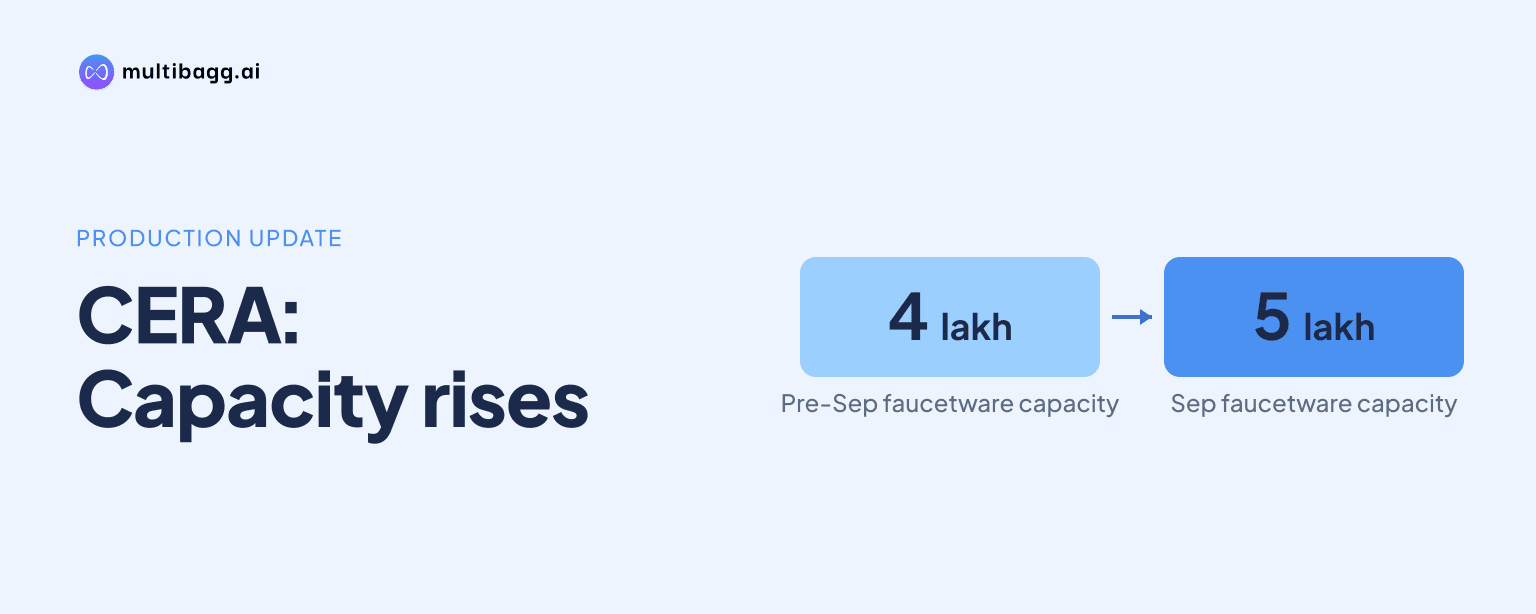
CERA increased faucetware capacity to 5 lakh pieces a month effective September, while holding a sanitaryware greenfield construction decision until a Q4 demand review despite Q2 utilization reaching about 82%. The faucetware addition uses equipment within the existing plant, whereas land for the sanitaryware project has already been acquired.
Know Cera Sanitaryware inside out
Results, valuation, peers and who's buying, in one view.
What changed in CERA's faucetware capacity?
CERA raised faucetware capacity from 4 lakh pieces to 5 lakh pieces per month in September. The 1 lakh-piece monthly increase followed a brownfield expansion undertaken two years earlier, which had lifted capacity from 3 lakh pieces to 4 lakh pieces a month. Management said the existing infrastructure was already built, enabling the latest increase through additional equipment.
Management said good demand in both faucetware and sanitaryware supported the September change. CERA did not disclose capital expenditure for the added equipment or a faucetware utilization rate, so the transcript does not quantify either the cost of the expansion or the immediate volume required to absorb the 5 lakh-piece monthly capacity.
How could CERA add more faucetware capacity?
CERA said its current faucetware facility could support capacity of around 6 lakh to 7 lakh pieces a month in phases if demand rises further. The company plans to review faucetware demand in Q4 before deciding whether to proceed beyond the 5 lakh-piece monthly level reached in September.
The route to a further increase differs from the earlier move from 3 lakh to 4 lakh pieces a month. Management described the September step as a smaller addition made possible because the plant infrastructure and space were already available, rather than as another large brownfield project. No timing, spending figure or formal commitment was given for capacity of 6 lakh or 7 lakh pieces monthly.
This leaves faucetware expansion tied to a stated Q4 demand assessment. CERA's capacity plan is therefore phased: 5 lakh pieces a month is the current level, while 6 lakh to 7 lakh pieces a month remains an option within the current facility rather than an approved project.
Why is CERA reviewing the sanitaryware greenfield project?
CERA is reviewing the sanitaryware greenfield project because Q2 capacity utilization reached around 82%, after being lower a couple of quarters earlier. Management said sanitaryware demand has increased month on month and quarter on quarter, largely on volume uplift, but it wants to assess demand through the end of the year before deciding on construction.
The company has already procured land for the proposed greenfield project. CERA said it expects to be in a better position by the end of Q4 to decide on construction, but it did not disclose the proposed plant's capacity, location, capital expenditure, commissioning date or a utilization threshold that would automatically trigger approval.
The comparison with faucetware is material. Faucetware may be increased from 5 lakh to around 6 lakh or 7 lakh pieces a month within an existing facility, while sanitaryware would require a separate greenfield construction decision. The 82% Q2 sanitaryware utilization rate is therefore evidence for a review, not an announced factory build.
Got a follow-up? Ask IRIS
What share of CERA's production is made in-house?
CERA made 55% of faucetware in-house and outsourced 45% in the current quarter, while it made 41% of sanitaryware in-house and sourced 59% externally. Compared with FY26 figures cited by an analyst of 53% in-house faucetware and 41% in-house sanitaryware, the current-quarter data show a 2-percentage-point increase in faucetware in-house production and no change in sanitaryware.
Management said CERA has been shifting substantial faucetware quantities from outsourcing to its own manufacturing and also intends to move sanitaryware toward more in-house production. It said that shift should not, by itself, change the overall margin profile because internal production is typically used for higher-value, feature-loaded and harder-to-make products, while simpler products are sourced from partners.
The sourcing split also matters for sanitaryware cost exposure. Management said gas represents about 30% to 35% of outsourced suppliers' input cost, compared with about 11% to 12% for CERA's own sanitaryware manufacturing. It said procurement costs from sanitaryware outsourcing partners had risen by 12% in total, comprising a 9% increase in April or May and a further 3% increase in September.
What will determine CERA's next capacity decisions?
CERA will use its Q4 review of demand to determine whether to expand faucetware beyond 5 lakh pieces a month and whether to begin sanitaryware greenfield construction. Management linked the first decision to potential phased use of existing faucetware space, while the second depends on its assessment of rising sanitaryware demand and the 82% utilization reported in Q2.
Management also declined to issue FY28 revenue-growth guidance before FY27 closes. It said it wants to evaluate FY27 demand, the scale-up of its manufacturing and how outsourcing performs before commenting on FY28. That position means the company has not committed either to a sanitaryware factory start date or to the next faucetware capacity phase.
External sourcing remains relevant to that assessment because sanitaryware is 59% outsourced in the current quarter. Management said the product mix differs between in-house and outsourced output, with more complex and higher-value products generally made internally; consequently, an increase in in-house production would not necessarily produce a like-for-like change in consolidated margins.
Conclusion
CERA has raised faucetware capacity by 1 lakh pieces a month, to 5 lakh pieces from September, using additional equipment within its existing facility. In sanitaryware, the 82% Q2 utilization rate and rising volume-led demand have moved the greenfield proposal to a year-end review stage, but management has not approved construction despite already acquiring land.
The next disclosed milestones are the Q4 faucetware demand review and the end-of-Q4 decision point for sanitaryware greenfield construction. Investors should also watch FY27 demand, the 55% in-house faucetware mix and 41% in-house sanitaryware mix, as management has said it will wait for FY27 to close before providing FY28 guidance.