










CERA Q2 revenue rose 27.4% but EBITDA margin fell 200 bps
Key highlights
- CERA's Q2 FY27 revenue from operations increased 27.4% year on year to Rs 603 crore.
- CERA's Q2 FY27 EBITDA margin fell 200 basis points year on year to 12.2%.
- CERA's Q2 FY27 raw-material expenses rose 40.6% year on year to Rs 338 crore.
- CERA's faucetware revenue grew 38% year on year and represented 43% of Q2 FY27 revenue mix.
powered by IRIS
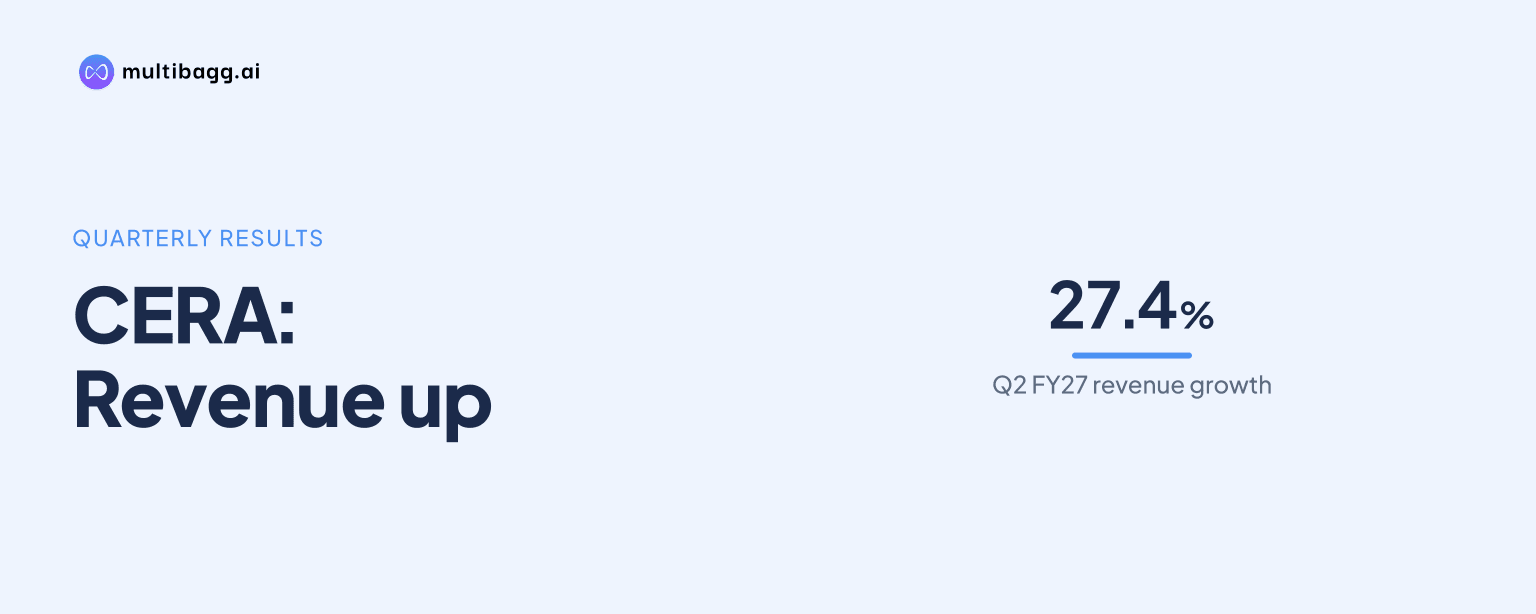
Cera Sanitaryware Limited reported standalone Q2 FY27 revenue from operations of Rs 603 crore, up 27.4% year on year, while its EBITDA margin fell 200 basis points to 12.2% as raw-material expenses rose 40.6% and brass and gas costs increased. Profit after tax declined 0.9% to Rs 56 crore.
Know Cera Sanitaryware inside out
Results, valuation, peers and who's buying, in one view.
What were CERA's Q2 FY27 financial results?
CERA recorded higher revenue in Q2 FY27, but profit growth did not keep pace because expenditure rose faster than income. Revenue from operations increased to Rs 603 crore from Rs 473 crore in Q2 FY26 and Rs 486 crore in Q1 FY27, representing 27.4% year-on-year and 24.1% quarter-on-quarter growth.
Earnings before interest, tax, depreciation and amortisation, or EBITDA, excluding other income, rose 9.1% to Rs 73 crore from Rs 67 crore. Profit after tax, or PAT, was Rs 56 crore versus Rs 57 crore, while PAT margin fell to 9.1% from 11.6% in the abridged profit and loss statement for the period ended September 30, 2026.
The first half reflected the same divergence between revenue and earnings. H1 FY27 revenue rose 23.7% to Rs 1,089 crore from Rs 880 crore, whereas EBITDA increased 1.9% to Rs 122 crore and PAT declined 1.7% to Rs 101 crore. CERA said prior-period revenue was restated because turnover discounts are now deducted from revenue under Indian Accounting Standards, with no impact on profitability or cash flows.
Why did CERA's EBITDA margin decline in Q2 FY27?
CERA's EBITDA margin declined because total expenditure and raw-material expenses increased faster than total income. Total expenditure rose 30.4% year on year to Rs 530 crore in Q2 FY27, while total income from operations increased 25.3% to Rs 614 crore. This resulted in EBITDA margin falling to 12.2% from 14.2%, a decline of 200 basis points.
Raw-material expenses rose 40.6% to Rs 338 crore from Rs 240 crore, compared with the 27.4% rise in revenue. CERA said brass and gas input costs increased by about 58% and 42%, respectively, year on year. Brass rose to Rs 932 per kg in Q2 FY27 from Rs 589 per kg in Q2 FY26 and Rs 837 per kg in Q1 FY27.
CERA's reported gas-cost metric increased to Rs 10.1 in Q2 FY27 from Rs 7.1 a year earlier and Rs 6.7 in Q1 FY27. Gross margin declined to 44.0% from 49.2% in Q2 FY26 and 45.8% in Q1 FY27. Weighted-average gas cost was Rs 47.3 per standard cubic metre, while gas represented 4.0% of revenue and GAIL supplied 76% of gas requirements.
The margin did improve by 210 basis points from 10.1% in Q1 FY27 to 12.2% in Q2 FY27. Management said CERA has a monthly brass-price pass-through mechanism and implemented a faucetware price revision in September 2026. It expects the benefits of pricing discipline in projects and cost-efficiency actions to materialise progressively.
Got a follow-up? Ask IRIS
Which CERA segments drove Q2 FY27 growth?
CERA's two largest categories, sanitaryware and faucetware, drove Q2 FY27 growth, with faucetware expanding faster. Sanitaryware grew 24% year on year and represented 45% of revenue, while faucetware grew 38% and accounted for 43%. Together, the core categories contributed 88% of quarterly revenue mix.
Tiles contributed 10% of Q2 FY27 revenue and grew 9% year on year, while wellness represented 2% and grew 71%. CERA described overall growth as volume-led and supported by a favourable price impact. Management also said retail demand continued to recover, with retail accounting for 61% of revenue mix and projects contributing 39%.
Faucetware capacity utilisation was 107% in Q2 FY27, up from 97% in Q2 FY26, whereas sanitaryware utilisation fell to 82% from 85%. CERA said its faucetware capacity expansion remains on track during FY27. The segment's 38% growth and 43% revenue share make execution of that expansion relevant to the company's stated volume-led growth plan.
What is CERA's FY27 outlook and financial position?
CERA management maintained its FY27 outlook of 18% to 20% revenue growth and an EBITDA margin of 13% to 14%. Management expects profitability to improve progressively in the second half through pricing actions and cost-efficiency initiatives, following an H1 FY27 EBITDA margin of 11.3% versus 13.7% in H1 FY26.
Management said it expects to surpass its revenue-growth target, supported by improving demand and deeper penetration across existing and emerging markets. This is management's outlook rather than a reported result. Its stated priorities include faucetware capacity expansion during FY27, operational efficiency, and inventory and cash-flow discipline.
CERA reported cash and cash equivalents of Rs 897 crore in September 2026, up from Rs 736 crore in September 2025, while net worth increased to Rs 1,470 crore from Rs 1,371 crore. Operating cash flow was Rs 143 crore, equal to 117% of EBITDA. Net working-capital days declined to 58 from 77, although net working capital increased to Rs 1,184 crore from Rs 1,075 crore.
Conclusion
CERA's Q2 FY27 results combined broad-based sales growth with input-cost pressure. Revenue rose 27.4% to Rs 603 crore, supported by 24% sanitaryware growth and 38% faucetware growth, but raw-material expenses increased 40.6% to Rs 338 crore. As a result, EBITDA margin was 12.2%, 200 basis points below the prior-year quarter, and PAT declined to Rs 56 crore.
The next indicators to watch are the effect of the September 2026 faucetware price revision, CERA's monthly brass pass-through mechanism, and its FY27 faucetware capacity expansion. Management's 13% to 14% FY27 EBITDA-margin outlook requires improvement from the 11.3% recorded in H1 FY27, while brass and gas costs remain the input variables identified by the company.