










Cera Sanitaryware Ltd Q2 Revenue Rises 27.4% to ₹603 Crore
Key highlights
- Cera reported Q2 FY27 revenue of ₹603 crore, up 27.4% year-on-year.
- Cera’s Q2 FY27 net profit was ₹56.1 crore, down 0.9% year-on-year.
- Cera’s Q2 EBITDA margin was 12.2%, versus 14.2% in Q2 FY26.
- Cera’s H1 FY27 revenue rose 23.7% year-on-year to ₹1,089 crore.
powered by IRIS
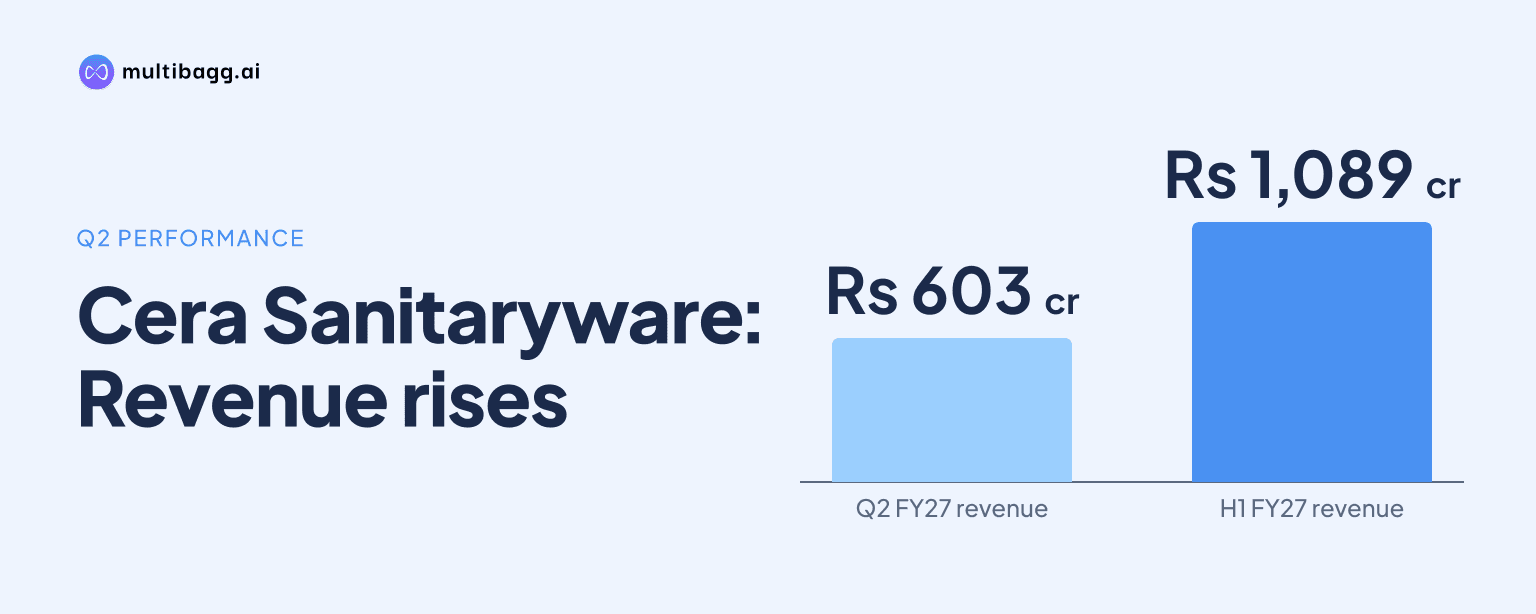
Cera Sanitaryware Ltd reported Q2 FY27 revenue from operations of ₹603 crore, up 27.4% year-on-year, while net profit was ₹56.1 crore, down 0.9% from the corresponding quarter a year earlier amid higher raw-material and operating costs.
Know Cera Sanitaryware inside out
Results, valuation, peers and who's buying, in one view.
What did Cera report for Q2 FY27?
Cera reported revenue from operations of ₹603 crore for the quarter ended September 30, 2026, compared with ₹473.4 crore in Q2 FY26. The increase was driven by volume growth across its sanitaryware, faucetware, tiles and construction chemicals businesses. Revenue for the first half of FY27 rose 23.7% year-on-year to ₹1,089 crore from ₹880.2 crore.
Net profit for the quarter was ₹56.1 crore, compared with ₹56.6 crore a year earlier. Basic and diluted earnings per share were ₹43.52, compared with ₹43.92 in Q2 FY26. The figures were part of the company’s unaudited results for the quarter and half year ended September 30, 2026.
Cera held its Q2 and H1 FY27 earnings conference call on November 5, 2026, and subsequently provided the audio recording of the call under its Regulation 30 disclosure. The call ran from 10:31 AM to 11:30 AM IST. A Q1 FY27 earnings-call transcript had previously been made available for the call held on August 8, 2026.
What drove Cera’s revenue growth in the quarter?
Cera’s Q2 revenue expansion was primarily volume-led, with sanitaryware revenue growth of 24% and faucetware growth of 38% year-on-year. The company’s reported quarterly revenue of ₹603 crore represents a 27.4% increase over the ₹473 crore level in the corresponding period of FY26.
The data indicates that growth was broad-based across the operating portfolio rather than limited to one product category. Sanitaryware and faucetware are key businesses for Cera, and the higher growth in faucetware supported the overall revenue increase during the quarter.
How did higher input costs affect Cera’s profitability?
Higher input costs constrained Cera’s profitability despite the strong rise in sales. Total expenditure increased 30.4% year-on-year to ₹530 crore, exceeding the 27.4% growth in revenue. Raw-material costs rose 40.6% to ₹338 crore during the quarter.
Management identified significant inflation in brass and gas costs during the earnings call. These inputs are relevant to the company’s manufacturing operations, particularly its sanitaryware and faucetware businesses. The cost increase was reflected in the movement in operating margin and the near-flat net-profit performance.
EBITDA increased 9.1% year-on-year to ₹73 crore, but the EBITDA margin declined to 12.2% from 14.2% in Q2 FY26. However, the margin improved by 210 basis points from the preceding quarter, showing a sequential improvement despite continued input-cost pressure.
Got a follow-up? Ask IRIS
What guidance did Cera maintain for FY27?
Cera maintained its FY27 revenue-growth guidance of 18% to 20% and its EBITDA-margin guidance of 13.5% to 14%. Management also indicated that profitability could improve progressively in the second half of FY27.
The maintained revenue guidance follows a first-half revenue increase of 23.7%. The company’s reported Q2 growth rate of 27.4% was above its full-year guidance range, although quarterly performance alone does not determine the annual outcome. Its ability to manage raw-material costs will remain relevant to achieving the stated margin range.
For investors, the quarter presents two clear trends. Revenue growth has remained strong and volume-led, while profit conversion has been affected by higher costs. The sequential improvement in EBITDA margin provides an additional operating metric to track alongside sales growth in the remaining quarters of FY27.
Why does Cera’s Q2 performance matter to investors?
Cera’s Q2 performance matters because it shows the difference between demand growth and earnings growth in a period of cost inflation. Revenue grew by more than a quarter year-on-year, but net profit fell marginally as expenditure and raw-material costs increased at a faster pace.
The result is also relevant for the wider building-products segment, where sanitaryware, faucets, tiles and related products are exposed to both construction and renovation demand as well as movements in commodity-linked inputs. Cera’s disclosures point to brass and gas as specific cost pressures during the quarter.
The company has made the earnings-call audio available, allowing investors to review management’s commentary on demand, product segments, costs and the FY27 outlook. The key disclosed operational markers remain revenue growth, the 12.2% Q2 EBITDA margin, and management’s guidance of 18% to 20% revenue growth with a 13.5% to 14% EBITDA margin for the full year.
Conclusion
Cera delivered strong Q2 FY27 revenue growth, with sales reaching ₹603 crore and rising 27.4% year-on-year. Growth in sanitaryware and faucetware volumes supported the result, but higher brass, gas and other input costs reduced operating margin and left net profit marginally below the prior-year level at ₹56.1 crore.
Investors will next watch whether the company’s second-half profitability improves as indicated by management and whether Cera can meet its FY27 guidance of 18% to 20% revenue growth and a 13.5% to 14% EBITDA margin. Movements in raw-material costs and the pace of volume growth across sanitaryware and faucetware remain important factors.