










CERA says project repricing supports FY27 margin recovery
Key highlights
- CERA's Q2 FY27 EBITDA margin was 12.2%, versus 14.2% in Q2 FY26 and 10.1% in Q1 FY27.
- Average brass cost reached Rs 932 per kg in Q2 FY27, up 58% year on year.
- CERA reported Q2 FY27 revenue of Rs 603 crore, up 27.4% year on year.
- Projects represented 39% of Q2 FY27 revenue, down from 43% in Q1 FY27.
powered by IRIS
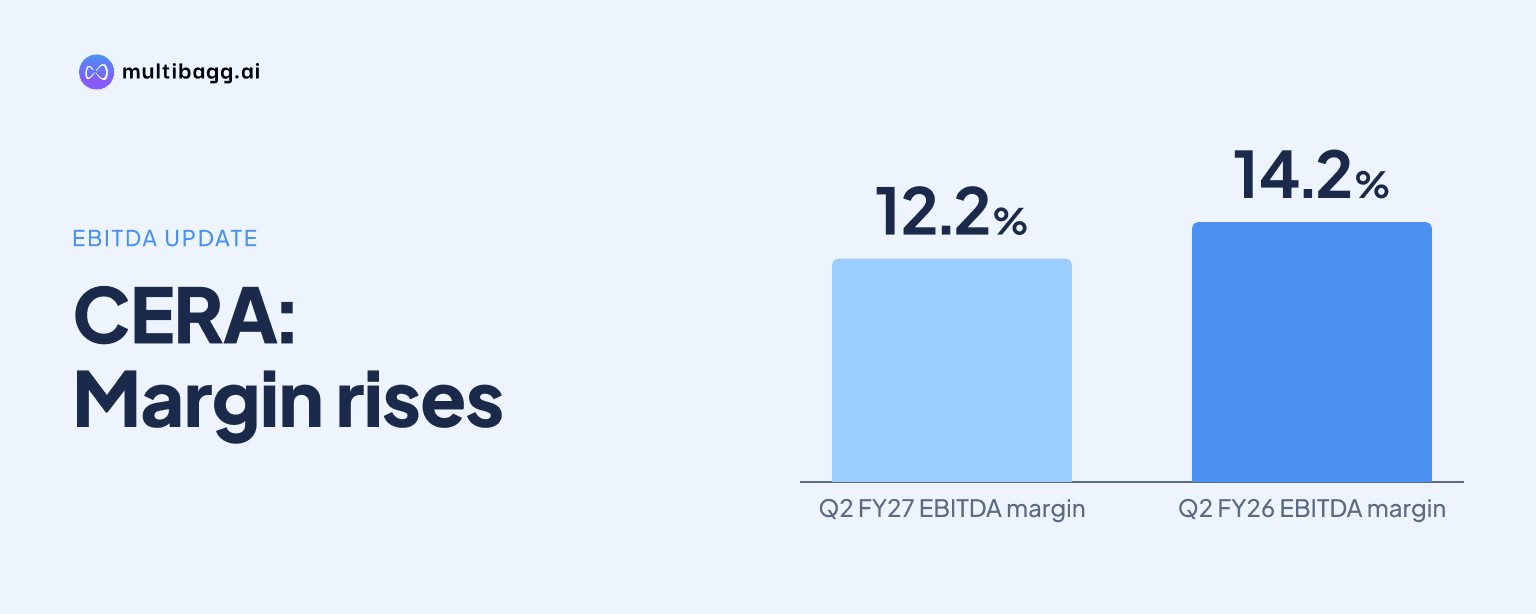
CERA expects to achieve its FY27 earnings before interest, tax, depreciation and amortisation (EBITDA) margin outlook of 13%-14% after the September 2026 quarter reported 12.2%, as completed legacy projects, lower discounts and the delayed effect of faucetware price increases offset a 58% year-on-year increase in brass costs to Rs 932 per kg.
Know Cera Sanitaryware inside out
Results, valuation, peers and who's buying, in one view.
Why did CERA's EBITDA margin fall to 12.2% in Q2 FY27?
CERA's EBITDA margin fell to 12.2% in Q2 FY27 from 14.2% in Q2 FY26 because brass inflation, higher discounts, publicity spending and increased sanitaryware and tiles sourcing costs outweighed pricing and volume benefits. The margin nevertheless improved from 10.1% in Q1 FY27, while revenue from operations rose 27.4% year on year to Rs 603 crore.
Management quantified the brass effect at 2.1 percentage points of EBITDA margin in Q2 FY27. Average brass cost rose to Rs 932 per kg from Rs 837 per kg in Q1 FY27 and Rs 589 per kg in Q2 FY26, an 11% quarter-on-quarter and 58% year-on-year increase. Gas cost also increased to Rs 47.29 per cubic metre from Rs 33.79 per cubic metre a year earlier.
Management said the 1.7-percentage-point discount impact was concentrated in projects whose selling prices had been agreed before input costs rose. Retail discounts also increased, although management said it had taken actions to reduce them. Profit after tax was Rs 56 crore in Q2 FY27, compared with Rs 57 crore in Q2 FY26, indicating that higher revenue did not translate into higher quarterly profit amid the cost increase.
How does CERA plan to restore FY27 margins?
CERA plans to restore margins through new project pricing, the fuller effect of its September faucetware price increase, lower retail discounts, cost controls and operating leverage from higher turnover. Management said most old projects were completed over the past two quarters, with some still remaining in Q3 FY27; it expects later Q3 and Q4 deliveries to be largely under new project orders and revised prices.
Management's Q2 explanation began with the 10.1% margin reported in Q1 FY27 and said one-time Q1 factors equivalent to 4.5% reversed in Q2. Since Q2 turnover was higher, that reversal translated to 3.8 percentage points. It also cited a 2.5-percentage-point realised price-rise benefit, against the 1.5 percentage points projected, and 1.9 percentage points of operating leverage before adverse factors reduced the reported margin to 12.2%.
The company said the September faucetware increase was not fully reflected in Q2 FY27 and should contribute in Q3 and Q4. It also expects automation and artificial-intelligence tools to yield visible cost benefits over the next couple of quarters and thereafter. These are management expectations rather than reported savings and remain dependent on input costs, demand and the timing of revised project pricing.
Got a follow-up? Ask IRIS
What revenue and mix trends support CERA's outlook?
CERA's revenue momentum supports management's outlook because Q2 FY27 revenue reached Rs 603 crore, up 27.4% year on year, and first-half FY27 revenue was Rs 1,089 crore, up 23.7%. Management said it was confident of surpassing its earlier 18%-20% full-year revenue-growth projection while maintaining the 13%-14% full-year EBITDA-margin outlook.
Faucetware was the fastest major segment in Q2 FY27, with revenue growth of 38%, compared with 24% for sanitaryware and 9% for tiles; wellness rose 71% from a smaller 2% revenue share. Faucetware accounted for 43% of revenue, close to sanitaryware's 45%, while tiles represented 10%. Within faucetware's 38% growth, management attributed 24 percentage points to volume, 10.3 percentage points to price and 1.9 percentage points to mix.
Project revenue declined as a share of sales to 39% in Q2 FY27 from 43% in Q1 FY27, while retail rose to 61% from 57%. Management described Q1 as an aberration because it accelerated deliveries of projects nearing completion as input costs were rising. It expects the mix to settle at about 40% projects and 60% retail, supported by recovering retail demand and continued project growth.
What could affect CERA's margin recovery in the second half?
CERA's second-half margin recovery could be affected by brass and gas prices, the completion of legacy projects, the realisation of faucetware price increases and retail discount control. Brass was the largest identified pressure: its average cost increased by Rs 95 per kg between Q1 FY27 and Q2 FY27, after increasing Rs 343 per kg from Q2 FY26.
Management said pricing benefits in projects arrive with a lag because earlier commitments are delivered under previously agreed commercial terms. It expects the negative project-discount factor to disappear as newly priced orders form a larger portion of Q3 and Q4 deliveries. That expectation does not remove exposure to further input inflation, which management identified as a material consideration for its full-year outlook.
Demand and supply execution also remain relevant because management said about 50% of output was dependent on outsourcing. In Q2 FY27, sanitaryware was 41% manufactured in-house and 59% outsourced, while faucetware was 55% manufactured in-house and 45% outsourced. Management said a shift between outsourcing and in-house production would not by itself change margin profiles because the product mix differs between the two sources.
Conclusion
CERA reported a sequential margin improvement in Q2 FY27, from 10.1% to 12.2%, but remained below the 14.2% recorded a year earlier as brass removed 2.1 percentage points from EBITDA margin and discounts removed another 1.7 points. Revenue growth of 27.4% to Rs 603 crore, including 38% growth in faucetware, gives management a larger sales base over which fixed costs can be absorbed.
The next evidence point is Q3 FY27, when management expects old-price projects to diminish, new project pricing and the September faucetware increase to contribute more fully, and retail-discount controls to take effect. Investors should also watch brass and gas costs, alongside planned FY27 capital expenditure of about Rs 43 crore, of which Rs 27 crore had been spent in the first half.