










CERA lifts FY27 brand budget above Rs 80 crore from Rs 50 crore
Key highlights
- CERA has budgeted more than Rs 80 crore for FY27 brand investment, compared with Rs 50 crore in FY26.
- CERA reports more than 10,000 advertising spots across Hindi and regional markets and three premium airport out-of-home locations.
- CERA has engaged more than 5,000 architects and designers and arranged 315 factory visits for trade and design professionals.
- CERA lists 32,000 retailers, 7,300 distributors and dealers, and 12 company-owned Experience Studios.
powered by IRIS
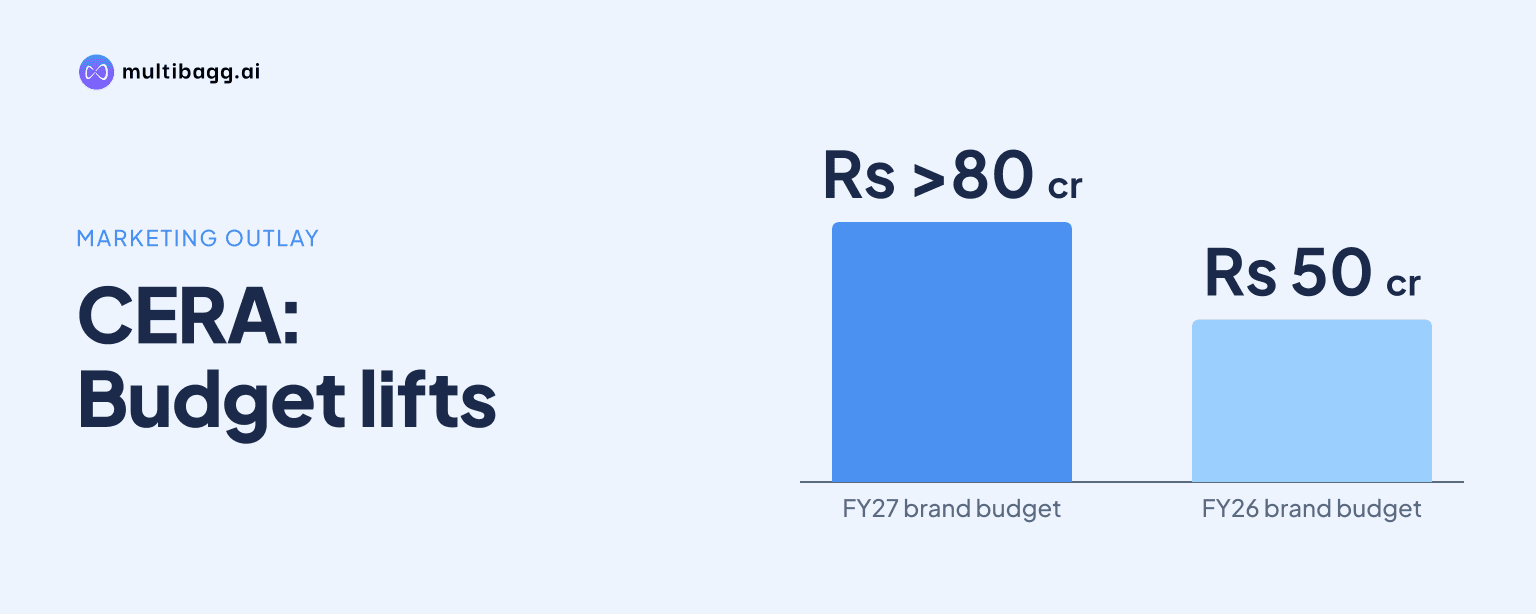
CERA has budgeted more than Rs 80 crore for brand investment in financial year (FY) 2027, up from Rs 50 crore invested in FY26, as it pursues greater consumer preference and premiumisation. The programme spans mass media, digital engagement, retail experiences, design-community outreach and service support, following Kriti Sanon’s appointment as CERA brand ambassador in July 2026.
Know Cera Sanitaryware inside out
Results, valuation, peers and who's buying, in one view.
Why is CERA raising its FY27 brand-investment budget?
CERA is raising its FY27 brand-investment budget to more than Rs 80 crore to support its stated move from a product brand to a complete bathroom-solutions and lifestyle proposition. The company describes this as a shift from functional bathrooms to spaces expressing comfort, design and personal identity, with the stated objective of moving consumers from visibility to preference.
The FY27 budget is more than Rs 30 crore higher than the Rs 50 crore disclosed for FY26. CERA does not provide a channel-wise allocation between television, digital media, celebrity endorsement, retail environments, architect programmes or service infrastructure, so the presentation does not quantify the expected contribution of any individual activity.
CERA presents the intended brand-building sequence as trust, preference, premiumisation, demand pull and long-term value. This is management’s stated framework rather than a disclosed financial target, because the presentation gives no FY27 target for brand awareness, market share, sales conversion or campaign-led revenue.
Kriti Sanon’s July 2026 appointment is part of this repositioning programme. CERA says its communication will have an integrated presence across television, digital platforms, over-the-top (OTT) services, cinema, print, outdoor media and social media, supporting its effort to be seen as a trusted complete bathroom-solutions brand.
Which channels will CERA use to build consumer preference?
CERA will use mass media, digital platforms and physical brand encounters, with more than 10,000 advertising spots reported across Hindi and regional markets and three premium airport out-of-home (OOH) locations. Television, OTT, cinema and outdoor formats are listed under awareness, while Facebook, Instagram, YouTube, X and Pinterest form the company’s disclosed digital engagement channels.
The programme also includes consumer-facing experiences through Experience Studios, exhibitions and trade shows, branded retail environments and strategic partnerships. CERA identifies both CERA and CERA LUXE in these experience-led activities, but does not disclose the number of visitor interactions, enquiries, retail conversions or sales generated by these formats in FY26.
CERA is targeting professional influencers as well as household consumers. It reports engaging more than 5,000 architects and designers, and arranging 315 factory visits for trade and design professionals; developers, channel partners and trade professionals are also listed in its influence and advocacy ecosystem.
This approach links broad-reach advertising with people who may influence product specification or recommendation. The presentation does not disclose how many of the 5,000-plus architect and designer engagements resulted in projects, product selections or repeat orders, leaving the commercial outcome of this outreach unquantified.
Got a follow-up? Ask IRIS
How do CERA’s retail formats and service operations support the plan?
CERA’s retail network is structured around discovery, consultation, conversion and service, with 12 company-owned Experience Studios, 318 Style Hubs, 285 Style Galleries and 1,755 retailer-owned CERA Style Centres. These branded formats operate alongside 32,000 retailers and 7,300 distributors and dealers across India.
The company distinguishes the role of each format in the purchase journey. Experience Studios are no-sales centres designed for product discovery, Style Hubs and Style Galleries offer personalised consultation and premium displays, while Style Centres and retailers are positioned as conversion points with product availability and after-sales support.
The network gives CERA a mechanism to connect its more-than-Rs-80-crore FY27 brand programme with physical product displays and local consultation. However, CERA does not disclose a FY27 target for additional Experience Studios, Style Hubs, Style Galleries, Style Centres, retail footfall or retailer sell-through.
After-sales service is another element of the company’s trust proposition. CERA reports 13 customer-care offices, 42 service officers and 169 dedicated technicians across every state, with customer requests routed through WhatsApp, a toll-free number or digital channels into a SAP-linked customer relationship management system.
CERA implemented WhatsApp service in November 2024 and says complaints are attended within 24 hours. The company describes this turnaround time as the industry’s lowest, while its service journey is intended to move from issue resolution to customer trust, brand loyalty and repeat or referral demand; it does not disclose complaint volumes or final-resolution rates.
What is the financial context for CERA’s higher brand budget?
CERA’s FY27 brand budget follows revenue growth in FY26, although earnings before interest, tax, depreciation and amortisation (EBITDA) and profit after tax (PAT) were lower than in FY25. Revenue increased to Rs 2,050 crore in FY26 from Rs 1,915 crore in FY25, while EBITDA declined to Rs 322 crore from Rs 353 crore and PAT declined to Rs 204 crore from Rs 246 crore.
The presentation does not attribute the FY25-to-FY26 changes in EBITDA or PAT to the Rs 50 crore FY26 brand investment. The FY27 amount is a budget, whereas the FY26 revenue and profit figures are reported outcomes, so the disclosed material does not establish a return on either year’s brand expenditure.
CERA also reports net working-capital days of 64 in FY26, down from 80 days in FY25, and net worth of Rs 1,472 crore in FY26, up from Rs 1,169 crore in FY23. These figures provide balance-sheet context for the higher FY27 budget, but the presentation gives no specific funding source or spending timetable for the brand programme.
The company links its brand proposition to design-led products and manufacturing capabilities, including water-efficient, wellness and intelligent bathroom technologies. CERA also cites robotic glazing, computer numerical control precision manufacturing and three-dimensional design and prototyping, while approximately 60% of its energy requirements are met through green-energy sources.
Conclusion
CERA is combining a more-than-Rs-80-crore FY27 brand budget with 10,000-plus advertising spots, 5,000-plus architect and designer engagements, 32,000 retailers and a service network of 169 technicians. The disclosed model is designed to connect awareness with product discovery, consultation, purchase support and repeat or referral demand.
The next item to watch is execution of the FY27 programme across media, retail experiences and professional advocacy. CERA has disclosed the July 2026 brand-ambassador appointment and the budget increase from Rs 50 crore in FY26, but has not disclosed channel-level spending, campaign outcome targets, retail conversion targets or a timetable for reporting results.