










CERA builds Senator and CERA Luxe beyond core franchise
Key highlights
- CERA positions Senator as a luxury brand and CERA Luxe as a premium brand between mass-premium and luxury.
- CERA’s distribution system includes 32,000 retailers, 7,300 distributors and dealers, and 12 Experience Studios.
- CERA reported H1 FY27 revenue from operations of Rs 1,089 crore, up 23.7% year on year.
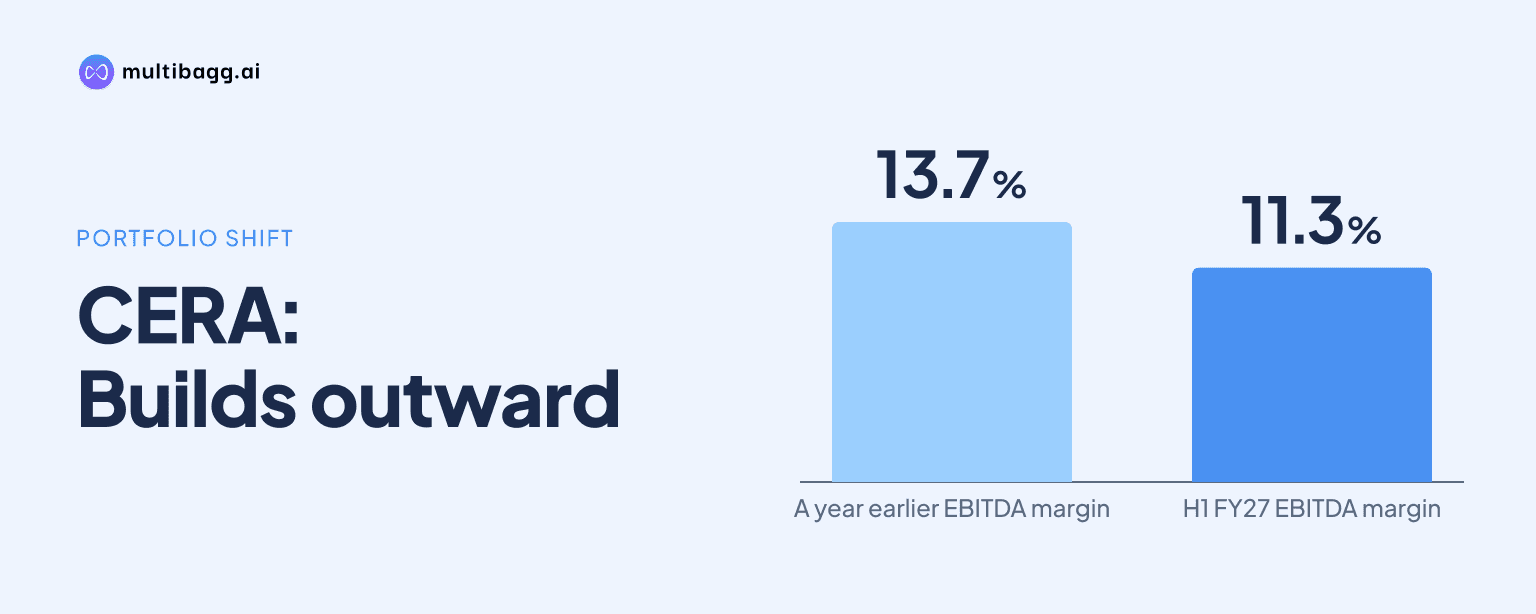
- H1 FY27 EBITDA excluding other income was Rs 122 crore, while EBITDA margin was 11.3% versus 13.7% a year earlier.
powered by IRIS
CERA is building Senator as its luxury bathroom proposition and CERA Luxe as a premium bridge between mass-premium and luxury, while retaining CERA as its flagship growth engine. The strategy is supported by a pan-India network of 32,000 retailers and an integrated bathroom portfolio across sanitaryware, faucetware, tiles, wellness, accessories and construction chemicals.
Know Cera Sanitaryware inside out
Results, valuation, peers and who's buying, in one view.
What do results show about CERA’s premiumisation plan?
CERA is using a three-brand structure in which its core CERA franchise remains the principal engine of growth, Senator addresses luxury bathrooms and CERA Luxe addresses the premium segment. The presentation describes the new brands as additional growth vectors to be scaled over time, rather than replacements for the core franchise. CERA’s stated aim is to expand its addressable opportunity while protecting the role of its existing flagship brand.
The segmentation is explicit: Senator is positioned as luxury, while CERA Luxe is designed to bridge mass-premium and luxury. CERA says it is making focused investments in premium and luxury categories, with the CERA brand retaining its established role. This separates the core business, including everyday sanitaryware essentials and faucetware, from propositions focused on premium design, finishes and bathroom solutions.
CERA reported standalone revenue from operations of Rs 1,089 crore in H1 FY27, up 23.7% from Rs 880 crore in H1 FY26. Q2 FY27 revenue from operations was Rs 603 crore, compared with Rs 473 crore a year earlier, an increase of 27.4%. These results cover CERA’s standalone operations as a whole and do not identify revenue from Senator or CERA Luxe.
Earnings before interest, tax, depreciation and amortisation (EBITDA), excluding other income, rose to Rs 122 crore in H1 FY27 from Rs 120 crore, while the EBITDA margin declined to 11.3% from 13.7%. Profit after tax fell to Rs 101 crore from Rs 103 crore, while raw-material expense increased 37.1% to Rs 601 crore, faster than revenue. CERA states that turnover discounts are now deducted from revenue under Indian Accounting Standards, with prior periods restated and no effect on absolute profitability or cash flows.
What is Senator designed to offer luxury consumers?
Senator is CERA’s differentiated luxury bathroom proposition, built around design-led luxury collections for premium residences and discerning consumers. Its plan includes dedicated products, retail formats and teams, indicating that Senator is intended to operate with a more specialised customer proposition than the core CERA franchise. CERA says the brand is being developed to build brand equity for long-term growth.
The presentation does not disclose Senator revenue, outlet numbers, product launches or a target date for scaling the brand. It instead identifies the commercial mechanism of dedicated product ranges and retail formats for a luxury proposition. The disclosed strategy is therefore directional rather than a quantified forecast of Senator’s sales contribution.
Got a follow-up? Ask IRIS
What role will CERA Luxe play in the portfolio?
CERA Luxe is the premium layer between mass-premium and luxury, with contemporary design and refined finishes forming its stated product proposition. CERA describes the brand as offering aspirational premium bathroom solutions and says it is expanding both the premium portfolio and retail presence. The intended opportunity is premiumisation rather than a move away from CERA’s core sanitaryware and faucetware categories.
The two new propositions differ in their stated positioning. Senator is directed at luxury collections and premium residences, whereas CERA Luxe is intended to bridge a broader mass-premium-to-luxury gap. Both sit alongside CERA’s core franchise, but the presentation gives no separate sales, margin or outlet figures for either brand.
How does CERA aim to raise wallet share per bathroom?
CERA aims to raise wallet share by selling an integrated bathroom solution across more than its core sanitaryware and faucetware categories. The portfolio also includes tiles, wellness solutions, accessories and construction chemicals. CERA says coordinated bathroom solutions from a trusted brand create cross-selling opportunities and enable it to participate across multiple consumer touchpoints without diluting the core brand.
The category roles are differentiated within that solution. Sanitaryware is described as core bathroom solutions and everyday essentials, while faucetware is associated with premium finishes, smart functionality and elevating the user experience. Tiles are intended to complete the look, wellness includes bathtubs and showers, accessories focus on convenience, and construction chemicals are positioned around building confidence.
Can CERA’s retail network support premium and luxury brands?
CERA’s distribution system provides several customer-contact formats for the premiumisation plan: 32,000 retailers, 7,300 distributors and dealers, 1,755 Style Centres, 285 Style Galleries, 318 Style Hubs and 12 Experience Studios. CERA describes this as a multi-layered, pan-India distribution and retail ecosystem. The formats range from broad product availability to consultation and product discovery.
The 12 company-owned Experience Studios are designed as immersive, no-sales environments for inspiration and product experience. Style Galleries and Style Hubs provide expert guidance and personalised consultation, while Style Centres and retailers are intended to convert demand through availability, service and after-sales support. This mix aligns with Senator’s dedicated retail-format plan and CERA Luxe’s stated expansion of premium retail presence.
Conclusion
CERA’s strategy combines a protected core franchise with Senator in luxury and CERA Luxe in premium, supported by an integrated-bathroom portfolio. The 32,000-retailer network and 12 Experience Studios provide different routes for discovery, consultation and conversion, while cross-selling tiles, wellness, accessories and construction chemicals is intended to increase wallet share.
The next items to watch are the pace at which CERA scales Senator and CERA Luxe, expands premium retail presence and translates dedicated formats into reported sales. The presentation provides no separate brand targets, launch timetable or financial contribution, so future CERA disclosures would need to show whether these additional growth vectors affect revenue mix, EBITDA margin or profit after tax beyond H1 FY27.