










CERA Revenue Rises 27% as Q2 Operating Margin Falls 200 Basis Points
Key highlights
- CERA’s Q2 FY27 revenue from operations rose 27.4% year on year to Rs 603 crore.
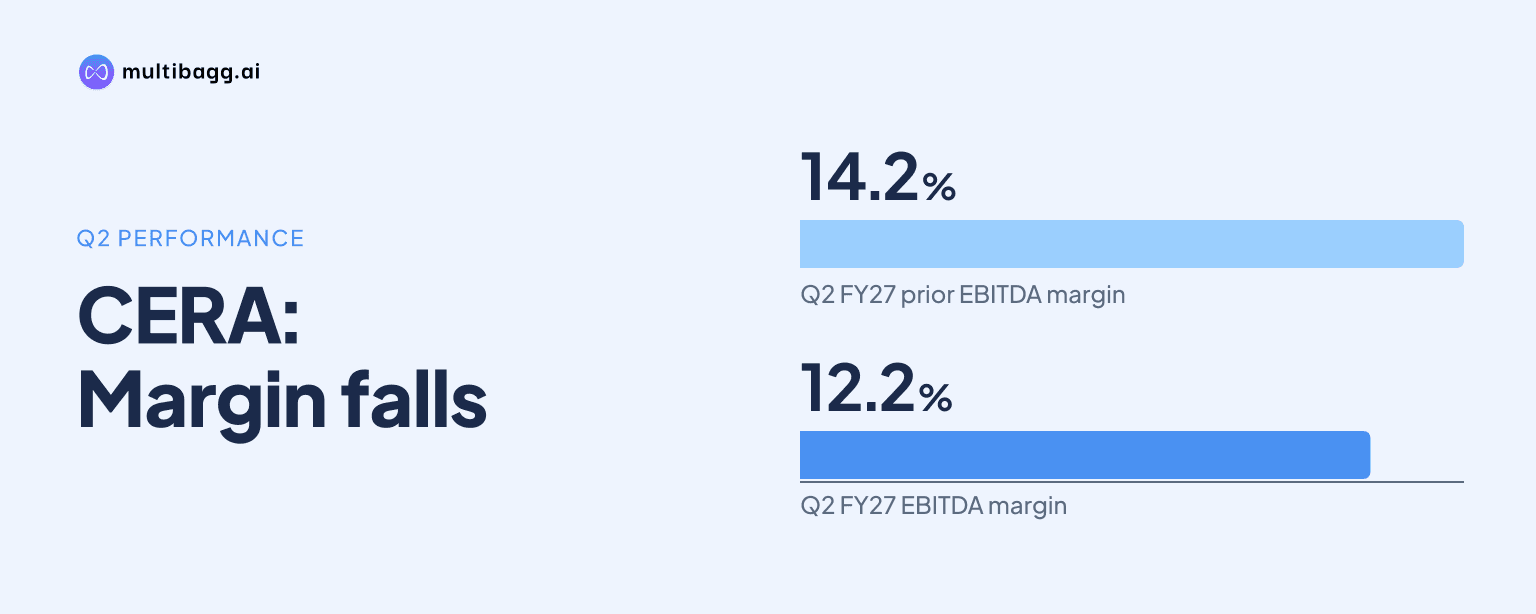
- CERA’s Q2 FY27 EBITDA margin excluding other income declined 200 basis points to 12.2% from 14.2%.
- CERA reported Q2 FY27 sanitaryware growth of 24% and faucetware growth of 38%.
- CERA’s H1 FY27 revenue rose 23.7% to Rs 1,089 crore while PAT declined 1.7% to Rs 101 crore.
powered by IRIS
Cera Sanitaryware Limited reported Rs 603 crore in revenue from operations in the second quarter of FY27, up 27.4% year on year, but its EBITDA margin excluding other income fell 200 basis points to 12.2% as management cited elevated brass and gas prices. Profit after tax declined 0.9% to Rs 56 crore.
Know Cera Sanitaryware inside out
Results, valuation, peers and who's buying, in one view.
Why did CERA’s Q2 FY27 operating margin fall?
CERA’s operating margin fell because revenue grew faster than EBITDA amid elevated brass and gas costs. EBITDA, or earnings before interest, tax, depreciation and amortisation, excluding other income rose 9.1% to Rs 73 crore in Q2 FY27 from Rs 67 crore in Q2 FY26, while revenue rose 27.4% to Rs 603 crore from Rs 473 crore. Consequently, EBITDA margin declined to 12.2% from 14.2%, a reduction of 200 basis points, where one basis point equals one-hundredth of a percentage point.
The communication’s headline results separately stated Q2 FY27 EBITDA of Rs 84 crore, while its detailed financial table reported Rs 73 crore excluding other income. CERA did not provide a reconciliation between those figures. The reported comparable margin measure is EBITDA excluding other income, and that is the measure on which the 200-basis-point year-on-year decline is stated.
Profit after tax, or PAT, declined to Rs 56 crore from Rs 57 crore despite the increase in sales. PAT margin fell 270 basis points to 9.3% from 12.0%, while diluted earnings per share declined 0.9% to Rs 43.52 from Rs 43.92. The quarterly figures show that the increase in revenue did not convert into higher reported profit.
Which CERA businesses drove Q2 FY27 revenue growth?
CERA said sanitaryware and faucetware generated volume-led growth, with sales growth of 24% and 38%, respectively, in Q2 FY27. Total revenue from operations, net of taxes, rose by Rs 130 crore year on year to Rs 603 crore. Management said recovering retail demand and steady projects-business performance supplemented growth across its key businesses.
Faucetware’s 38% growth exceeded both sanitaryware’s 24% expansion and CERA’s overall 27.4% revenue growth. The company did not disclose revenue or profit amounts for sanitaryware, faucetware, retail, or projects, so the relative contribution of each business cannot be calculated from the communication. Management attributed momentum through the quarter ended September 30, 2026 to improving demand conditions and execution.
CERA said investments made over the past two years in distribution, focus markets and execution capabilities were beginning to yield results. It also cited manufacturing investments and selective in-house production of key products as supporting product availability. Management said these actions helped it gain incremental market share, but it did not disclose a market-share percentage.
How did CERA’s H1 FY27 results compare with last year?
CERA’s first half, or H1, FY27 revenue rose 23.7% to Rs 1,089 crore from Rs 880 crore, whereas EBITDA excluding other income rose only 1.9% to Rs 122 crore from Rs 120 crore. This difference reduced the H1 EBITDA margin by 240 basis points to 11.3% from 13.7%. The H1 margin decline was wider than the 200-basis-point year-on-year reduction reported for Q2 FY27.
PAT for H1 FY27 fell 1.7% to Rs 101 crore from Rs 103 crore, and PAT margin declined to 9.3% from 11.7%. Diluted earnings per share decreased to Rs 78.66 from Rs 80.00. The Rs 209 crore increase in first-half revenue was accompanied by a Rs 2 crore increase in EBITDA excluding other income.
Q2 FY27 EBITDA margin of 12.2% was above the H1 FY27 margin of 11.3%, although the measures cover a quarter and a half year, respectively. Management also said operating margins improved from the preceding quarter, but the communication did not disclose that earlier quarter’s margin. The stated comparison indicates that a lower-margin period was included in the H1 outcome.
Got a follow-up? Ask IRIS
What is CERA doing to manage brass and gas costs?
CERA said it is using calibrated price revisions, pricing discipline in the projects business, sourcing arrangements, in-house manufacturing and cost optimisation to address higher input costs. Management specifically disclosed a faucetware price revision in September 2026. It said the benefit of these measures would materialise progressively rather than being fully reflected in the Q2 FY27 result.
The company did not disclose the size of the faucetware price increase, brass or gas price levels, or expected cost savings. Its reported Q2 figures show EBITDA excluding other income increased by Rs 6 crore while revenue increased by Rs 130 crore. Management’s expected benefits from price actions and efficiency measures are forward-looking statements rather than savings reported for the quarter.
CERA also cited selective in-house production of key products as a way to maintain product availability and respond to demand. Management said its established sourcing arrangements and manufacturing capabilities provide support in the current cost environment. The communication did not quantify production volumes, procurement savings, or the share of products made in-house.
What is CERA’s FY27 margin outlook?
CERA management retained its full-year FY27 EBITDA margin outlook of 13% to 14% and said it expects profitability to improve progressively in the second half. The guidance follows an H1 FY27 EBITDA margin excluding other income of 11.3% and a Q2 FY27 margin of 12.2%. Management said cumulative pricing actions and cost-efficiency initiatives underpin its expectation.
Management also said it remained confident of surpassing its revenue-growth target, although the communication did not state that target numerically. It linked its growth expectation to improving demand and deeper penetration in existing and emerging markets. Sanitaryware growth of 24% and faucetware growth of 38% in Q2 FY27 provide the reported segment growth context for that outlook.
The company cautioned that forward-looking statements are subject to risks including government actions, local, political or economic developments, technological risks and other factors. The 13% to 14% margin range is therefore management guidance, not a reported financial result. The communication does not provide quarterly revenue, EBITDA or PAT forecasts for the second half of FY27.
Conclusion
CERA’s Q2 FY27 result combined higher volume-led sales with lower profitability ratios. Revenue rose 27.4% to Rs 603 crore, supported by 24% sanitaryware growth and 38% faucetware growth, but EBITDA excluding other income increased only 9.1% and its margin fell to 12.2%. PAT consequently declined 0.9% to Rs 56 crore.
The next disclosed milestone is delivery in the second half of FY27 against management’s plan for benefits from the September 2026 faucetware price revision, projects-business pricing discipline and cost-efficiency measures. CERA retained a full-year EBITDA margin outlook of 13% to 14% after reporting an 11.3% H1 FY27 margin, while leaving its revenue-growth target undisclosed.