










Danish Power plans Rs 200 crore expansion to 26,000 MVA
Key highlights
- Danish Power plans Rs 200 crore of greenfield investment with an 18-to-24-month timeframe.
- Danish Power targets transformer capacity of about 26,000 MVA in FY28, from about 11,000 MVA currently.
- Planned Unit 3 would manufacture power transformers up to the 400 kV class.
- Danish Power reported capacity utilization of 75% in H1 FY27, compared with 45% in FY25.
powered by IRIS
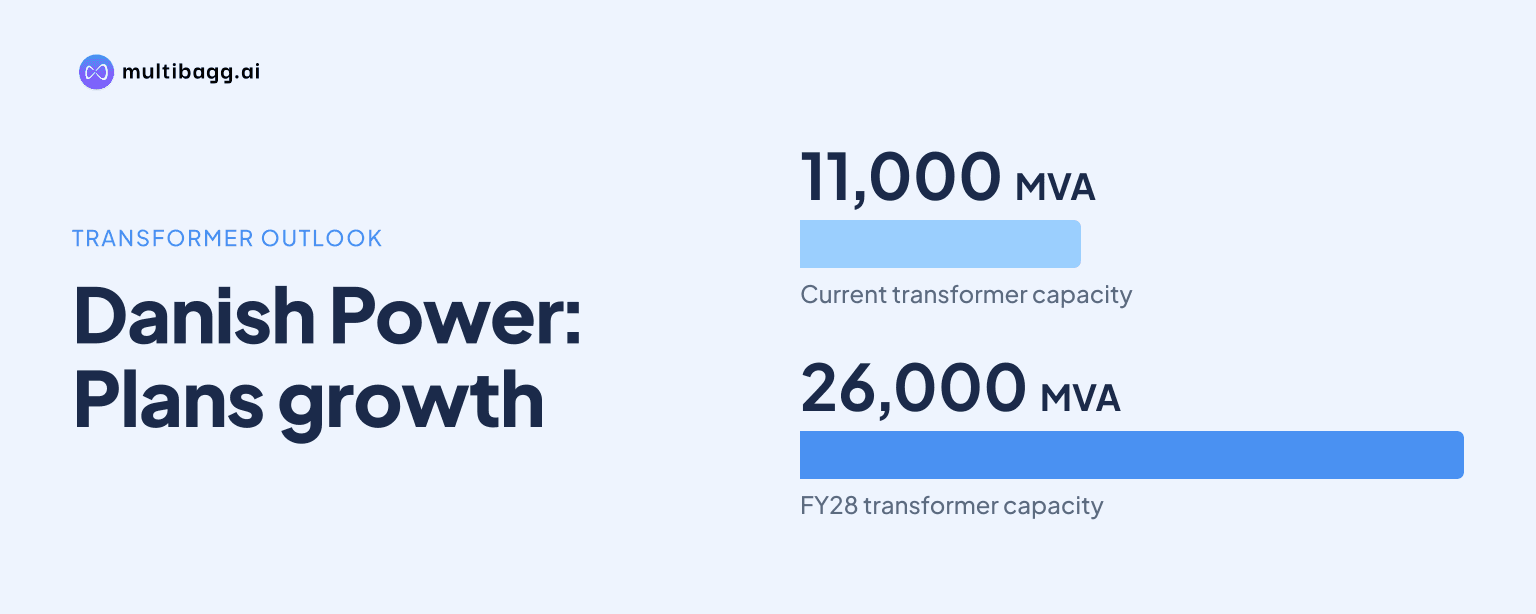
Danish Power plans a Rs 200 crore greenfield transformer project in Jaipur that would increase capacity from about 11,000 megavolt-amperes (MVA) to about 26,000 MVA from FY28 onwards and add planned power-transformer manufacturing up to the 400 kilovolt (kV) class. The stated project timeframe is 18 to 24 months.
Know Danish Power inside out
Results, valuation, peers and who's buying, in one view.
What is Danish Power building under its new capex plan?
Danish Power is planning a third manufacturing unit at Mahindra World City, Sanganer, Jaipur, Rajasthan, for power transformers. The planned Unit 3 has stated installed capacity of 12,000 MVA to 15,000 MVA and manufacturing capability up to the 400 kV class. Danish Power identifies the project as a greenfield investment rather than an addition within either of its two operating facilities.
The estimated investment is Rs 200 crore, with an execution timeframe of 18 to 24 months. Danish Power says it intends to finance the greenfield project through internal accruals and debt. The presentation does not disclose the proportion to be funded by each source, a specific commissioning date, or projected revenue and profitability from Unit 3.
The planned facility also includes a fully automated in-house radiator plant intended to meet about 90% of Danish Power’s radiator requirement. This is the project’s stated backward-integration element, meaning the company plans to make a transformer component internally. The presentation does not state the radiator plant’s separate capital cost, output capacity or expected cost effect.
How much transformer capacity will Danish Power add by FY28?
Danish Power expects transformer capacity to increase from about 11,000 MVA at Unit 1 to about 26,000 MVA in FY28. That implies an increase of about 15,000 MVA, and the company says the additional capacity is expected to be operational from FY28 onwards. The FY28 total is more than double the current transformer capacity stated for Unit 1.
Danish Power’s capacity-expansion slide also lists figures of about 4,681 in March 2025, 2,500 in October 2025, 3,819 in December 2025 and 15,000 in FY28(E). However, the source does not define the unit or measurement basis for those entries. The clearly labelled comparison is between the existing 11,000 MVA transformer base and the stated FY28 capacity of about 26,000 MVA.
Danish Power says it has adequate land for a potential roughly twofold increase in capacity over time. This is a statement of available land and expansion flexibility, not a further announced capital-expenditure programme. The company also says its greenfield approach provides flexibility to scale capacity in line with industry demand, without disclosing another MVA target beyond FY28.
Why does the new unit matter for Danish Power’s product range?
Danish Power plans to manufacture power transformers up to the 400 kV class at Unit 3, compared with its existing power-transformer portfolio of up to 245 kV. The project therefore extends the stated power-transformer voltage range by 155 kV. This matters because transformers account for 90% of Danish Power’s revenue mix in the presentation.
Danish Power’s existing transformer products include distribution transformers, dry-type cast-resin transformers, and inverter-duty and wind-turbine-generator transformers, each rated up to 33 kV. Its traction or locomotive transformers and special-application transformers are rated up to 220 kV. Power transformers are used at power-generation and bulk-transmission points, according to the product portfolio.
Danish Power already lists control relay panels with substation automation up to the 400 kV class, but these are not power transformers. Control relay panels account for the remaining 10% of revenue mix. Unit 2 at Sitapura Industrial Area in Jaipur produces control relay panels and sheet-metal fabrication, with installed capacity of about 1,000 units across about 60,000 square feet.
Got a follow-up? Ask IRIS
What does Danish Power’s utilization trend show before expansion?
Danish Power reported capacity utilization of 45% in FY25, 60% in FY26 and 75% in H1 FY27. Utilization increased by 30 percentage points between FY25 and H1 FY27, including a 15-percentage-point increase in each reported interval. These figures provide the operating context before the company expects new capacity from FY28 onwards.
The 75% figure applies to H1 FY27, or the first half of FY27, and is therefore not a full-year result comparable directly with FY25 or FY26. Danish Power does not disclose a utilization target for FY28, production volumes for the 26,000 MVA capacity base, or order-book information in the supplied presentation.
Danish Power currently operates two facilities in Jaipur. Unit 1 at Mahindra World City is the transformer plant, with about 11,000 MVA of installed capacity across about 250,000 square feet, while Unit 2 has about 1,000 units of panel and sheet-metal capacity. Unit 3 is planned at Mahindra World City, the location of the existing transformer operation.
Which demand drivers does Danish Power cite for transformer expansion?
Danish Power cites a transmission and distribution pipeline that includes Rs 9.15 lakh crore of transmission investment by 2032, 1.27 lakh MVA of transformation capacity and 33 gigawatts of new high-voltage direct-current links. These are industry-demand figures cited in the presentation, not orders or revenue guidance for Danish Power.
The presentation also links transformer demand to India’s generation build-out. It states that 147,720 megawatts of renewable energy, 47,545 megawatts of thermal capacity and 8,000 megawatts of nuclear capacity were under construction as of June 2026. The source says this build-out is expected to take installed generation capacity to about 874 gigawatts by FY32.
Danish Power also identifies battery energy storage systems, artificial-intelligence-driven data centres and electric vehicles as emerging electricity-load sources. The cited figures include an Indian target of about 236 gigawatt-hours of battery storage by FY32 and projected data-centre capacity of about 8 gigawatts by 2030. The presentation does not quantify Danish Power’s sales exposure to these end markets.
Conclusion
Danish Power’s Rs 200 crore project combines a planned increase of about 15,000 MVA from its current 11,000 MVA transformer base with entry into planned 400 kV-class power-transformer manufacturing. The scale expansion is material to its product mix because transformers represent 90% of revenue, while the stated FY28 capacity total is about 26,000 MVA.
What to watch next is execution against the disclosed 18-to-24-month timeframe, the start of additional capacity from FY28 onwards, and the eventual funding mix between internal accruals and debt. Danish Power has also reported utilization rising to 75% in H1 FY27 and says it has land for a potential roughly twofold capacity increase over time, but it has not disclosed a further project target or timing.