










DEE Development Engineers Limited targets Rs 200 crore nuclear FY29
Key highlights
- DEE projects nuclear piping revenue of Rs 50-60 crore in FY28 and up to Rs 200 crore in FY29.
- DEE signed a nuclear-project framework agreement with a domestic EPC contractor on October 16, 2026.
- DEE's order book stood at Rs 2,531 crore on September 30, 2026, up 94% year on year.
- Q2 FY27 operating EBITDA rose 33.7% to Rs 58.9 crore and margin increased to 20.1% from 16.3%.
powered by IRIS
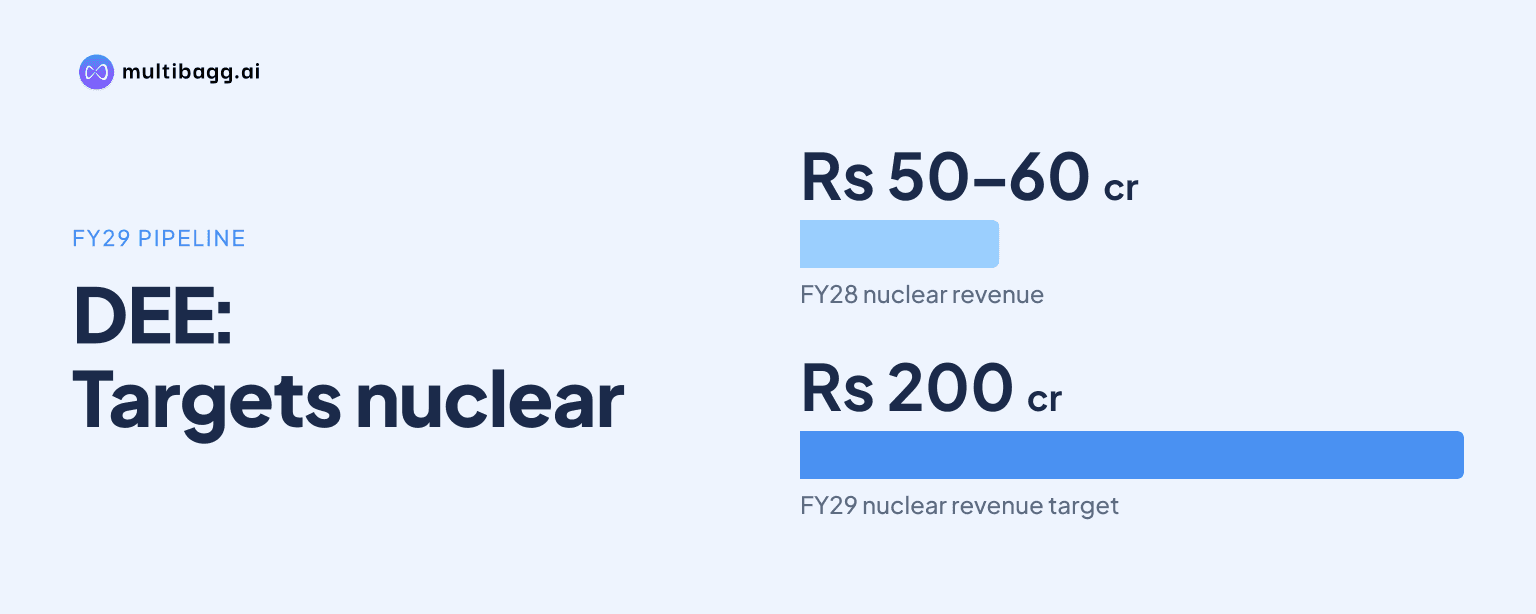
DEE Development Engineers Limited projects nuclear piping revenue of Rs 50-60 crore in FY28 and up to Rs 200 crore in FY29, subject to formal customer approvals and slow nuclear-project delivery cycles. Management disclosed the outlook on November 18, 2026, while confirming that a dedicated nuclear piping facility is under construction at Anjar.
Know DEE Development Engineers inside out
Results, valuation, peers and who's buying, in one view.
What nuclear piping revenue does DEE expect in FY28 and FY29?
DEE expects Rs 50-60 crore of nuclear piping revenue in FY28 and up to Rs 200 crore in FY29, based on management's current projection. Management described FY28 as an initial contribution and said the business would ramp gradually because nuclear-sector material deliveries and project take-offs take time.
The FY29 outlook is about three to four times the FY28 range, but management said the estimate remains conditional rather than committed revenue. It said nuclear work could have margins above 25%, while also cautioning that a higher margin does not overcome the slower conversion of approved work into revenue.
Management said its Rs 2,500 crore FY30 revenue ambition does not currently include nuclear contribution. Nuclear piping was therefore presented as a potential addition to the longer-term plan, rather than an activity already embedded in the stated FY30 revenue target.
What must happen before DEE can record nuclear revenue?
DEE needs formal approvals from nuclear-sector customers before its FY28 and FY29 projections can turn into revenue. Management called the current nuclear plan a blueprint and said the pace of work would depend on approvals, even though it expects a comparatively stable pipeline of potential nuclear work.
On October 16, DEE signed a framework agreement with a domestic engineering, procurement and construction contractor to jointly pursue Indian projects involving pressurised heavy-water reactors, light-water reactors and small modular reactors. DEE's role under the agreement is limited to shop-manufactured piping, and management did not identify a confirmed order value or delivery schedule from the agreement.
DEE is also in advanced discussions with a global partner on a nuclear piping joint venture, with management expecting closure by the end of FY27. The company has started basic infrastructure work for its dedicated nuclear piping plant at Anjar, ordered machinery and begun receiving some machines, but these preparations do not eliminate the approval and delivery-timing risks management identified.
Got a follow-up? Ask IRIS
How does nuclear piping fit within DEE's current business?
DEE's near-term business remains conventional piping and heavy fabrication, supported by an order book of Rs 2,531 crore as of September 30, 2026. The order book was 94% above Rs 1,308 crore a year earlier and increased from Rs 2,428 crore at the end of June 2026, before reaching Rs 2,586 crore after Rs 148 crore of October order flow.
Power accounted for Rs 1,476 crore of the piping and fitting order book at September-end, while oil and gas contributed Rs 871 crore. Power represented more than 60% of the piping book, so the nuclear initiative is being developed alongside a much larger existing power-sector execution programme.
DEE said more than Rs 400 crore of its order book was job work, where customers supply the material, with the balance comprising with-material contracts. About 45% of H1 FY27 execution was job work, limiting reported revenue, but management expects more than 70% of H2 FY27 execution to be with-material work and around 30% to be job work.
The company separately operates a 7,000-tonne seamless pipe plant at Anjar that management said is fully operational. For FY28, management projected about Rs 300 crore of seamless-pipe revenue, comprising Rs 150-200 crore of direct sales and Rs 150-200 crore of internal consumption, with the overlapping ranges reflecting an indicative estimate rather than a fixed split.
What current performance supports DEE's expansion plans?
DEE reported Q2 FY27 revenue from operations of Rs 293 crore, up 8.5% year on year, and operating earnings before interest, tax, depreciation and amortisation, or EBITDA, of Rs 58.9 crore, up 33.7%. Operating EBITDA margin rose to 20.1% from 16.3% in Q2 FY26, which management attributed to higher utilisation, a larger power-sector contribution and improved non-core performance.
For H1 FY27, revenue was Rs 587.4 crore, up 19% year on year, while operating EBITDA increased 35.9% to Rs 108.6 crore. The H1 operating EBITDA margin reached 18.5%, compared with 16.2% in H1 FY26, and profit after tax rose 27.8% to Rs 39.5 crore before the proposed nuclear business is expected to make a material contribution.
Management maintained FY27 revenue guidance of Rs 1,500 crore after reporting Rs 587.4 crore in H1. It said work in progress and requests for processing totalled about Rs 100-125 crore, and it expects higher-value with-material orders to move through the shop floor and begin dispatching more quickly from December.
DEE repaid Rs 225 crore of borrowings using proceeds from a preferential issue that generated about Rs 293 crore net. Finance costs fell sequentially to Rs 15.3 crore in Q2 from Rs 17.2 crore in Q1, and management said lower finance costs plus a largely stable fixed-cost base should support profitability as revenue rises.
Conclusion
DEE is positioning nuclear piping as a new revenue stream that could begin at Rs 50-60 crore in FY28 and reach up to Rs 200 crore in FY29. The estimates sit outside its stated Rs 2,500 crore FY30 revenue ambition, while the company's immediate financial performance remains dependent on executing its Rs 2,531 crore September order book, particularly in power and oil-and-gas piping.
The next events to watch are the expected closure of the proposed global nuclear joint venture by the end of FY27, progress at the dedicated Anjar nuclear plant and formal customer approvals. Management's ability to meet its Rs 1,500 crore FY27 revenue guidance, including its expected H2 shift to more than 70% with-material contracts, will also show how the existing business is funding and absorbing the planned expansion.