










DEE Sees Roughly Rs 300 Crore FY28 Seamless-Pipe Revenue
Key highlights
- DEE expects about Rs 300 crore of seamless-pipe revenue in FY28.
- DEE expects its 7,000-tonne seamless-pipe unit to be almost fully utilised in FY28.
- Management estimates 10% to 15% savings on eligible pipe purchases replaced by internal production.
- Two submitted tenders cover more than 8,000 tonnes of potential pipe demand.
powered by IRIS
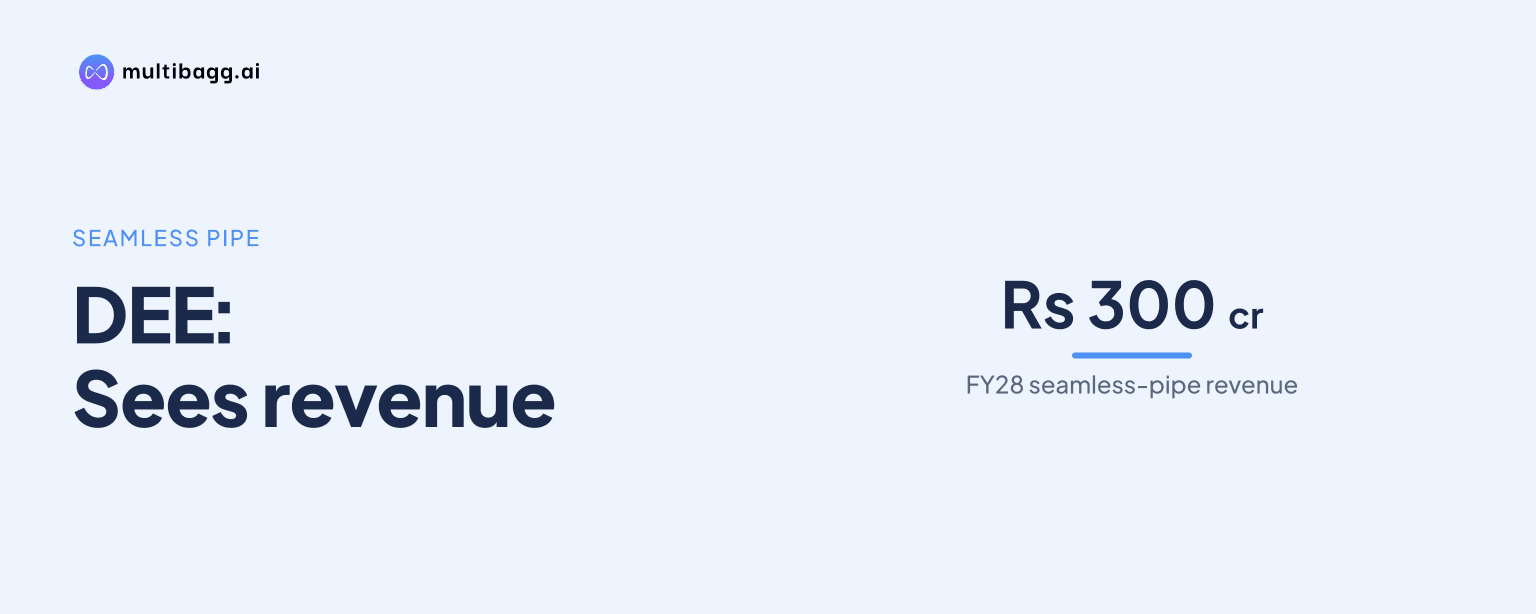
DEE Development Engineers Limited expects roughly Rs 300 crore of seamless-pipe revenue in FY28 from its 7,000-tonne unit, which management expects to operate at almost full utilisation. Management envisages a mix of direct sales and captive consumption, with internally produced eligible pipes potentially reducing procurement costs by 10% to 15%.
Know DEE Development Engineers inside out
Results, valuation, peers and who's buying, in one view.
How much seamless-pipe revenue does DEE expect in FY28?
DEE expects de facto revenue of about Rs 300 crore from seamless pipes in FY28, according to Chairman and Managing Director Krishan Lalit Bansal. Management said Rs 150 crore to Rs 200 crore could come from direct sales and Rs 150 crore to Rs 200 crore from internal consumption, alongside the overall estimate of about Rs 300 crore.
The two channel estimates are indicative ranges rather than a reconciled revenue split, because the upper ends add to more than the total forecast. The central point is that DEE intends to use the 7,000-tonne facility both to supply external customers and to manufacture pipes used in its own projects.
DEE said the plant is fully operational and its processes have been streamlined, with goods already produced. Management said the unit should begin generating a reasonably higher level of revenue in the coming H2, initially with output directed towards captive requirements and with some production allocated to direct pipe orders.
Management cited an order from Larsen & Toubro involving pipe supply as an example of potential direct business. It did not disclose the order's value, tonnage, delivery schedule or the share that would be supplied from the new seamless-pipe unit.
Will DEE use its 7,000-tonne pipe capacity fully in FY28?
DEE expects its 7,000-tonne seamless-pipe capacity to be almost fully utilised in FY28. Management qualified that expectation by saying any further increase in capacity would depend on order inflow, but said the existing 7,000-tonne facility should be almost fully used.
This would mark a ramp from the current year, when the facility had only recently become operational and management was still establishing processes and producing goods. DEE did not disclose current utilisation, current production in tonnes or revenue already generated by the seamless-pipe unit, so the FY28 utilisation outlook is management's projection rather than a reported operating result.
Two submitted tenders cover more than 8,000 tonnes, exceeding the unit's stated 7,000-tonne capacity. Management did not state when those tenders would be decided or whether DEE would receive either order, so their volume should not be treated as contracted production.
Potential orders under discussion with JSW and Adani could also create opportunities for DEE to use its own pipes, management said. At the time of the call, management said there was no Adani order in hand, while discussions with JSW were progressing and another meeting was expected after the Diwali holiday period.
Got a follow-up? Ask IRIS
How could captive pipe production reduce DEE's costs?
DEE expects savings of about 10% to 15% on the portion of pipes it can manufacture internally instead of purchasing. Management described this as a benefit on pipe buying, rather than as a saving on a project's full cost or a company-wide margin forecast.
The benefit is limited by the facility's product range and output capacity. Management said it can make only a small and limited range of pipes, meaning the net financial impact will not be large even as the unit is integrated into projects.
The saving should emerge as eligible internally made pipe replaces external procurement in project execution. Management did not quantify the value of DEE's total pipe purchases, the share of purchases that the unit can replace, or the rupee amount of savings expected in FY28.
The production ramp also comes as DEE's order mix changes. Management said job work represented about 40% to 45% of H1 activity, compared with a historical range of about 25% to 30%, and expected more than 70% of H2 business to be with-material orders. With-material work requires DEE to supply materials, but management did not quantify how much of that material requirement will be met by the seamless-pipe plant.
Could DEE add machinery to expand seamless-pipe output?
DEE may add one or two machines if demand requires output beyond the current 7,000-tonne capacity. Management said an additional machine might be needed under the present scenario, but made any decision conditional on business inflow rather than announcing a committed capital-expenditure plan.
Management did not provide a cost, incremental capacity, installation timetable or financing plan for additional equipment. The possible expansion therefore remains contingent on the conversion of demand into orders and on the pace at which the current plant reaches near-full utilisation.
DEE's broader project pipeline could support captive pipe requirements, although it is not confirmed seamless-pipe demand. Management estimated pending Bharat Heavy Electricals Limited work at about Rs 300 crore and Larsen & Toubro work at about Rs 150 crore, with the Larsen & Toubro figure covering job work and some pipe orders.
The wider order book also has varying execution periods. Management said orders generally carry delivery schedules of six to 18 months, while larger orders such as the Dow project can run for two years. This timing affects when projects may require pipe supplies and when potential captive-production savings could be realised.
What should investors assess in DEE's seamless-pipe ramp?
DEE's FY28 plan depends on converting available demand into actual production across captive use and direct sales. The reported target is about Rs 300 crore of seamless-pipe revenue at almost full use of 7,000 tonnes, but management has not disclosed the final production split, current utilisation or a committed machinery expansion.
The main disclosed evidence of prospective volume is the more than 8,000 tonnes covered by two submitted tenders and the potential use of DEE-made pipes in future JSW or Adani projects. Neither tender awards nor JSW and Adani orders had been confirmed on the call, leaving order conversion an unresolved part of the ramp.
Conclusion
DEE's seamless-pipe strategy combines external pipe sales with captive production for its own projects. Management's FY28 expectation of about Rs 300 crore of revenue and almost full use of the 7,000-tonne unit rests on expanding plant output after operations and processes were established, while replacing eligible external pipe purchases could save 10% to 15% on that procurement portion.
The next indicators are awards from the two tenders covering more than 8,000 tonnes, progress in JSW and Adani discussions, and whether demand justifies one or two additional machines. Management has not committed to that equipment investment and has not disclosed a final direct-sales versus captive-use tonnage allocation.