










DEE Development Engineers Limited Q2 PAT rises 31.8% to ₹23.54 crore
Key highlights
- DEE Development Engineers reported Q2 FY27 revenue of ₹293 crore, up 8.5% year-on-year.
- Operating EBITDA rose 33.7% year-on-year to ₹58.94 crore, with margin improving to 20.1% from 16.3%.
- Q2 FY27 profit after tax increased 31.8% year-on-year to ₹23.54 crore.
- The order book stood at ₹2,531 crore on September 30, 2026, up 94% from ₹1,308 crore a year earlier.
powered by IRIS
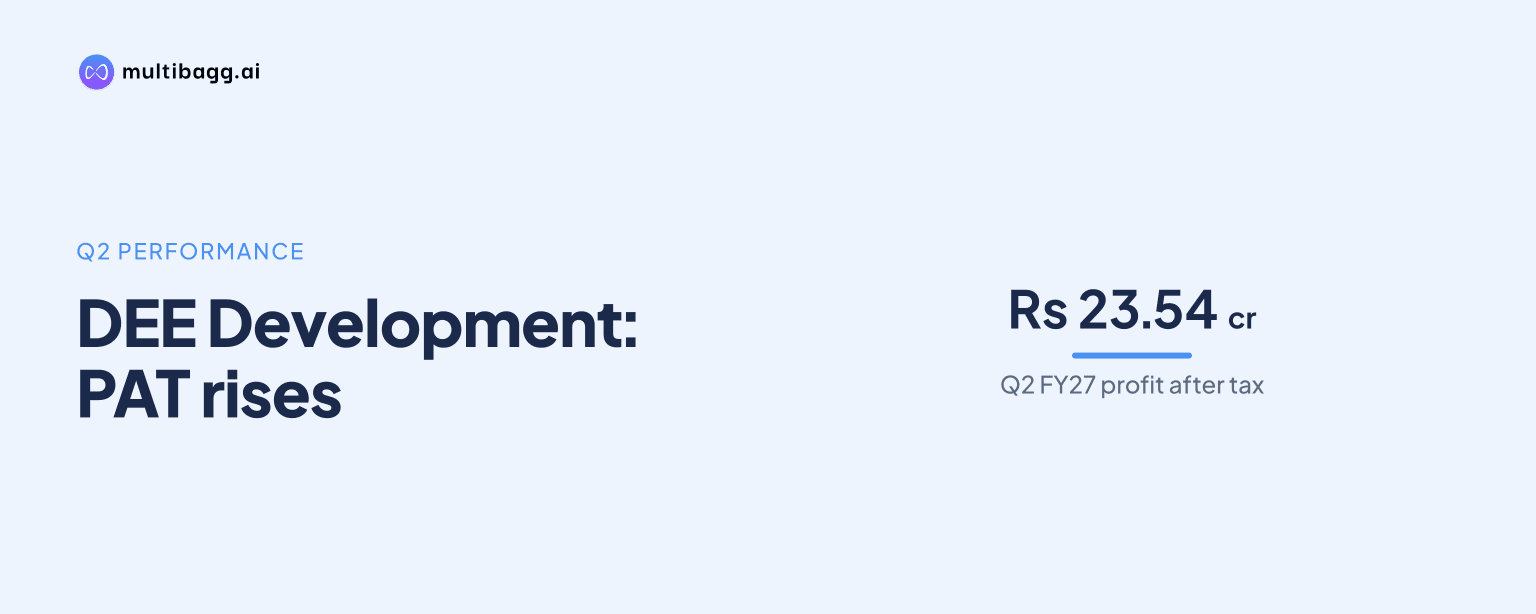
DEE Development Engineers Limited reported Q2 FY27 profit after tax of ₹23.54 crore, up 31.8% year-on-year, as revenue reached ₹293 crore and operating EBITDA margin expanded to 20.1% from 16.3%. The company also ended September 2026 with an order book of ₹2,531 crore.
Know DEE Development Engineers inside out
Results, valuation, peers and who's buying, in one view.
How did DEE Development Engineers perform in Q2 FY27?
DEE Development Engineers delivered higher revenue, operating profit and net profit in the quarter ended September 30, 2026. Revenue from operations stood at ₹293 crore, rising 8.5% year-on-year, supported by execution in piping and fabrication-related operations and steady supplies to the power sector.
Operating EBITDA increased 33.7% year-on-year to ₹58.94 crore. The resulting EBITDA margin rose to 20.1%, compared with 16.3% in Q2 FY26. Profit after tax rose 31.8% year-on-year to ₹23.54 crore, with a net profit margin of 8%.
The improvement in profitability outpaced revenue growth during the quarter. Management attributed the operating progress to the gradual ramp-up of its Anjar fabrication facility and seamless pipe plant, with higher utilisation at both units contributing to the reported numbers.
What drove the improvement in quarterly margins?
Higher utilisation at the Anjar fabrication facility and the seamless pipe plant was the principal operational factor cited by DEE Development Engineers. The company said the facilities were ramping up steadily and that the increase in utilisation was flowing through to financial performance.
Its operating EBITDA margin expanded by 3.8 percentage points year-on-year, from 16.3% in Q2 FY26 to 20.1% in Q2 FY27. EBITDA growth of 33.7% was therefore materially higher than the 8.5% increase in revenue, indicating that the quarter's reported profit growth was supported by the stated operating leverage and plant utilisation.
The company serves customers in the power, oil and gas, and processing industries in India and export markets. For Q2, management specifically linked revenue execution to piping and fabrication work, with steady power-sector supplies supporting sales.
What does the ₹2,531 crore order book indicate?
DEE Development Engineers closed Q2 FY27 with an order book of ₹2,531 crore as of September 30, 2026. This was 94% higher than the ₹1,308 crore order book reported a year earlier and ₹103 crore above the ₹2,428 crore order book at the end of June 2026.
The order book provides disclosed visibility across the company's core markets, including power, oil and gas, and process industries. Management said demand visibility in India and overseas remained healthy, while referring to a healthy project pipeline across key segments.
The order book should be assessed as a pipeline of contracted work rather than as immediate revenue. Its conversion into sales depends on project schedules and execution. Still, the increase from June and the substantial year-on-year expansion show that the company entered the second half of FY27 with a larger reported base of orders.
Got a follow-up? Ask IRIS
How does Q2 compare with recent performance?
DEE Development Engineers had reported revenue of ₹294.5 crore in Q1 FY27, with operating EBITDA of ₹49.7 crore and a margin of 16.9%. Q2 revenue of ₹293 crore was broadly similar to the preceding quarter, while Q2 operating EBITDA was higher at ₹58.94 crore and the margin rose to 20.1%.
For Q1 FY27, profit after tax was ₹16.1 crore. The Q2 profit after tax of ₹23.54 crore was higher than that reported for Q1, although the company did not provide a sequential growth percentage in the supplied call transcript.
The recent quarterly data follows a stronger FY26, when the company reported revenue from operations of ₹1,142 crore, up 38% year-on-year. Reported operating EBITDA for FY26 was ₹189.3 crore, up 52.9%, while FY26 profit after tax was ₹77.2 crore, up 76.9% year-on-year. These figures provide context for management's focus on execution, utilisation and operating leverage entering FY27.
Why do these results matter for investors and industry customers?
The Q2 result matters because DEE Development Engineers combined moderate revenue growth with a larger increase in EBITDA and profit after tax. The margin expansion was tied by management to higher utilisation at new or ramping facilities, making capacity utilisation an important operational measure for investors to track in future disclosures.
For customers in power, oil and gas, and process industries, the ₹2,531 crore order book indicates that the company has a significant disclosed pipeline of work across its operating segments. However, the supplied information does not give project-wise delivery schedules or a breakup of the September order book by industry or geography.
The company had earlier stated in its Q1 FY27 call that its order book included roughly ₹400 crore of HRSG business in India and about ₹200 crore from Thailand. That detail related to the June 2026 order book and should not be treated as a composition of the September order book without a fresh company disclosure.
Conclusion
DEE Development Engineers reported a Q2 FY27 profit after tax of ₹23.54 crore, a 31.8% year-on-year increase, while operating EBITDA margin improved to 20.1%. Revenue of ₹293 crore and an order book of ₹2,531 crore show the company maintained execution momentum across its key industrial markets while plant utilisation increased.
The next disclosures to watch are the pace of order-book conversion, revenue contribution from the Anjar fabrication facility and seamless pipe plant, and whether EBITDA margins remain near the Q2 level. Management has identified power, oil and gas, process industries and export markets as the principal demand areas supporting its project pipeline.