










DSM Fresh Foods Reports ₹7.3 Crore H1 FY27 Profit, Call Available
Key highlights
- DSM Fresh Foods' call highlights cited H1 FY27 revenue of ₹165.5 crore, up 72.6% year-on-year.
- H1 FY27 EBITDA was cited at ₹17.6 crore, up 18%, while profit after tax was ₹7.3 crore, up 4%.
- Gross margin declined to 28.9% in H1 FY27 from 33.6% previously.
- Business-to-business and horeca contributed 84% of H1 FY27 revenue, versus 68% in FY26.
powered by IRIS
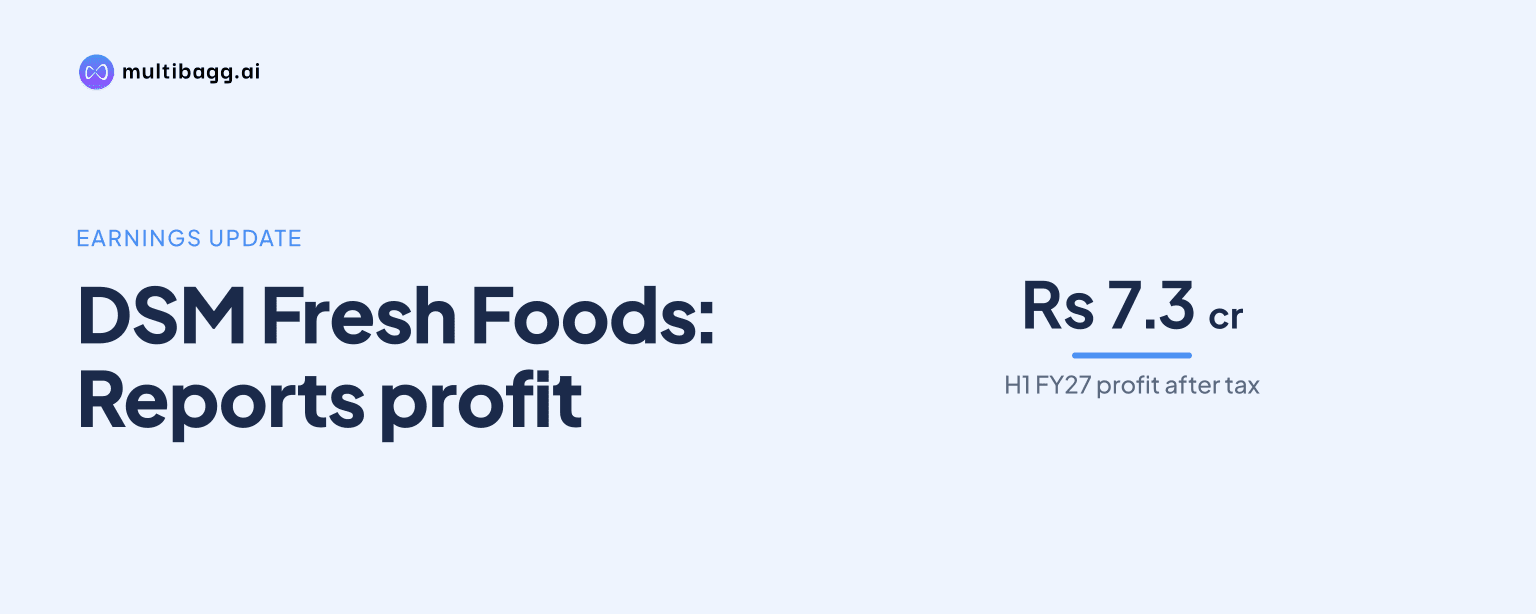
DSM Fresh Foods Limited reported a consolidated net profit of ₹7.3 crore for the half year ended September 30, 2026, while revenue discussed on its H1 FY27 call reached ₹165.5 crore, up 72.6% year-on-year. The company has also made the November 16, 2026 analyst and investor call recording available on its website.
Know DSM Fresh Foods inside out
Results, valuation, peers and who's buying, in one view.
What did DSM Fresh Foods report for H1 FY27?
DSM Fresh Foods reported rapid revenue growth in H1 FY27, although earnings growth was materially slower than the increase in sales. Call highlights stated that revenue rose 72.6% year-on-year to ₹165.5 crore, EBITDA increased 18% to ₹17.6 crore, and profit after tax rose 4% to ₹7.3 crore.
The company, which operates the Zappfresh meat and seafood brand, discussed its operational and financial performance at the analyst and investor call held on November 16 at 3:00 PM IST. Go India Advisors hosted the call. DSM Fresh Foods subsequently informed exchanges that the audio and video recording was available on its website.
A separately reported H1 FY27 results item cited revenue from operations of ₹153.6 crore, up 60.2% year-on-year, and net profit of ₹8.8 crore, up 25.7% year-on-year. The provided materials do not explain the difference between those figures and the call highlights, and investors may need to refer to the company's financial filing for the applicable reporting basis and reconciliation.
Why did DSM Fresh Foods' margins lag revenue growth?
DSM Fresh Foods attributed the weaker earnings conversion chiefly to a higher business-to-business and horeca sales mix, along with start-up costs for its Mewa Foods business. Gross margin declined to 28.9% in H1 FY27 from 33.6% previously, while EBITDA and profit grew far more slowly than revenue.
Business-to-business and horeca accounted for 84% of H1 FY27 revenue, compared with 68% of FY26 revenue, according to the call summary. The business-to-consumer share consequently fell to 16% from 32%. Management said business-to-business volumes support recurring sales and infrastructure utilisation, but the channel carries lower gross margins.
Management stated that its longer-term channel objective remains a roughly 50:50 split between business-to-business and business-to-consumer operations. On specific margin questions, management did not provide a numerical target, stating that it could not comment on specific margins.
Got a follow-up? Ask IRIS
How is Mewa Foods affecting DSM Fresh Foods' expansion?
Mewa Foods contributed around ₹12 crore, or 7% of H1 FY27 revenue, but remains an investment-led business rather than a proven profit contributor. DSM Fresh Foods said the brand's launch response and customer-acquisition economics were encouraging, while acknowledging that the operation remains too small to demonstrate its expected margins.
Management indicated that Mewa Foods could break even in FY27 after around eight to nine months of operations. It also cited revenue potential of ₹120 crore to ₹140 crore for the facility in the immediately coming financial year, rising to ₹300 crore to ₹400 crore over three to four years. These are management projections rather than reported financial results.
The company is also using partner retail and quick-commerce channels to strengthen its consumer reach. Partner stores increased from about 100 at the end of FY26 to 200 by September. DSM Fresh Foods had earlier launched its Meevaa Foods brand on Amazon India, with access to 350 distribution points, according to the supplied information.
What should investors take from the H1 FY27 earnings call?
DSM Fresh Foods' call presented a trade-off between sales growth and near-term profitability. Revenue expansion was supported by business-to-business volumes, seafood integration, retail development and new-brand investments, but the associated mix shift and start-up spending reduced gross-margin performance.
For investors, the key disclosed indicators are the 72.6% revenue increase, the 18% EBITDA increase and the 4% profit-after-tax increase in the call highlights. The difference in growth rates shows that the additional revenue did not translate proportionately into operating profit or net profit during H1.
Management expressed an aspiration for FY27 revenue growth of 70% to 80%, broadly in line with the H1 growth rate. Delivery for the full year remains dependent on H2 execution, including the development of Mewa Foods, seafood operations and retail channels. No transcript or investor presentation had been filed at the time of the call listing, though the recording is available.
Conclusion
DSM Fresh Foods has made its H1 FY27 analyst and investor call accessible after reporting strong sales growth but more limited growth in EBITDA and profit. The available call highlights point to lower gross margins from a greater business-to-business and horeca contribution, alongside early investment costs in Mewa Foods and other expansion initiatives.
The next disclosed item to watch is progress toward management's 70% to 80% FY27 revenue-growth aspiration and its stated expectation that Mewa Foods could break even within FY27. Investors will also need to monitor any subsequent transcript, presentation or financial filing that clarifies the differing H1 revenue and profit figures cited in the supplied reports.