










Zappfresh institutional mix reaches 84%, cutting gross margin
Key highlights
- Zappfresh revenue from operations rose 72.6% year-on-year to Rs 165.5 crore in H1 FY27.
- Zappfresh's B2B and HoReCa mix increased to 84% in H1 FY27 from about 68% at FY26-end.
- Zappfresh gross margin declined to 28.9% in H1 FY27 from 33.6% in H1 FY26.
- Zappfresh's retailer partner network doubled to 200 stores as of September 2026 from about 100 at FY26-end.
powered by IRIS
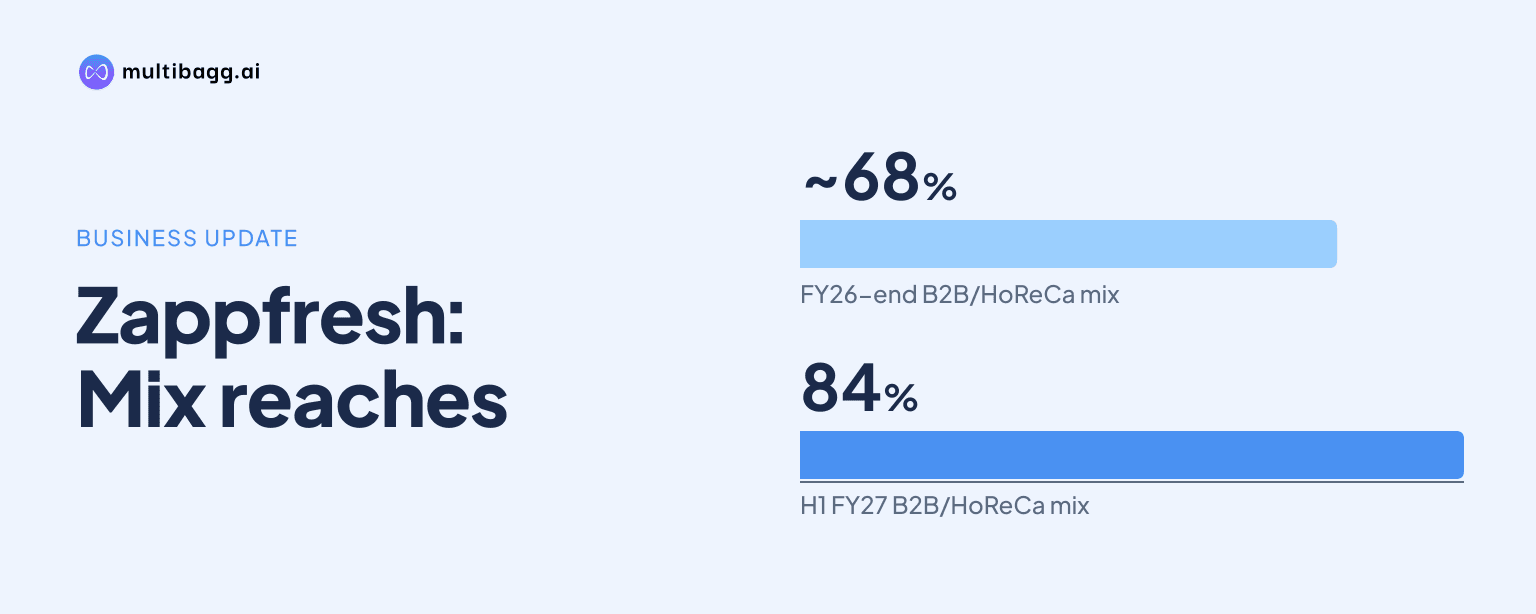
DSM Fresh Foods Limited, operating as Zappfresh, derived 84% of H1 FY27 revenue from B2B and HoReCa, helping revenue rise 72.6% year-on-year to Rs 165.5 crore but reducing gross margin to 28.9% from 33.6%. Management said institutional sales carry relatively lower gross margins despite adding volume, recurring demand and infrastructure utilisation.
Know DSM Fresh Foods inside out
Results, valuation, peers and who's buying, in one view.
What changed in Zappfresh's channel mix?
Zappfresh's B2B and HoReCa share rose to 84% of revenue in H1 FY27 from about 68% at the end of FY26, while B2C fell to 16% from 32%. The 16-percentage-point increase in institutional mix reflects faster growth in business-to-business and hotel, restaurant and catering channels than in consumer sales.
The shift coincided with a substantial rise in the revenue base. Revenue from operations reached Rs 165.5 crore in H1 FY27, compared with Rs 95.9 crore in H1 FY26, an increase of 72.6%. Management described institutional operations as a source of higher volumes and recurring demand, and said the channel makes better use of Zappfresh's integrated sourcing, processing and cold-chain infrastructure.
The channel development occurred alongside a broader product mix in H1 FY27. Chicken contributed 55% of revenue, goat meat 20%, and fish and seafood 25%. Vegetarian and non-vegetarian products accounted for 7% and 93%, respectively, of consolidated revenue, showing that the business remained predominantly focused on animal-protein categories after launching vegetarian heat-and-eat products.
Why did Zappfresh's gross margin decline?
Zappfresh's gross margin declined because the faster-growing institutional business operates at relatively lower gross margins, according to management. Gross margin was 28.9% in H1 FY27, down 4.7 percentage points from 33.6% in H1 FY26, even as gross profit increased 48.4% to Rs 47.7 crore.
Revenue expanded faster than gross profit during the half year. Revenue rose 72.6% to Rs 165.5 crore, whereas gross profit rose 48.4% to Rs 47.7 crore, consistent with management's explanation that a larger institutional contribution altered the economics of sales. Management nevertheless cited volume, recurring demand and better infrastructure utilisation as operating benefits of B2B and HoReCa.
Seafood illustrates another mix consideration. Its revenue contribution rose from 21% in H1 FY26 to 27% in H2 FY26, before settling at 25% in H1 FY27. Management identified seafood as an opportunity for portfolio diversification, backward integration and medium-term margin improvement through direct farmer relationships, contract farming and more integrated sourcing.
How did Zappfresh's earnings move as revenue increased?
Zappfresh remained operationally profitable in H1 FY27, with earnings before interest, tax, depreciation and amortisation, or EBITDA, increasing 18% year-on-year to Rs 17.6 crore. EBITDA margin was about 11%, with management attributing the lower pace of EBITDA growth relative to revenue partly to fixed costs from launching and scaling Meevaa Foods.
Profit after tax increased 4% year-on-year to Rs 7.3 crore, compared with the 72.6% increase in revenue. The different growth rates across revenue, gross profit, EBITDA and profit after tax show that the rapid institutional expansion did not flow through proportionately to each profit measure during the half year.
Meevaa contributed about Rs 12 crore, or around 7% of consolidated revenue, in H1 FY27. Management had previously stated an aspiration for Meevaa to provide 10% to 15% of FY27 revenue, supported by product launches, wider distribution and deeper customer engagement. The domestic range began with 12 vegetarian products, including samosas, momos, spring rolls and Dal Makhani.
Got a follow-up? Ask IRIS
What did Zappfresh say about working capital?
Zappfresh did not disclose a receivable-days figure in the supplied H1 FY27 earnings-call transcript. Management said working-capital efficiency and cash-flow generation would remain priorities as it expands, but did not quantify trade receivables or provide a comparison of receivable days between periods.
The call instead provided detail on short-term loans and advances. Management said the reported balance of about Rs 93 crore included around Rs 22 crore advanced to subsidiary Avyom for an acquisition, leaving about Rs 70 crore for business purposes, principally supplier and vendor advances for procurement and contract farming.
Management said these advances are used to lock in procurement prices and had increased as commodity prices rose. It also said disruption from war had affected some suppliers' businesses, requiring Zappfresh to step in to maintain supply arrangements. Separately, an analyst noted that fixed assets in the consolidated balance sheet had risen to around Rs 34 crore, which management confirmed related to the Meevaa Foods facility.
How does Zappfresh plan to rebalance its sales mix?
Zappfresh plans to build a more balanced mix through offline retail expansion and consumer-facing businesses with higher gross-margin potential. Management's stated objective is to combine the scale advantages of institutional operations with B2C channels that strengthen customer relationships, brand visibility and participation in higher-value categories.
Its neighbourhood meat-retailer partnership network doubled from about 100 stores at the end of FY26 to 200 stores as of September 2026. Management is pursuing 300 to 400 stores and described the model as asset-light because it adds physical presence and local visibility without the capital intensity of a fully company-owned retail chain.
Meevaa is another part of the planned mix change. Zappfresh reported that e-commerce and quick-commerce revenue for the brand was 3.7 times higher in August than July, while customer-acquisition cost per order declined by about 60% in the same period. Management plans further distribution through digital platforms, dedicated Meevaa outlets and co-branded Zappfresh outlets, while focusing on repeat consumption and customer retention.
Conclusion
Zappfresh's H1 FY27 performance shows a trade-off: institutional sales drove revenue to Rs 165.5 crore and lifted the B2B and HoReCa mix to 84%, while gross margin fell to 28.9% from 33.6%. Gross profit, EBITDA and profit after tax still increased to Rs 47.7 crore, Rs 17.6 crore and Rs 7.3 crore, respectively, but each grew more slowly than revenue.
The next test is execution in H2 FY27. Management retained its earlier FY27 growth aspiration of 70% to 80%, while saying delivery depends on second-half execution, including winter demand, seafood expansion, Meevaa distribution and the retailer network's progress toward 300 to 400 stores. It also identified operating leverage, working-capital efficiency and cash-flow generation as priorities without disclosing receivable days in the call.