










Zappfresh Meevaa reaches Rs 12 crore in first-half FY27 sales
Key highlights
- Meevaa contributed approximately Rs 12 crore, or around 7%, of Zappfresh’s consolidated H1 FY27 revenue.
- Meevaa e-commerce and quick-commerce revenue grew 3.7 times in August 2026 versus July.
- Meevaa received more than 5,000 orders within 48 hours of its domestic launch.
- Zappfresh’s retailer partner network reached 200 stores in September 2026, up from about 100 at FY26-end.
powered by IRIS
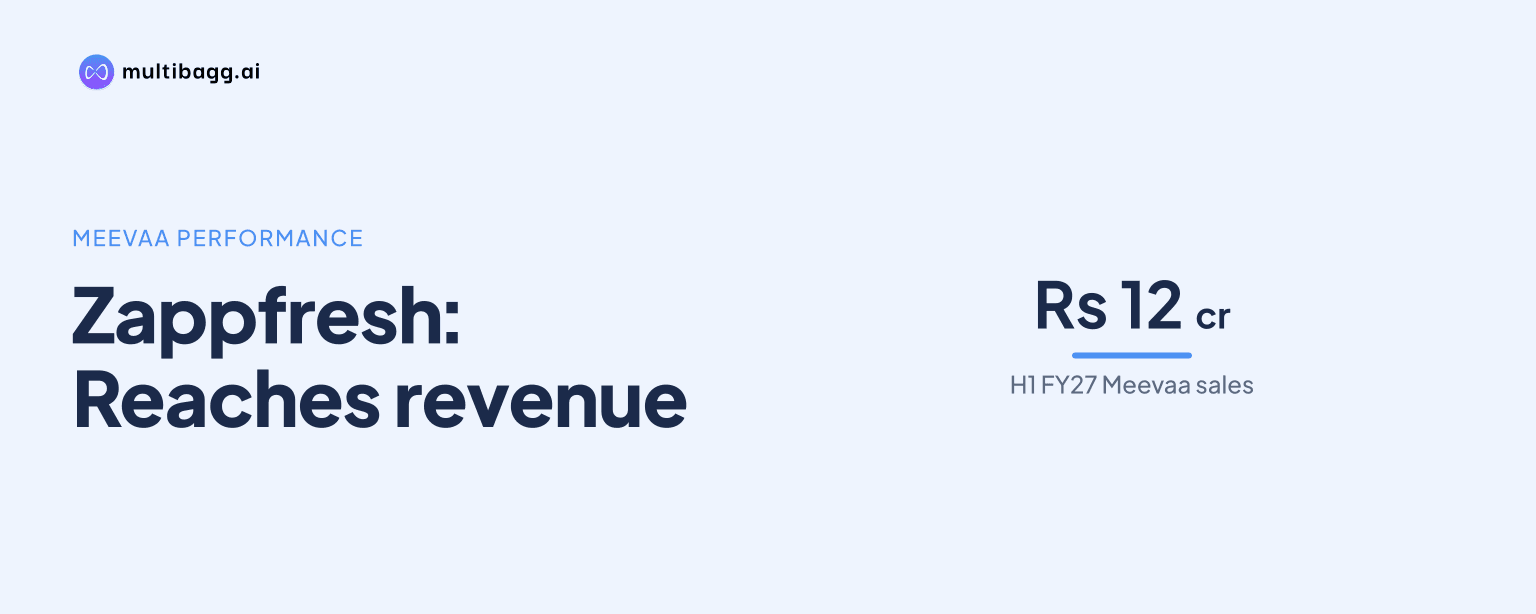
DSM Fresh Foods Limited’s Zappfresh said its Meevaa heat-and-eat brand generated about Rs 12 crore in H1 FY27, equal to roughly 7% of consolidated revenue, following a domestic launch that drew more than 5,000 orders in its first 48 hours and an August jump in quick-commerce revenue.
Know DSM Fresh Foods inside out
Results, valuation, peers and who's buying, in one view.
How much revenue did Zappfresh’s Meevaa generate in H1 FY27?
Meevaa generated approximately Rs 12 crore in H1 FY27, contributing around 7% of Zappfresh’s consolidated revenue. Zappfresh reported revenue from operations of Rs 165.5 crore for the half year ended September 30, 2026, up 72.6% from Rs 95.9 crore in H1 FY26. The Meevaa contribution places the new heat-and-eat range within a business still led by fresh protein, where chicken accounted for 55% of H1 FY27 revenue, goat meat 20% and fish and seafood 25%.
Meevaa began its domestic rollout with 12 vegetarian products, including samosas, momos, spring rolls, kebabs, patties, tikkis and dal makhani. Management said the products contain no preservatives, monosodium glutamate, or MSG, or other chemicals and are blast-frozen. The company received more than 5,000 orders within 48 hours of launch, then added Amazon Now and Blinkit, with Blinkit joining in October 2026.
How quickly is Zappfresh growing Meevaa on quick commerce?
Zappfresh said Meevaa’s e-commerce and quick-commerce revenue grew 3.7 times in August 2026 compared with July, while customer-acquisition cost per order declined by approximately 60% over the same period. Those are early operating indicators rather than a full-period profitability measure, but they show that the brand’s digital distribution accelerated after its initial launch. Management identified product innovation, wider distribution and customer engagement as support for its earlier aspiration that Meevaa contribute 10% to 15% of FY27 revenue.
Marketing campaigns provided further evidence of initial demand, although the transcript did not disclose their costs or repeat-order rates. Meevaa’s monsoon campaign reached approximately 65 lakh people, while the 11:11 campaign lifted online orders by 362% over June; first-time customers represented more than 80% of July orders. A Ganesh Chaturthi campaign subsequently generated about 72% of September online orders, making conversion from first purchase into repeat consumption a stated management priority.
How will Zappfresh expand Meevaa distribution?
Zappfresh plans to expand Meevaa through quick commerce, retail partnerships, digital platforms, dedicated Meevaa outlets and co-branded Zappfresh outlets. The brand is currently present on Amazon Now and Blinkit, and management said it intends to launch on other leading e-commerce marketplaces. It also described Meevaa as likely to become mainly a business-to-consumer, or B2C, and business-to-business-to-consumer, or B2B2C, operation, with distributors and supermarket penetration forming part of the domestic model.
International expansion is another stated route, centred on North Indian offerings for Indian consumers in the US, Canada and Europe, where Zappfresh said it already has relationships. Management said the Chandigarh facility is approved by the US Food and Drug Administration and meets European standards. In response to an analyst question, management estimated that the facility could generate Rs 120 crore to Rs 140 crore of revenue in the immediate coming financial year, while describing potential Meevaa revenue of Rs 300 crore to Rs 400 crore over the next three to four years as a conservative estimate.
Got a follow-up? Ask IRIS
What does Meevaa’s ramp-up mean for Zappfresh’s financial profile?
Meevaa’s launch coincided with higher fixed costs and a lower consolidated gross margin, even as Zappfresh’s revenue expanded. Gross profit rose 48.4% year on year to Rs 47.7 crore in H1 FY27, but gross margin fell to 28.9% from 33.6% in H1 FY26. Zappfresh attributed much of that margin movement to the faster growth of lower-margin institutional business, while saying new-business costs associated with Meevaa also affected earnings: earnings before interest, tax, depreciation and amortisation, or EBITDA, increased 18% to Rs 17.6 crore and profit after tax rose 4% to Rs 7.3 crore.
The channel mix illustrates the scale-versus-margin issue management is seeking to address. Business-to-business, or B2B, and hotel, restaurant and catering, or HoReCa, revenue represented 84% of H1 FY27 revenue, compared with 68% at the end of FY26, while B2C fell to 16% from 32%. An analyst raised concerns about debt, receivables, supplier advances and Meevaa’s early profitability; management responded that three newer initiatives, the retailer programme, seafood project and Meevaa, require upfront investment, and said its long-term steady-state aim is a 50:50 B2B-B2C mix.
Conclusion
Meevaa adds a convenience-food category to Zappfresh’s predominantly institutional fresh-protein operations, but management described it as an early-stage investment with costs still preceding scale benefits. The 3.7-times month-on-month increase in August digital revenue and the approximately 60% reduction in acquisition cost per order indicate initial channel traction, while H1 EBITDA rose 18% to Rs 17.6 crore despite the launch-related fixed costs.
What to watch next is H2 FY27 execution on marketplace distribution, repeat consumption and manufacturing utilisation. Management’s FY27 growth aspiration remains 70% to 80%, with delivery dependent on the second half, while its Meevaa plans include additional e-commerce platforms, dedicated outlets, co-branded outlets and overseas expansion. The retailer-partner network, which rose from about 100 stores at FY26-end to 200 in September 2026, is also progressing toward management’s ambition of 300 to 400 stores.