










e2E RAIL EDRC Supports 25+ Projects, Reports 56% Win Ratio
Key highlights
- e2E RAIL reports that EDRC has supported more than 25 internal projects.
- EDRC has produced more than 19,000 engineering deliverables with more than 60 design engineers.
- e2E RAIL reports a 56% EDRC bid-support win ratio.
- e2E RAIL has 73 active projects, including 54 Indian Railways projects and 19 private and industrial projects.
powered by IRIS
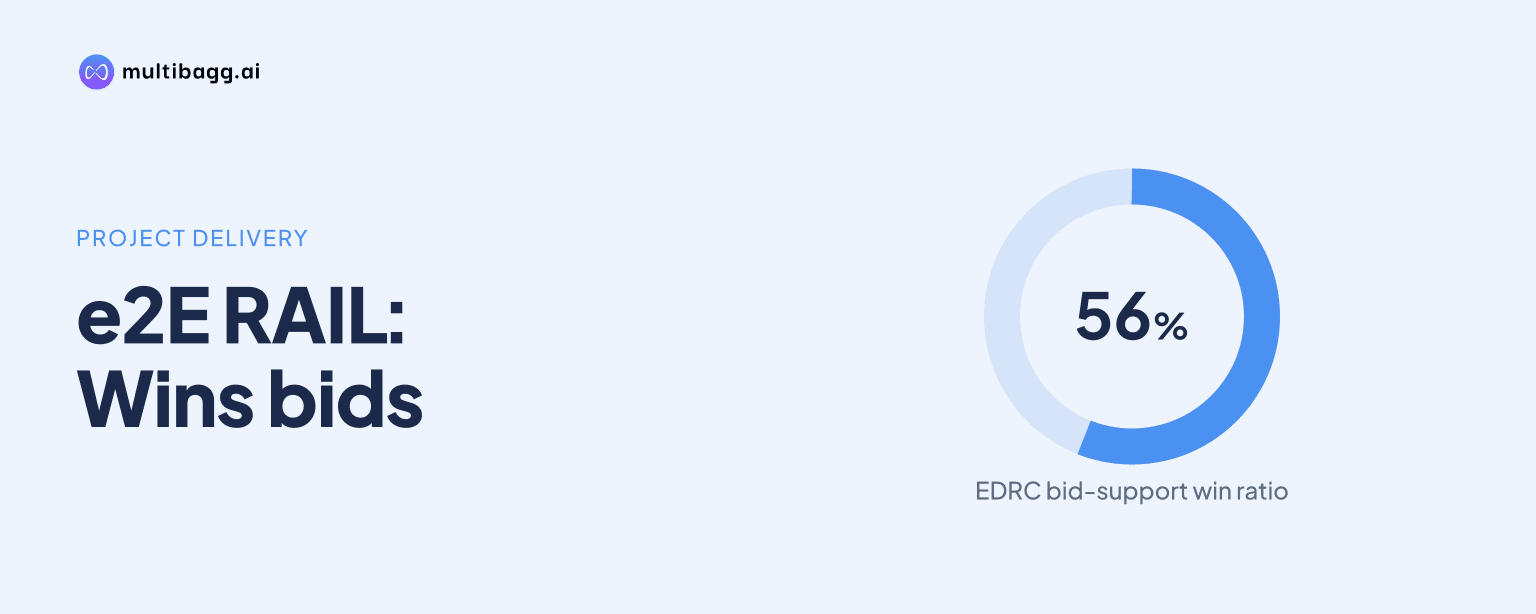
In its presentation, E To E Transportation says its e2E RAIL Engineering Design & Research Center has supported more than 25 internal projects, produced more than 19,000 engineering deliverables and reported a 56% bid-support win ratio. The company presents its 60-plus design engineers and SUTRA workflow as tools for design control, bid preparation and execution coordination.
Know E to E Transportation Infrastructure inside out
Results, valuation, peers and who's buying, in one view.
What has e2E RAIL’s EDRC delivered?
EDRC has supported more than 25 internal projects and generated more than 19,000 engineering deliverables, according to e2E RAIL’s presentation. Those figures describe an internal design capability rather than a separately reported revenue segment, and the source does not provide a date range for either measure. The centre has more than 60 design engineers, which is the stated staff base behind its five design disciplines.
The presentation places this engineering activity within a wider delivery platform of 73 active projects: 54 active Indian Railways projects and 19 current private and industrial railway projects. That wider base spans 15 railway zones in the business-to-government segment and five industrial sectors in the business-to-business segment, including power, cement, steel, ports and mining. The source does not say that EDRC worked on every one of the 73 projects.
The 54-to-19 split shows that Indian Railways accounts for the larger share of the current 73-project base, while private and industrial work is a separate 19-project stream. The nine projects completed in FY27, as labelled in the presentation, are a completed-project measure rather than an active-project count. The source therefore shows projects moving through execution but does not provide enough information to calculate a net change in the active portfolio.
How does e2E RAIL’s SUTRA workflow connect design work?
SUTRA is e2E RAIL’s unified toolkit that links five EDRC design disciplines in a continuous process from design intelligence to final sanction. The workflow presented runs through bill of quantities, or BOQ, generation, indoor design, original equipment manufacturer, or OEM, delivery, outdoor design and automated Factory Acceptance Testing and Site Acceptance Testing, or FAT/SAT, validation. e2E RAIL describes SUTRA as the thread running through every project, but it provides no separate adoption percentage or cycle-time result.
The stated operational benefits are faster engineering, higher accuracy, project standardisation and better project control. More specifically, the presentation says the system is intended to reduce design-cycle time, minimise design and execution errors, make designs reusable, compliant and scalable, and improve visibility and collaboration. These are management-stated design objectives rather than quantified performance outcomes, since the page gives no before-and-after figures for time, rework or project cost.
SUTRA’s relevance extends beyond the 19,000-plus deliverables because it is designed to connect handoffs in rail projects. e2E RAIL identifies signalling, telecom, electrification and composite projects as parts of its integrated rail offering, while the EDRC page identifies indoor and outdoor design as linked stages. The presentation therefore frames the toolkit as a control mechanism across engineering interfaces, rather than as a standalone software product with reported sales.
Got a follow-up? Ask IRIS
What does e2E RAIL’s 56% bid-support win ratio mean?
The 56% figure means e2E RAIL reports a bid-support win ratio for EDRC, indicating that bids backed by the centre won in 56% of the cases included in management’s measure. The presentation does not disclose the number of bids, contract values, measurement period or whether the ratio covers only internal bids. It should therefore be read as a stated operating metric, not as a complete measure of company-wide tender conversion.
Management links in-house design to bid support by presenting EDRC as a source of engineering input before a project is won. e2E RAIL’s broader model combines engineering, system integration, project management and product development, and it says this integrated structure gives greater control over cost, quality and delivery. The page characterises the design centre as contributing to margin and competitive positioning, but it does not report a margin comparison between projects with and without EDRC support.
The bid metric sits alongside a business mix that includes 54 Indian Railways projects and a Rs 303 crore private and industrial order value across 19 active projects. The presentation says the business-to-business order book has nine clients and can help even out seasonality. However, it does not allocate the Rs 303 crore order value to EDRC-supported work, so no direct link can be made between the 56% ratio and that order book.
What expansion plans has e2E RAIL set for EDRC?
e2E RAIL plans to expand EDRC through design-as-a-service, international design consulting, wider automation, new rail verticals and tool licensing. The design-as-a-service plan targets OEMs, metro systems and railways that hold contracts but lack design capability. The presentation describes these as future directions and does not disclose revenue targets, launch dates or signed external customers for any of them.
International consulting is presented as an opportunity to use EDRC’s licensed engineering capability and global design experience. e2E RAIL also plans vertical expansion into metro and high-speed rail design beyond zonal Indian Railways work. This would broaden the stated application of the more than 60 design engineers, but the source gives no project count for metro or high-speed rail design within the current 25-plus internal projects supported.
The technology plan includes extending automation beyond the current design disciplines and commercialising EDRC tools with data analytics and digital-twin capabilities. e2E RAIL also identifies licensing the SUTRA toolkit as a future possibility. These plans differ from the existing internal workflow because they contemplate external services or technology use, yet the presentation provides no pricing model, investment requirement or timetable for commercial deployment.
Conclusion
e2E RAIL’s presentation provides specific scale indicators for its internal engineering centre: more than 25 internal projects supported, more than 19,000 deliverables, more than 60 design engineers and a reported 56% bid-support win ratio. In the context of 73 active projects across Indian Railways and industrial railways, e2E RAIL presents EDRC and SUTRA as mechanisms for joining design stages and supporting bids, rather than as separately reported businesses.
The next points to watch are management’s disclosed plans for design-as-a-service, international consulting, expanded automation, metro and high-speed rail design, and SUTRA licensing. The presentation does not provide timing, revenue targets, pricing or external customer commitments for these initiatives.