










e2E RAIL targets KAVACH order in March 2027, steady state in 2028
Key highlights
- e2E Rail targets its first KAVACH order for March 2027 and commercial steady state for March 2028.
- e2E Rail targets RDSO approval in December 2027 after field trials scheduled from July 2027.
- e2E Rail reported a Rs 994 crore executable order book as of 11 November 2026.
- e2E Rail lists 11 safety-critical products in its NOVA Raksha pipeline.
powered by IRIS
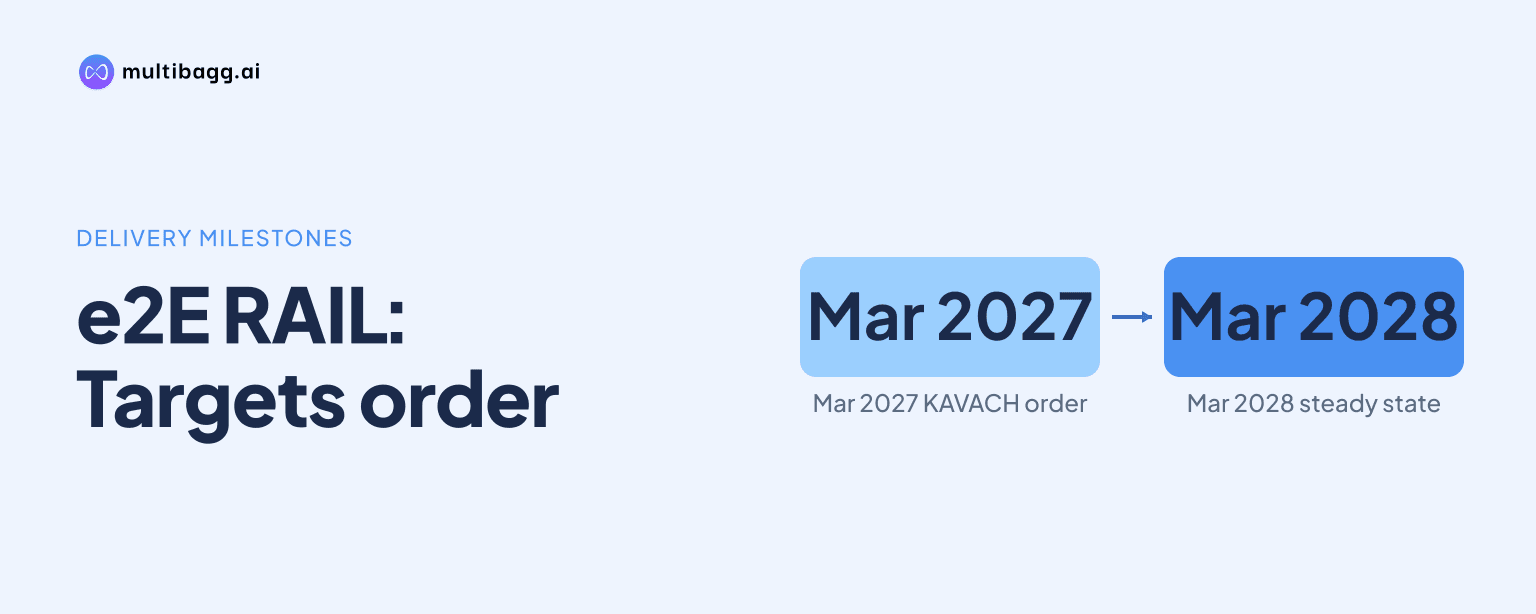
e2E Rail targets its first KAVACH order for March 2027, revenue recognition from October 2027 and commercial steady state by March 2028. The schedule depends on milestones including prototype approval in March 2027, field trials from July 2027 and Research Designs and Standards Organisation, or RDSO, approval targeted for December 2027.
Know E to E Transportation Infrastructure inside out
Results, valuation, peers and who's buying, in one view.
What is e2E Rail’s KAVACH commercial timetable?
e2E Rail plans a first KAVACH order in March 2027, followed by the start of revenue recognition in October 2027 and commercialisation at steady state in March 2028. These are forward-looking commercial milestones in the presentation, rather than reported KAVACH orders or revenue.
The presentation does not disclose an expected value, customer, route length, revenue contribution or margin for the planned first order. It also does not define steady state through a specified installation count, revenue run rate or other quantitative measure.
The stated commercial timing overlaps with the approval programme. Revenue recognition is scheduled to begin in October 2027, while RDSO approval is targeted for December 2027; e2E Rail does not explain the project stage or contractual mechanism expected to support revenue recognition before that target date.
Which KAVACH approvals are still on e2E Rail’s roadmap?
e2E Rail’s remaining KAVACH approval path runs from ATP completion listed as in progress for November 2026 to RDSO approval targeted for December 2027. CCA approval was achieved in May 2026, according to the presentation, while the company listed hardware as ready for ATP testing from December 2026.
Prototype approval and the start of RDSO FTP are both scheduled for March 2027, the same month as the planned first KAVACH order. The next named threshold is 70% FTP by June 2027, followed by field trials from July 2027.
The timeline distinguishes completed CCA approval in May 2026 from the later milestones that remain in progress or planned. In particular, e2E Rail has not reported prototype approval, field trials or RDSO approval as completed, and its December 2027 RDSO target remains a disclosed objective.
Got a follow-up? Ask IRIS
What technology platform supports e2E Rail’s KAVACH plan?
e2E Rail bases its KAVACH plan on the NOVA platform and says its NOVA plus TEL KAVACH team has more than 100 people. The company describes NOVA as an integrated railway-safety platform spanning products and infrastructure delivery.
NOVA’s stated vertical-integration model includes indigenous design of onboard and wayside hardware, safety-critical software and algorithms, system integration, and after-sales and annual maintenance contracts, or AMC. e2E Rail says its software stack is certified to Safety Integrity Level 4, or SIL-4, and says indigenous hardware design reduces import dependency.
The NOVA Raksha pipeline comprises 11 safety-critical products across four categories. Train-protection systems include KAVACH 4.0, electronic interlocking, axle counters and platform screen doors, while train-control systems include KAVACH 5.0, BTCS and communications-based train control, or CBTC.
The other two categories are intelligence and monitoring, which include train management systems, centralised traffic control and RDPMS, and train intelligence and propulsion systems, which include TCMS, DPWS and propulsion systems. The 11-product portfolio places KAVACH within a wider technology pipeline rather than presenting it as e2E Rail’s only product offering.
How does KAVACH fit e2E Rail’s current rail business?
e2E Rail is pursuing the KAVACH roadmap alongside an executable order book of Rs 994 crore as of 11 November 2026, excluding goods and services tax and L1 positions. Of this amount, business-to-government, or B2G, work accounted for Rs 870 crore and business-to-business, or B2B, work for Rs 124 crore, making B2G the larger segment.
Its current order book, including goods and services tax and L1 positions, was approximately Rs 1,200 crore. In FY27 year to date, it reported Rs 724.04 crore of orders, comprising 12 B2G orders worth Rs 568.80 crore and seven B2B orders worth Rs 155.24 crore.
The secured-order mix included Rs 183.40 crore of capacity-expansion work, Rs 179.20 crore for Mission Raftar, Rs 155.24 crore for private sidings, Rs 108.70 crore for signalling upgrades and Rs 97.50 crore for signalling on new lines. e2E Rail says average B2G ticket sizes have shifted from an earlier Rs 20 crore to Rs 60 crore range to Rs 50 crore to Rs 500 crore now, citing a Kalahasti project order of more than Rs 200 crore.
Execution activity remains primarily project based. e2E Rail reported 73 active projects, including 54 B2G projects across 15 railway zones and 19 private-siding projects across five industry sectors, and said nine B2G projects had been completed in FY27. This existing execution base differs from KAVACH, for which the first order is still scheduled for March 2027.
Conclusion
e2E Rail has set out a dated route from KAVACH technical milestones to commercialisation, with a first order planned for March 2027, revenue recognition from October 2027 and steady state by March 2028. The plan is supported by a NOVA Raksha portfolio of 11 safety-critical products and sits alongside a Rs 994 crore executable order book, but the presentation reports no current KAVACH revenue, order value or deployment.
The next disclosed events to watch are ATP completion in November 2026, type testing from December 2026, and prototype approval plus the start of RDSO FTP in March 2027. The June 2027 target for 70% FTP, field trials from July 2027 and RDSO approval targeted for December 2027 are the remaining stated milestones before the March 2028 steady-state objective.