










e2E RAIL receivables drop Rs 108 crore as cash outflow narrows
Key highlights
- e2E RAIL trade receivables fell Rs 108 crore, from Rs 229 crore in March 2026 to Rs 121 crore in September 2026.
- e2E RAIL reported net operating cash outflow of Rs 39 crore in H1 FY27, versus Rs 37 crore in H1 FY26.
- e2E RAIL collected Rs 270 crore through 12 November 2026, including Rs 199 crore from opening receivables.
- e2E RAIL total borrowings increased Rs 66 crore to Rs 229 crore at September 2026.
powered by IRIS
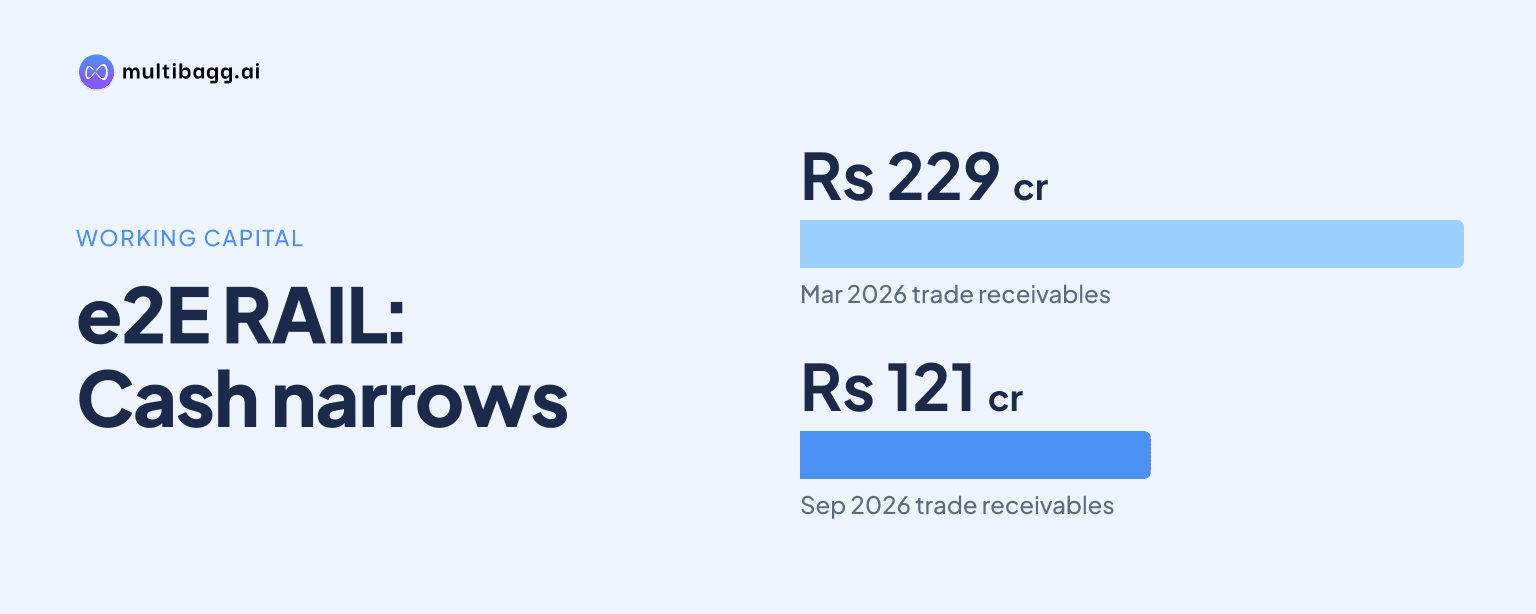
e2E RAIL reduced trade receivables by Rs 108 crore in H1 FY27, taking the balance from Rs 229 crore in March 2026 to Rs 121 crore in September 2026, while net cash used in operating activities was Rs 39 crore. The presentation reported Rs 270 crore of collections through 12 November 2026, including Rs 199 crore from opening receivables.
Know E to E Transportation Infrastructure inside out
Results, valuation, peers and who's buying, in one view.
How much did e2E RAIL reduce receivables in H1 FY27?
e2E RAIL reduced trade receivables by Rs 108 crore, or 47%, during H1 FY27, according to the presentation. The balance was Rs 121 crore at September 2026, down from Rs 229 crore at March 2026, after having risen from Rs 94 crore at March 2025. The September 2026 amount remained above the Rs 63 crore recorded at March 2024 and Rs 34 crore at March 2023.
The company reported Rs 270 crore of total cash collections through 12 November 2026, with Rs 199 crore coming from opening receivables of Rs 228 crore. These collection figures cover a date after the 30 September 2026 H1 balance-sheet date, so they are not a measure of H1 operating cash flow alone. They nevertheless provide the disclosed context for the reduction in debtors after March 2026.
Did e2E RAIL's operating cash flow improve in H1 FY27?
e2E RAIL reported net operating cash outflow of Rs 39 crore in H1 FY27, compared with an outflow of Rs 37 crore in H1 FY26. On this year-on-year first-half comparison, the outflow increased by Rs 2 crore. The presentation instead compares H1 FY27 with H2 FY26, when it says the outflow narrowed 39% from Rs 65 crore, and with the Rs 102 crore full-year FY26 outflow.
Operating profit before working-capital changes was Rs 6 crore at September 2026, compared with negative Rs 1 crore at September 2025. However, working-capital changes used Rs 42 crore, compared with Rs 39 crore a year earlier, resulting in negative Rs 37 crore of cash generated from operations. Direct taxes paid were Rs 3 crore, leaving net cash from operating activities at negative Rs 39 crore.
What kept e2E RAIL's operating cash flow negative?
e2E RAIL's receivables reduction was accompanied by increases in other current assets and inventories during H1 FY27. Other current assets rose Rs 61 crore to Rs 224 crore at September 2026, inventories increased Rs 18 crore to Rs 23 crore, and short-term loans and advances rose Rs 9 crore to Rs 29 crore. Together, these movements left working-capital cash use at Rs 42 crore despite the lower receivables balance.
Management says other current assets include unbilled revenue and security deposits, whose collection cycle is generally about two to two-and-a-half years because of contractual terms. Management also says the balance does not reflect operating performance and that it is monitoring the build-up. Its stated expectation is to reduce the current-asset load significantly by year-end as multiple projects approach commissioning and completion.
Got a follow-up? Ask IRIS
What happened to e2E RAIL's payables and borrowings?
e2E RAIL said trade payables reduced by Rs 56 crore in H1 FY27, with the reported balance declining to Rs 117 crore at September 2026 from Rs 172 crore at March 2026. Dues to micro and small enterprises fell from Rs 23 crore to Rs 14 crore, while dues to other enterprises declined from Rs 149 crore to Rs 103 crore. A fall in payables can consume cash even as collections reduce receivables.
Total borrowings rose Rs 66 crore to Rs 229 crore at September 2026, comprising Rs 196 crore of short-term borrowings and Rs 33 crore of long-term borrowings. The comparable March 2026 total was Rs 163 crore, made up of Rs 149 crore short-term and Rs 14 crore long-term borrowings. Financing activities provided Rs 52 crore in H1 FY27, compared with Rs 37 crore in H1 FY26, while investing activities used Rs 25 crore.
Is revenue growth converting into cash for e2E RAIL?
e2E RAIL's revenue from operations increased 45.1% year on year to Rs 161.11 crore in H1 FY27, while net operating cash flow remained negative Rs 39 crore. Earnings before interest, tax, depreciation and amortisation, or EBITDA, turned positive at Rs 5.09 crore from negative Rs 1.46 crore in H1 FY26. The EBITDA margin rose to 3.16% from negative 1.31%, showing improved operating profit before the working-capital movements.
The company says Indian Railways, its major client, incurs much of its spending toward year-end, producing a recurring second-half weighting. In FY26, H1 accounted for 29% of revenue and H2 accounted for 71%, while H1 FY27 revenue of Rs 161.11 crore was below H2 FY26 revenue of Rs 268.99 crore. Management's FY27 H2 illustration uses the same 29:71 split, but the presentation states that this illustration is not guidance or a reported result.
Conclusion
e2E RAIL's H1 FY27 figures show a substantial reduction in trade receivables, from Rs 229 crore in March 2026 to Rs 121 crore in September 2026, but not yet a conversion to positive operating cash flow. The Rs 39 crore operating outflow reflected Rs 42 crore of working-capital cash use as other current assets reached Rs 224 crore and inventories reached Rs 23 crore.
The next measure is management's stated plan to reduce the current-asset load by year-end as projects are commissioned and completed. Investors can watch whether that plan lowers other current assets as well as receivables, improves operating cash flow, and reduces the need for financing after borrowings reached Rs 229 crore at September 2026.