










e2eRAIL H1 revenue rises 45% but H2 drives profit outlook
Key highlights
- e2eRAIL reported audited H1 FY27 revenue of Rs 161.11 crore, up 45.1% year on year.
- e2eRAIL recorded H1 FY27 EBITDA of Rs 5.09 crore, compared with a Rs 1.46 crore EBITDA loss in H1 FY26.
- e2eRAIL's H1 FY27 PAT loss narrowed 38.0% to Rs 4.53 crore.
- H2 contributed 71% of e2eRAIL's FY26 revenue, and its FY27 illustration assumes the same H2 share.
powered by IRIS
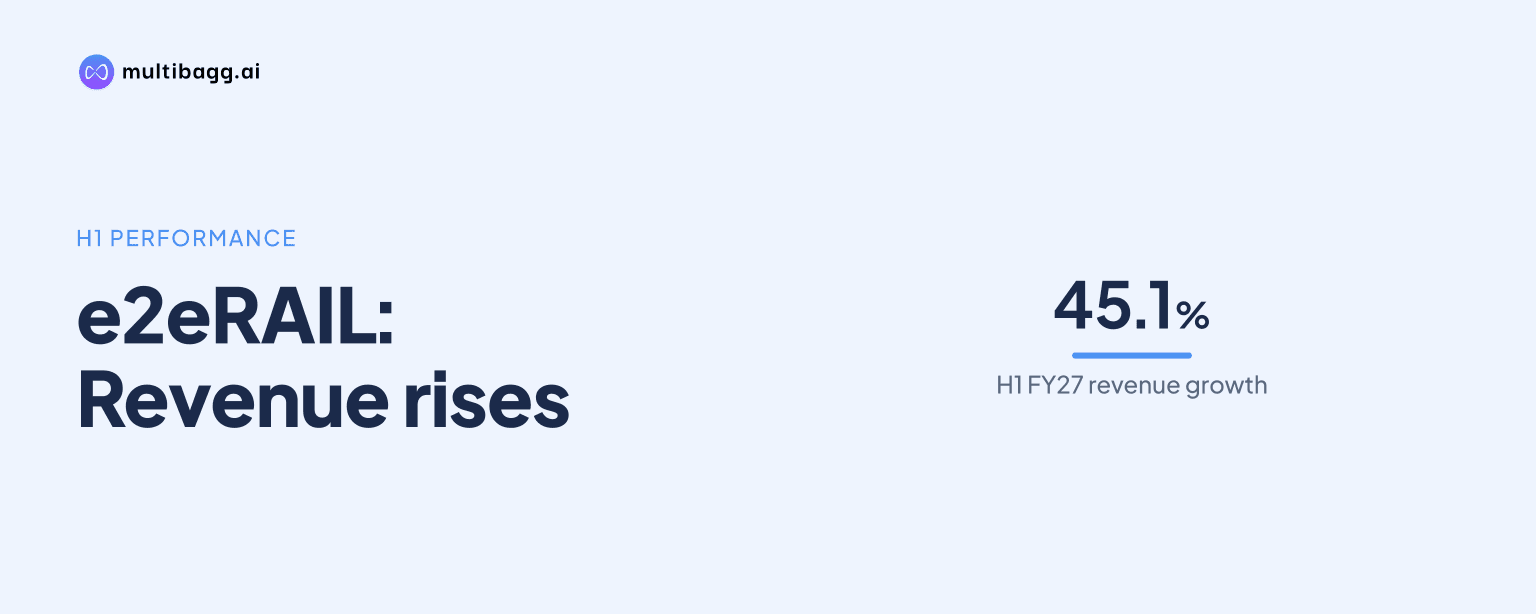
E to E Transportation Infrastructure Ltd. reported audited H1 FY27 revenue of Rs 161.11 crore, up 45.1% year on year, and EBITDA of Rs 5.09 crore against a prior-year loss, but its Rs 4.53 crore PAT loss leaves the FY27 profit outcome reliant on the historically larger H2 railway-spending period.
Know E to E Transportation Infrastructure inside out
Results, valuation, peers and who's buying, in one view.
How did e2eRAIL perform in H1 FY27?
e2eRAIL improved revenue and operating profitability in H1 FY27, although it remained loss-making after finance costs. Revenue from operations rose to Rs 161.11 crore from Rs 111.00 crore in H1 FY26, while EBITDA, or earnings before interest, tax, depreciation and amortisation, turned positive at Rs 5.09 crore from a Rs 1.46 crore loss. EBITDA margin increased by 447 basis points to 3.16% from negative 1.31%.
The improvement did not reach profit after tax, or PAT. Profit before tax was a Rs 6.39 crore loss in H1 FY27, compared with a Rs 10.17 crore loss a year earlier, and PAT narrowed to a Rs 4.53 crore loss from Rs 7.31 crore. Finance cost rose to Rs 13.80 crore from Rs 9.85 crore and exceeded earnings before interest and tax of Rs 4.36 crore in the latest first half.
The latest period also exceeded the two earlier H1 revenue levels disclosed by e2eRAIL. Revenue increased from Rs 91.87 crore in H1 FY25 to Rs 111.00 crore in H1 FY26 and Rs 161.11 crore in H1 FY27. EBITDA was negative at Rs 7.72 crore in H1 FY25 and Rs 1.46 crore in H1 FY26 before becoming positive in H1 FY27.
Why does e2eRAIL depend on H2 for profitability?
e2eRAIL depends on H2 because Indian Railways, its major client, incurs most spending towards the financial year-end, according to the presentation. H2 represented 79% of FY24 revenue, 63% of FY25 revenue and 71% of FY26 revenue. Across FY24 to FY26, the average revenue split was 29% in H1 and 71% in H2.
The timing of revenue affects earnings because staff and other fixed overheads absorbed 31% to 44% of H1 revenue, compared with 14% to 18% in H2. In FY26, H1 revenue of Rs 111.00 crore produced a Rs 1.46 crore EBITDA loss and a Rs 7.31 crore PAT loss, whereas H2 revenue of Rs 268.99 crore produced Rs 39.20 crore EBITDA and Rs 24.11 crore PAT.
FY25 showed the same broad pattern. H1 FY25 recorded Rs 91.87 crore of revenue, negative Rs 7.72 crore of EBITDA and negative Rs 9.56 crore of PAT, while H2 FY25 delivered Rs 158.94 crore of revenue, Rs 36.55 crore of EBITDA and Rs 23.74 crore of PAT. The presentation’s half-year summary lists H2 FY26 EBITDA at Rs 39.70 crore, while the detailed profit-and-loss table gives Rs 39.20 crore; both reported figures are substantially above H1 FY26.
Got a follow-up? Ask IRIS
What does e2eRAIL's FY27 outlook assume for H2?
e2eRAIL’s H2 FY27 illustration assumes a materially larger second-half contribution, but management says the figures are an extrapolation rather than guidance or a reported result. The illustration shows H2 FY27 revenue of Rs 388.90 crore, EBITDA of Rs 50.30 crore, profit before tax of Rs 39.50 crore and PAT of Rs 28.90 crore, calculated by subtracting actual H1 FY27 results from an assumed full-year outcome.
The illustration assumes approximately 45% FY27 revenue growth, following full-year growth of 47% in FY25 and 52% in FY26. It also holds FY26 full-year margins constant: 10.1% EBITDA margin, 6.0% profit-before-tax margin and 4.4% PAT margin. Management’s stated FY27 guidance is revenue growth on a similar trajectory to FY25 and FY26, with PAT margin similar to FY26, rather than a specific H2 revenue target.
The illustrated Rs 388.90 crore H2 FY27 revenue would account for 71% of the implied FY27 total, matching the FY26 and FY27E revenue mix shown in the presentation. It would be Rs 119.91 crore above the Rs 268.99 crore of H2 FY26 revenue in the detailed profit-and-loss statement. The timing of railway customer spending and project execution will therefore determine the extent to which the illustration translates into reported results.
What supports e2eRAIL's revenue visibility and margin plan?
e2eRAIL reported FY27 year-to-date order inflow of Rs 724.04 crore, including L1 positions, as of November 10, alongside an order book of about Rs 1,200 crore including goods and services tax. The company also disclosed a Rs 3,423 crore pipeline, 73 active projects across 15 railway zones and five industry sectors, and nine business-to-government projects completed in FY27. The presentation does not specify when individual orders will be recognised as revenue.
Management’s plan to reduce seasonality includes growing the business-to-business share and building NOVA multi-year product orders, including Kavach, once commercialised. e2eRAIL said its hardware was ready for automatic train protection testing and that its NOVA and TEL team had more than 100 people. It identified December 2026 or January 2027 as the expected timing for a first Kavach order.
The presentation also cites EDRC and SUTRA as in-house design capabilities intended to support margins and win rates, without disclosing separate revenue or profit contribution. Trailing 12-month revenue was Rs 430.10 crore, compared with Rs 379.99 crore in FY26, while trailing PAT was Rs 19.58 crore versus Rs 16.80 crore. The trailing measure combines H2 FY26 with H1 FY27 and therefore includes the Rs 24.11 crore PAT recorded in H2 FY26.
Conclusion
The H1 FY27 result shows operating progress, with e2eRAIL increasing revenue by 45.1%, moving EBITDA by Rs 6.55 crore into positive territory and narrowing its PAT loss by 38.0%. Yet the first-half PAT remained negative at Rs 4.53 crore, and the company’s own history shows that year-end railway spending and lower H2 fixed-cost absorption have determined the annual earnings outcome.
The next result to watch is H2 FY27 execution against management’s plan for revenue growth similar to FY25 and FY26 and PAT margin similar to FY26’s 4.42%. Management also expects a first Kavach order in December 2026 or January 2027, while its business-to-business and NOVA product plans are intended to make revenue supply phases more uniform after commercialisation.