










Emami international growth returned in October despite disruptions
Key highlights
- Emami said international business grew at a high-double-digit rate in October.
- Emami said international operations were positive in August, September and October.
- Hazardous-form OTC products unable to leave India account for roughly 2% of Emami’s global business.
- Emami said Iraq had almost zero sales in the second quarter before it identified a Port Aqaba route.
powered by IRIS
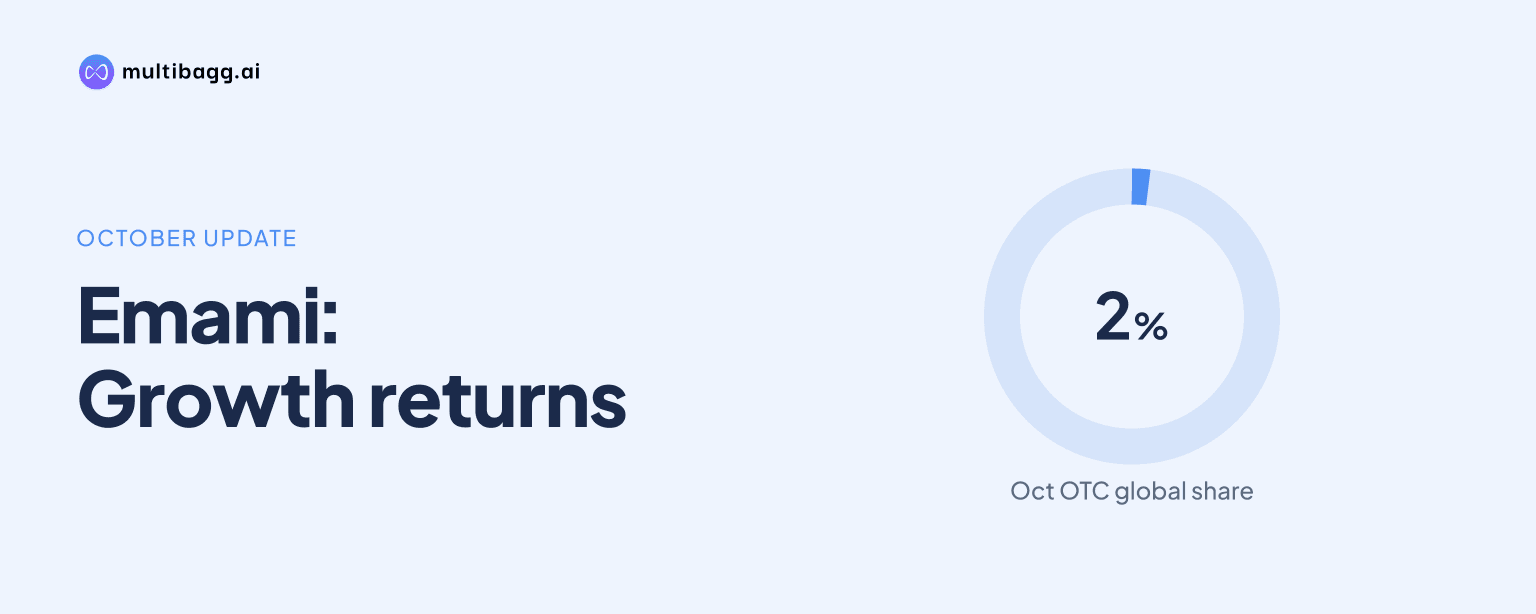
Emami Limited said its international business grew at a high-double-digit rate in October, extending positive performance from August and September despite an unresolved shipping restriction affecting hazardous-form over-the-counter products that account for about 2% of global business. The improvement followed a second quarter in which Iraq recorded almost zero sales, according to management.
Know Emami inside out
Results, valuation, peers and who's buying, in one view.
How did Emami’s international business perform in October?
Emami’s international business grew at a high-double-digit rate in October, management said, after returning to positive territory in August and September. The company therefore described three consecutive positive months through October, following a period when overseas supply-chain disruptions had weighed on reported performance.
The October result contrasts with the second quarter, when an analyst said Emami’s international business had declined by nearly 7% year on year. Management did not provide an October revenue value, country-level sales figures or a numerical full-year international-growth target. It said only that growth was now being seen in many markets and that just a couple of geographies had not managed growth.
Management’s assessment was that the worst was behind the international business, based on the October outcome and growth in almost every geography. That is management’s view rather than formal guidance, and the call did not establish whether October’s high-double-digit rate reflected a full recovery in every affected market or product category.
Which markets are supporting Emami’s overseas recovery?
Emami said it had turned around its business in Bangladesh and the Gulf Cooperation Council, or GCC, markets, while most other geographies were growing. The company also said Russia and Ukraine were growing despite describing those territories as disturbed geographies, where cross-border movement can be affected by regional conditions.
Iraq was the clearest disclosed exception during the second quarter. Management said Iraq, along with adjacent markets affected by disruption around the Hormuz region, suffered significantly in the quarter, with Iraq recording almost zero sales because Emami could not move goods into the market.
Emami said it has since found an alternative route into Iraq through Port Aqaba. Management indicated that this route had removed a limitation on moving goods to Iraq, but it did not provide a sales figure after the change, a date when normal Iraqi trading resumed, or a target for restoring the market to its earlier contribution.
The recovery is therefore not presented as a uniform improvement across all overseas operations. Bangladesh and GCC have turned around, according to management, while Iraq was dependent on a newly identified route and the business continued to face a separate product-shipping issue from India.
Why are Emami’s OTC products still unable to ship abroad?
Emami cannot currently export part of its over-the-counter, or OTC, pain-management portfolio because products in spray and gaseous forms are classified as hazardous, management said. The restriction prevents those goods from being moved out of India, rather than merely limiting their sale in one particular overseas market.
The affected OTC portfolio contributes roughly 2% of Emami’s global business, according to management. That estimate identifies the direct sales exposure disclosed on the call, although Emami did not state the revenue value of the blocked products, the countries they were intended for, or their profitability.
This hazardous-goods constraint differs from the Iraq problem. The Iraq issue concerned the movement of goods into a market affected by regional route disruption, for which Emami named Port Aqaba as an alternative. The OTC issue remains unresolved because the products’ hazardous classification continues to curtail exports from India.
Management gave no timetable for restarting OTC shipments. As a result, the positive August-to-October international trend includes a continuing constraint on about 2% of global business, and the October growth figure does not mean all of Emami’s exportable product portfolio is moving normally.
Got a follow-up? Ask IRIS
How does Emami’s manufacturing network affect international sales?
Emami said it has manufacturing in India, Bangladesh, the United Arab Emirates and Germany, as well as toll manufacturing in Thailand. Management noted that goods produced at these locations still need to move into the markets where Emami operates, making the reliability of shipping routes relevant to overseas sales.
During the second quarter, the Black Sea route serving Russia and other markets was also disrupted, management said. Russia and Ukraine nevertheless grew for Emami, but the company’s comments show that performance can vary by route, destination and the products being transported rather than moving in line across the international portfolio.
In response to an analyst’s comparison with Dabur, management said the other company had almost 11 manufacturing locations outside India and operated in markets including the United States, Africa, South Africa and Nigeria. Emami said its overlap with that peer was mainly in GCC and Bangladesh, so the logistics constraints facing the two companies were not directly comparable.
Emami also said inflation had been felt in many international markets and that it had implemented price increases and reduced schemes. The call did not quantify overseas price increases, scheme reductions or their effect on the October high-double-digit growth rate, leaving the relative contribution of pricing and volume unspecified.
What is management’s outlook for Emami’s international business?
Management said Emami was on a growth path internationally after the high-double-digit October result and the positive August-to-October run. It based that conclusion on growth in almost every geography, the turnaround in Bangladesh and GCC, and the ability to use an alternative route for Iraq.
Emami did not issue a numerical international-growth forecast for the next quarter or the full year. Its disclosed actions were operational: moving goods to Iraq through Port Aqaba, using manufacturing in India, Bangladesh, the United Arab Emirates and Germany, and relying on toll manufacturing in Thailand where relevant.
The key unresolved matter is the hazardous-form OTC portfolio, which management said represents roughly 2% of global business and cannot now leave India. A second issue is the stability of routes such as the Black Sea corridor, which management said was disturbed during the second quarter even as Russia and Ukraine delivered growth.
Conclusion
Emami’s high-double-digit October international growth indicates that the overseas decline discussed around the second quarter has eased. The change was supported by a turnaround in Bangladesh and GCC, positive trading in August and September, and an alternative route into Iraq after almost zero Iraqi sales in the second quarter.
The next marker is whether Emami can sustain positive overseas growth while rebuilding Iraq sales through Port Aqaba and resolving the hazardous-form OTC export restriction. Management disclosed no timetable for restarting those OTC shipments, which affect roughly 2% of global business, and no numerical international-growth target for the next quarter or full year.