










Emami Limited Q2 Revenue Rises 36% to ₹1,088 Crore
Key highlights
- Emami reported Q2 FY27 revenue from operations of ₹1,087.7 crore, up 36.2% year-on-year.
- Reported domestic sales rose 49% and reported domestic volume growth reached 43% in Q2 FY27.
- EBITDA increased 25% to ₹222 crore, while gross margin declined by 520 basis points.
- Profit after tax fell 2.8% to ₹144.16 crore following effective tax-rate normalisation.
powered by IRIS
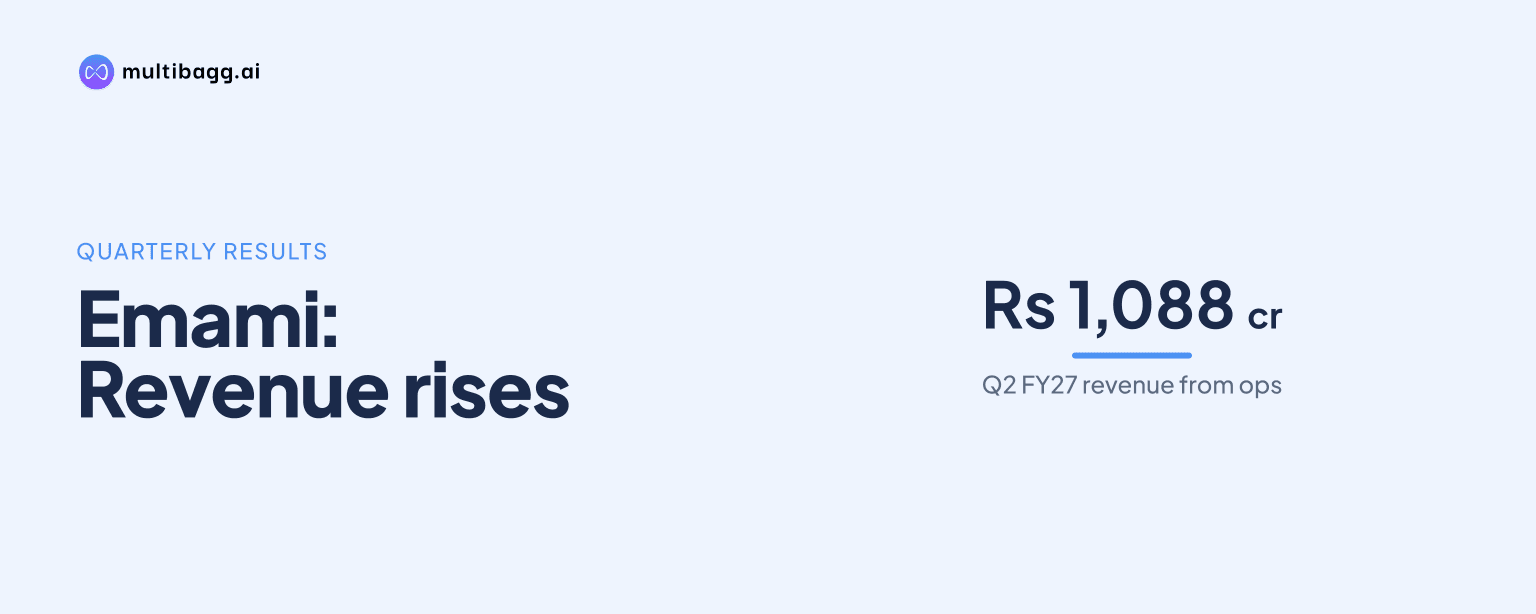
Emami Limited reported consolidated revenue from operations of ₹1,088 crore in Q2 FY27, up 36% year-on-year, led by 49% reported growth in domestic sales and 43% reported volume growth. However, higher input costs and a normalised tax rate led to a 3% decline in profit after tax to ₹144 crore.
Know Emami inside out
Results, valuation, peers and who's buying, in one view.
What did Emami report for Q2 FY27?
Emami reported strong topline growth for the quarter ended September 30, 2026, with consolidated revenue from operations rising 36.2% year-on-year to ₹1,087.7 crore. The company’s domestic business was the main driver, recording 49% reported sales growth, while reported domestic volume growth stood at 43%.
On a like-for-like basis, consolidated revenue increased 24%, indicating that the company’s underlying business also expanded after excluding the effect of acquired businesses. Domestic sales rose 32% on a like-for-like basis and volume increased 26%. The quarterly performance showed broad-based demand across Emami’s core categories as well as contributions from its strategic investment portfolio.
EBITDA rose 25% year-on-year to ₹222 crore and profit before tax increased 29% to ₹194 crore. Yet consolidated profit after tax attributable to owners of the company declined 2.8% year-on-year to ₹144.16 crore. The decline was linked primarily to the normalisation of the effective tax rate after fiscal benefits related to the company’s Assam manufacturing facility were phased out.
Which businesses supported Emami’s domestic growth?
Emami’s domestic growth was supported by its core personal-care categories and strategic investments. Skincare sales grew 31%, hair and scalp care expanded 30%, and the 7 Oils in One brand nearly doubled its sales during the quarter, according to the earnings-call highlights.
The strategic investments portfolio grew 73% on a like-for-like basis and accounted for about 26% of domestic business. Axiom and Brillare each more than doubled sales. This portfolio contribution is relevant because it adds to reported growth while also changing the product mix of the domestic business.
Chief Growth Officer Dhruv Vajerwal said the portfolio would exceed ₹800 crore during the year and could approach ₹1,000 crore to ₹1,100 crore at the current run rate. This was management commentary reported in the earnings-call material, rather than a figure included in the investor-meet filing.
The company held its Q2 FY27 investor meeting after announcing unaudited standalone and consolidated results. Its exchange-related disclosure said shareholders could access an audio recording through the investor portal, but did not itself provide financial figures or forward guidance.
Why did Emami’s margin and profit after tax fall?
Emami’s gross margin declined by 520 basis points because of raw-material inflation and a changing mix following the integration of acquired businesses. Vice Chairman Mohan Goenka said roughly 400 basis points of the impact came from raw-material costs, with the remaining impact linked to the business mix.
This cost pressure did not prevent EBITDA from increasing in absolute terms, as revenue growth outpaced the effect of lower gross margins. But the pace of EBITDA growth, at 25%, was below revenue growth of 36%, reflecting the margin compression during the quarter.
Profit after tax faced a separate tax-related effect. Emami said the effective tax rate normalised after fiscal benefits for its Assam manufacturing facility were phased out. Consequently, the company reported higher profit before tax but lower profit after tax compared with the year-earlier quarter.
For investors, the distinction is important. Operating earnings remained higher year-on-year, while the reported net-profit decline reflected both input-cost pressure and the tax-rate change. The supplied material does not disclose a Q2 FY27 share-price movement, so no direct market-price reaction can be assessed from this information.
Got a follow-up? Ask IRIS
What happened in Emami’s international business?
Emami’s international business declined 2% in Q2 FY27, affected by floods in Nepal and supply-chain challenges in Gulf markets. The company said international operations returned to growth in October, with high double-digit growth, and management indicated that the worst disruption was behind it.
The overseas business has exposure to markets that can face operational disruption, including Russia, Ukraine and Iraq. International Business CEO Vivek Deer noted that Emami has manufacturing locations in India, Bangladesh, the UAE and Germany, along with toll manufacturing in Thailand.
The movement of over-the-counter pain-management goods, including sprays and aerosols classified as hazardous, also remained curtailed from India. These products account for about 2% of the global business, based on the earnings-call highlights.
International sales therefore remained a drag on quarterly growth relative to the domestic business. October’s improvement provides a more recent operational data point, but the material does not provide a separate international revenue target or a quantified full-year outlook.
What is Emami’s outlook for the second half of FY27?
Emami’s management said business momentum was continuing and guided for 18% to 20% growth in the second half of FY27. The guidance follows a quarter in which reported domestic sales rose 49%, supported by organic demand and the inclusion of acquired businesses.
The second-half outlook will be viewed alongside the company’s ability to manage raw-material costs, which reduced gross margin by 520 basis points in Q2. It will also depend on whether the international business sustains the growth reported for October after disruptions in Nepal and Gulf markets.
The quarter highlights a mixed earnings picture for the FMCG company. Revenue, volumes and EBITDA increased, and core categories performed well. At the same time, the lower net profit shows how tax changes and cost inflation can affect shareholder earnings even when consumer demand remains strong.
Conclusion
Emami delivered 36% revenue growth to ₹1,088 crore in Q2 FY27, with domestic sales, volumes, core brands and strategic investments supporting the expansion. EBITDA and profit before tax also rose, but raw-material inflation, acquisition-related mix effects and a normalised tax rate reduced gross margin and led to a 3% fall in profit after tax.
Investors will next watch Emami’s stated 18% to 20% second-half FY27 growth expectation, the trajectory of input costs, and whether the international business maintains the high double-digit growth management reported for October. The scale-up of the strategic investments portfolio will also remain relevant after it contributed about 26% of domestic business in the quarter.