










Emami Limited targets 18%-20% total growth in second half
Key highlights
- Emami expects total-business growth of 18%-20% in the second half of FY27.
- Emami reported H1 FY27 revenue of Rs 2,127 crore, up 25% year on year.
- Q2 EBITDA rose 25% to Rs 222 crore despite a 520-basis-point gross-margin decline.
- Organised channels contributed 37% of domestic business, while quick commerce accounted for about 15% of digital sales.
powered by IRIS
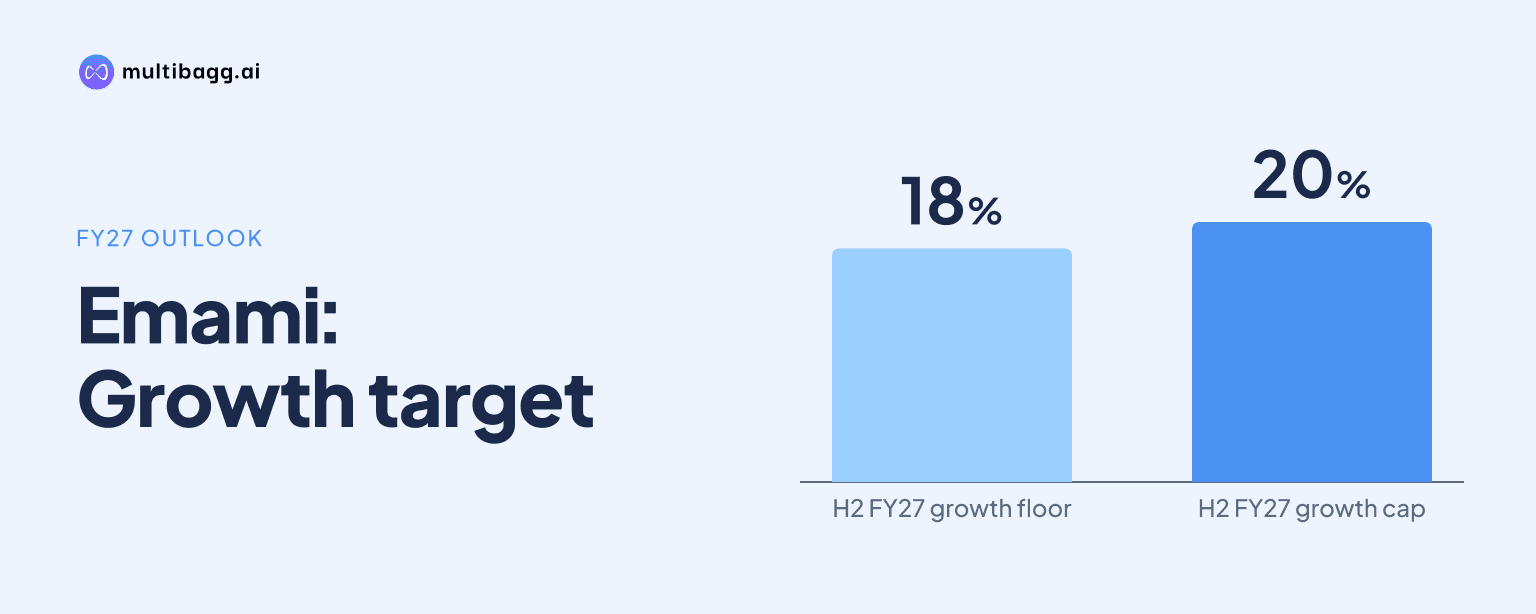
Emami Limited expects total-business growth of 18%-20% in the second half of financial year 2027 (FY27), after first-half revenue rose 25% year on year to Rs 2,127 crore. Management said core-brand momentum was continuing, although the first half was influenced by a low base, goods and services tax (GST)-related channel effects and changes in festive timing.
Know Emami inside out
Results, valuation, peers and who's buying, in one view.
What growth is Emami targeting in the second half of FY27?
Emami is targeting 18%-20% growth for its total business in the second half of FY27. Mohan Goenka gave the outlook in response to a question on the core portfolio and clarified that it covered “everything put together,” rather than only the core business.
The target follows first-half FY27 revenue of Rs 2,127 crore, up 25% year on year. Earnings before interest, tax, depreciation and amortisation (EBITDA) rose 15% to Rs 449 crore, while profit before tax increased 15% to Rs 388 crore, showing that profit growth trailed revenue growth during a period of higher costs.
An analyst noted that the first half included a comparatively low prior-year base associated with GST-related issues, inventory upstocking and destocking, and a shift in festive timing. Emami did not quantify each effect, so the 18%-20% second-half expectation remains management’s outlook rather than a target tied to disclosed monthly sales milestones.
What is driving Emami’s second-half growth outlook?
Emami’s outlook is based on core-brand momentum and channel expansion, with organised channels contributing 37% of domestic business. Modern trade and e-commerce maintained momentum, while quick commerce accounted for about 15% of digital sales, according to management.
The company is using these channels for new launches. The BoroPlus baby-care range is being introduced through e-commerce and modern trade at prices management said are 25%-50% below other products in the market, depending on the product. Management estimated the baby-care market at Rs 30,000 crore to Rs 40,000 crore and said it would test the range in the market.
Kesh King Scalp First is positioned differently, with prices of about Rs 500 to Rs 1,000. Management said the premium range includes detoxifying scalp and scalp-serum products, will rely heavily on research and development, and will use ingredient-focused communication on e-commerce and quick-commerce platforms.
Emami is also expanding Brillare, The Man Company, Axiom and IncNut through separate plans. Management said the strategic-investment portfolio was up 12% versus the first quarter, while The Man Company grew more than 30% in the second quarter after reformulation and marketing measures. It cautioned that growth of about 70% would probably not continue indefinitely.
How are commodity costs and advertising spending affecting Emami?
Emami’s gross margin fell 520 basis points year on year in the second quarter, with about 400 basis points caused by raw-material costs and the balance by business mix. A basis point is one-hundredth of a percentage point. Management also cited the integration of an acquired business as a factor raising cost of goods sold.
Despite the gross-margin decline, second-quarter EBITDA rose 25% to Rs 222 crore and profit before tax increased 29% to Rs 194 crore. Profit after tax was Rs 144 crore, down 3%, which management attributed mainly to normalisation of the effective tax rate after fiscal benefits were phased out.
Management said it had taken price increases of about 5.5% for the full year and passed cost increases to consumers. On advertising and promotion spending, it told an analyst to assume a range of 18%-19% at most for the full year, while saying that top-line growth remained the immediate focus.
Higher-cost inventory has already been procured for the second half, according to management. It therefore expects input-cost corrections to benefit the next financial year rather than the current second half, leaving the 18%-20% growth target exposed to commodity costs even if revenue momentum continues.
Got a follow-up? Ask IRIS
How do rural demand and overseas operations affect Emami’s target?
Emami described rural demand as mixed, with weaker performance in parts of southern and western India affected by low rainfall and drought-like conditions, as well as in some districts of Uttar Pradesh. Management said districts with good rainfall performed well and expected demand to pick up after Diwali during the winter peak season.
International revenue declined 2% in the second quarter, but international business grew 6% after excluding Nepal and Iraq. Nepal was affected by severe floods, while Gulf markets faced supply-chain disruption linked to regional conflict, making the overseas result uneven across geographies.
Management said international sales were positive at a high-double-digit rate in October and had also turned positive in August and September. It said Bangladesh and the Gulf Cooperation Council had improved, although it did not disclose sales values or a formal international growth target.
Restrictions on exports of certain over-the-counter pain-management products remain unresolved because spray and gaseous products are treated as hazardous. Management said the affected products represent roughly 2% of Emami’s global business, although it has found an alternate route to Iraq through Port Aqaba.
What other plans could support Emami’s execution?
Emami said it is digitising processes from forecasting through fulfilment, including supply chain, invoicing and distributor-led frontline booking. Management said the data analytics and artificial-intelligence programme was progressing ahead of plan and had produced results in pilot markets.
Management expects to complete the transition in the next quarter and said it should begin seeing “real gains” from April. The company did not quantify expected savings, sales benefits or a margin effect, so the financial contribution of the programme remains undisclosed.
Conclusion
Emami’s second-half target of 18%-20% growth combines first-half revenue growth of 25% to Rs 2,127 crore with expanding organised-channel participation of 37% of domestic business. The cost trade-off remains clear: second-quarter EBITDA rose 25% to Rs 222 crore, but gross margin declined 520 basis points as raw-material costs and business mix changed.
The next points to watch are the expected post-Diwali winter-season demand pickup, the continuity of international growth after October’s high-double-digit increase, and the unresolved export restrictions affecting roughly 2% of global business. Management also expects its technology transition to be completed next quarter, with gains expected from April.