










Emami says 400 basis points of margin decline came from inputs
Key highlights
- Emami said raw-material inflation caused 400 basis points of its 520-basis-point Q2 FY27 gross-margin decline.
- Emami reported Q2 FY27 revenue of Rs 1,088 crore, up 36%, and EBITDA of Rs 222 crore, up 25%.
- Emami said price increases were about 5.5% for the full year, while higher-cost procurement will affect the second half.
- Emami’s strategic-investment portfolio grew 73% like for like and contributed about 26% of domestic business.
powered by IRIS
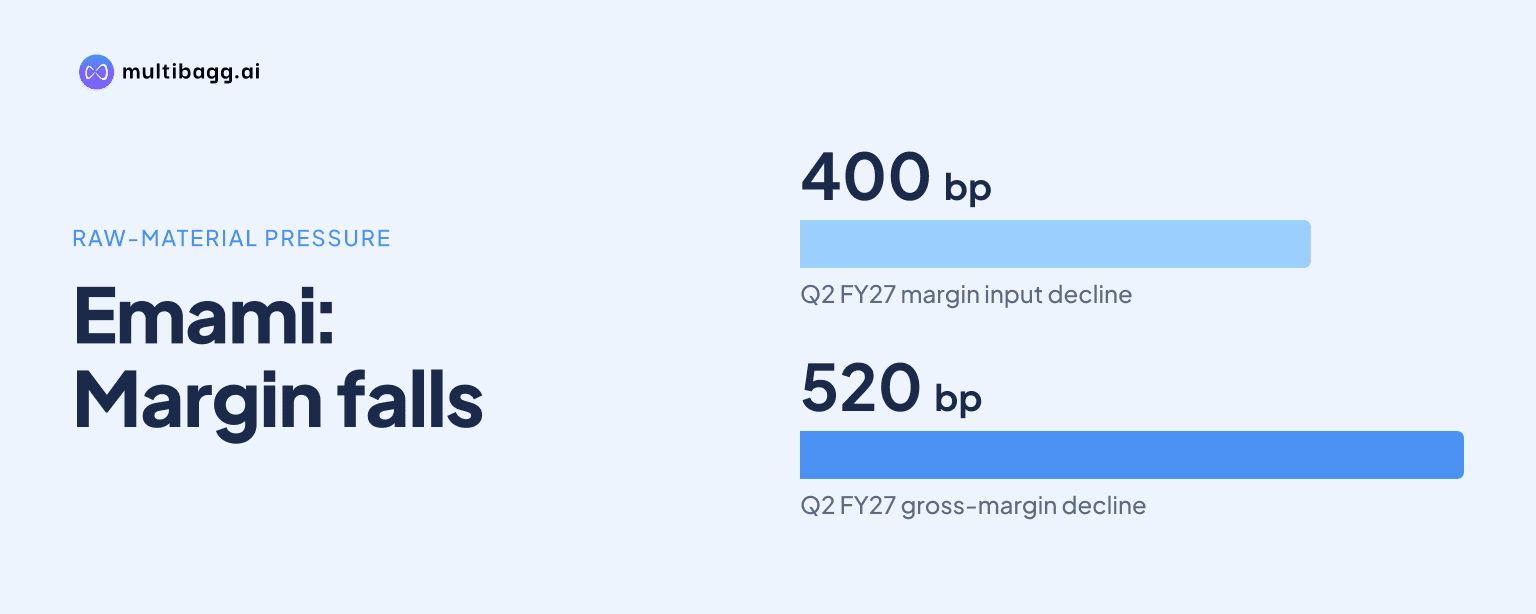
Emami Limited said raw-material inflation caused 400 basis points of its 520-basis-point year-on-year gross-margin decline in Q2 FY27, while the changed business mix following acquired-business integration accounted for the remaining 120 basis points. Management expects input-cost corrections to benefit the following year after higher-cost procurement affects the second half.
Know Emami inside out
Results, valuation, peers and who's buying, in one view.
What caused Emami’s gross-margin decline in Q2 FY27?
Emami said higher raw-material costs were the principal cause of the Q2 FY27 gross-margin decline: 400 basis points, or about 77% of the total 520-basis-point reduction from the year-earlier quarter. Management attributed the remaining 120 basis points to the changed mix after integrating the acquired business, which it said increased cost of goods sold, or COGS.
The 120-basis-point mix effect is the balance after management’s stated 400-basis-point raw-material impact from the overall 520-basis-point decline. This split separates the effect of commodity costs from the effect of sales composition, as Emami expands acquired and digital-first businesses alongside its established personal-care and healthcare portfolio.
How did margin pressure compare with Emami’s revenue and profit growth?
Emami’s Q2 FY27 consolidated revenue rose 36% year on year to Rs 1,088 crore, while earnings before interest, tax, depreciation and amortisation, or EBITDA, increased 25% to Rs 222 crore. The slower EBITDA growth relative to revenue coincided with higher COGS and the 520-basis-point gross-margin moderation disclosed by management.
Domestic sales grew 49%, supported by 43% volume growth, although management said the like-for-like comparison including prior-period revenue of Axiom and IncNut Digital was lower. On that basis, consolidated sales rose 24%, domestic business grew 32%, and domestic volume increased 26%, showing that acquisitions affected the reported growth comparison as well as the business mix cited in the margin explanation.
Profit before tax rose 29% to Rs 194 crore in Q2 FY27, but profit after tax declined 3% to Rs 144 crore. Management attributed the profit-after-tax movement largely to normalisation of the effective tax rate after fiscal benefits were phased out; for the first half of FY27, revenue was Rs 2,127 crore and EBITDA was Rs 449 crore.
Can pricing and input-cost corrections improve Emami’s margin outlook?
Emami said it had taken price increases of about 5.5% for the full year and had passed cost increases on to consumers. That pricing action addresses part of the commodity-cost pressure, but management said the second half of FY27 would carry higher costs because the company had already procured inputs at elevated prices.
Management said it expects to benefit from input-cost corrections in the following year, rather than presenting an immediate Q2 FY27 margin-recovery target. The statement is conditional on those corrections occurring: Emami did not specify which raw materials would decline, the timing of lower-cost purchases, or a projected gross-margin level for the following year.
Advertising and promotion, or A&P, spending is another variable in the profitability outlook. Management said Emami is in spending mode to grow revenue and indicated full-year A&P spending in a range of 18% to 19% of sales at most, while noting it was not focused on changes of 0.5% or 1% where growth opportunities justified expenditure.
Got a follow-up? Ask IRIS
How is Emami’s changing portfolio influencing the margin discussion?
Emami said strategic investments contributed about 26% of domestic business in Q2 FY27 and grew 73% on a like-for-like basis. Axiom and Brillare more than doubled sales, IncNut grew by over 50%, and The Man Company grew by over 30%, increasing the relevance of these businesses to the domestic sales mix management identified as a 120-basis-point margin factor.
The core portfolio also recorded growth across categories in Q2 FY27: skincare rose 31%, hair and scalp care increased 30%, and healthcare grew 11%. Within those categories, talc sales more than doubled, Navratna Oil rose in the 30% range, and 7 Oils in One nearly doubled, meaning the quarter’s sales expansion came from multiple products rather than strategic investments alone.
Channel changes add another dimension to that mix. Organised channels represented 37% of domestic business, and QuickCom accounted for about 15% of digital sales in Q2 FY27. Emami is expanding Axiom through modern trade and QuickCom and moving IncNut beyond direct-to-consumer sales into marketplaces, QuickCom and new international markets.
What should readers watch in Emami’s second half of FY27?
Emami expects total business growth of 18% to 20% in the second half of FY27, according to management’s response on the call. That outlook follows first-half revenue growth of 25% to Rs 2,127 crore, but it comes alongside the company’s warning that second-half input costs will be higher because of purchases already made at elevated prices.
International operations are another item to monitor. International revenue declined 2% in Q2 FY27, though Emami said business excluding Nepal and Iraq grew 6%; management cited severe floods in Nepal and supply-chain difficulties linked to regional conflict in Gulf markets. It also said October international business recorded high-double-digit growth, while hazardous over-the-counter pain-management goods representing roughly 2% of global business remained unable to move out of India.
Conclusion
Emami paired 36% Q2 FY27 revenue growth to Rs 1,088 crore with 25% EBITDA growth to Rs 222 crore despite higher COGS. The result shows that broad-based domestic sales growth and strategic-investment expansion continued, while commodity inflation and the acquired-business mix reduced the share of revenue retained as gross profit.
The next results should show whether Emami’s 5.5% full-year price increases and planned 18% to 19% A&P-to-sales range support its 18% to 20% second-half growth expectation. Readers should also watch management’s expectation that input-cost corrections could help in the following year, along with progress in restoring international supply routes and the unresolved movement restrictions on hazardous OTC products.