










Indian stock market rises on Rs 21,607 crore FII buying
Key highlights
- FIIs bought Rs 21,607.38 crore of Indian shares on the last reported trading day, while DIIs sold Rs 20,105.05 crore.
- The Nifty closed at a two-month high of 23,961 and the Sensex ended at 77,301 after five straight gains.
- DIIs bought a net Rs 62,220 crore in October, roughly 138% of the stated FII outflow.
- Domestic institutions hold about 19% of the market, compared with roughly 14% for foreign investors.
powered by IRIS
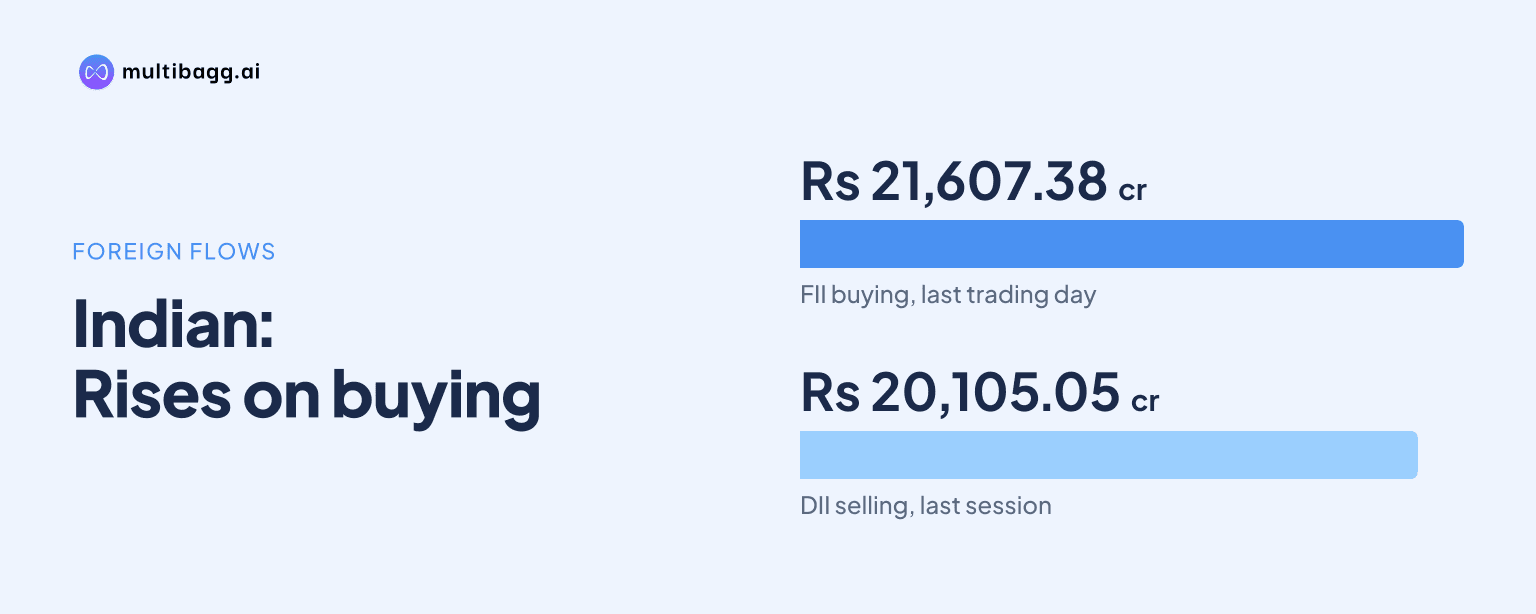
Indian stock market rose to a two-month Nifty high of 23,961 after foreign institutional investors bought Rs 21,607.38 crore of shares on the last trading day, outweighing domestic institutional investors' Rs 20,105.05 crore of selling and extending a five-session advance.
Why did the Indian market rise despite DII selling?
The Indian market rose because foreign institutional investor buying was larger than domestic institutional investor selling on the reported trading day. FIIs purchased Rs 21,607.38 crore of equities, while DIIs sold Rs 20,105.05 crore, leaving a net institutional buying difference based on those two flow figures.
The benchmark move coincided with five consecutive sessions of gains. The Nifty closed at 23,961, a two-month high, while the Sensex finished at 77,301. Reliance Industries and HDFC Bank led the advance alongside stronger FMCG stocks, while Alembic Pharmaceuticals was cited for a sharp move after solid results.
A single day of institutional flows does not by itself determine market direction. However, a large imbalance between foreign demand and domestic selling can provide immediate support to prices and liquidity, particularly when broader sentiment is improving.
How did recent FII and DII flows compare?
Recent flow data show a shift from an extended period of foreign selling to selective foreign buying, while domestic institutions have remained an important source of demand. FIIs were reported to have bought more than Rs 20,000 crore over four trading days leading up to November 4, after previously being net sellers for 10 weeks.
Earlier in October, FIIs sold Rs 30,294 crore during an eighth consecutive week of net selling. DIIs bought Rs 30,313 crore in the same week, effectively absorbing that selling. In another reported period, FIIs ended a 10-week selling run with net purchases of Rs 6,305 crore, while DIIs logged an eleventh straight week of net buying, though their purchases slowed to Rs 3,110 crore.
The figures show why the Indian market can hold up even during periods of overseas withdrawals. Domestic flows have frequently matched or exceeded foreign sales, reducing the immediate effect of supply hitting the market.
Can domestic institutions cushion foreign selling?
Yes, domestic institutional buying can cushion foreign selling when the scale of domestic purchases is sufficient to absorb the shares offered by overseas investors. DIIs include mutual funds, insurance companies, pension funds and corporate treasuries, and their consistent purchases have been identified as a key support for the Indian market in 2026.
DIIs bought a net Rs 62,220 crore in October, roughly 138% of the stated FII outflow, according to the discussion. They have purchased about Rs 7 lakh crore so far in 2026, compared with FII net sales of about Rs 4.5 lakh crore. This buying has helped limit sharp index declines that comparable foreign outflows may have caused in earlier cycles.
The cushion is not absolute. Prolonged and aggressive foreign sales can still pressure individual sectors and stocks, even if headline indices remain resilient. A run of five to 10 days of flows is generally more relevant for sentiment than a single day's buying or selling figure.
Got a follow-up? Ask IRIS
What does the ownership shift mean for the Indian market?
The ownership shift means the Indian market has a larger domestic institutional base than in the past, which can make it less directly dependent on foreign flows. Domestic institutions now hold about 19% of the market, compared with roughly 14% for foreign investors, based on the provided data.
That ownership balance does not make FII activity irrelevant. Foreign investors remain a large pool of capital, and changes in global risk appetite, interest-rate expectations and crude oil prices can affect their allocations to Indian equities. The recent FII buying was linked to improving risk sentiment after the US Federal Reserve left interest rates unchanged.
The broader backdrop remains mixed. Earnings are described as beating expectations and valuations as less stretched, but Brent crude above $110 a barrel has clouded the macro outlook. The next market move may depend on whether oil prices ease, inflation stays contained and earnings improvement spreads beyond a limited group of cyclical sectors.
How should retail investors read FII and DII data?
Retail investors should treat FII and DII data as an indicator of institutional positioning and liquidity, not as a stand-alone buy or sell signal. Heavy buying can raise demand for securities, while heavy selling can put pressure on prices, but earnings, valuations, economic developments and global markets also shape returns.
When FIIs buy and DIIs sell, as on the reported trading day, the relative size of transactions matters. When FIIs sell and DIIs buy, domestic demand can absorb the supply and keep the broader market steadier. Neither pattern guarantees the direction of the Nifty, Bank Nifty or a particular stock.
The current rebound also included a 2% weekly gain in the Nifty to 23,053.10 in an earlier reported week. The Nifty Midcap 100 rose 2.7% and the Nifty Smallcap 100 gained 4% in that period, indicating that improving risk appetite extended beyond the benchmark indices.
Conclusion
The latest FII buying gave the Indian market a clear near-term demand boost, with foreign purchases of Rs 21,607.38 crore exceeding DII sales of Rs 20,105.05 crore on the reported day. More importantly, the broader 2026 flow pattern shows that domestic institutions have absorbed a substantial part of foreign selling, supported by their larger 19% market ownership share.
Investors will now watch whether foreign buying persists after the recent reversal from a 10-week selling streak. Crude oil, inflation, global event risk and the breadth of the earnings recovery remain the disclosed factors that could determine whether the market's advance extends or loses momentum.