










GNFC Limited faces fiercer TDI competition after Wanhua
Key highlights
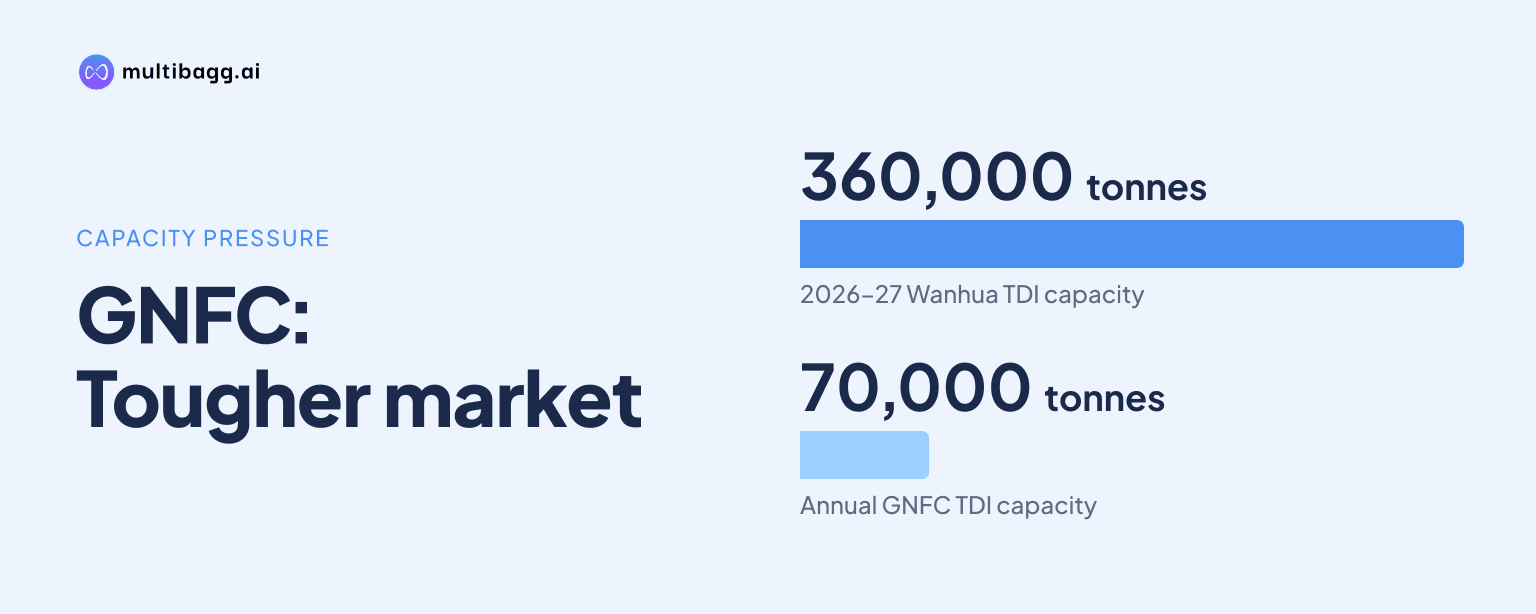
- Wanhua commissioned a new 360,000-tonne TDI plant in 2026-27, according to GNFC management.
- GNFC described India as a 120,000-tonne TDI market growing at 8% to 9% annually.
- GNFC has 70,000 tonnes of annual TDI capacity and produced 8,700 tonnes in Q2 FY27.
- GNFC reported an average Q2 FY27 TDI price of about Rs 2.85 lakh, with Rs 3.10 lakh in the last week of September.
powered by IRIS
GNFC Limited faces greater TDI competition after Wanhua commissioned a 360,000-tonne new plant, but management said on November 3, 2026 that India remains a 120,000-tonne market growing at an 8% to 9% annual rate and that GNFC has no plan to close its Bharuch plant.
Know Gujarat Narmada Valley Fertilizers & Chemicals inside out
Results, valuation, peers and who's buying, in one view.
How much new TDI capacity did Wanhua commission?
Wanhua commissioned a new 360,000-tonne TDI plant in 2026-27, according to GNFC management. GNFC said the addition had increased Wanhua’s capacity and acknowledged that Chinese imports had created “fierce competition” in the Indian TDI market.
GNFC did not disclose Wanhua’s earlier capacity, the commissioning date within 2026-27, or the volume of TDI imported into India. It also did not quantify the price effect from the 360,000-tonne plant, so the transcript supports added competitive supply but not a measured impact on GNFC’s sales, margins or market share.
Can GNFC's Indian TDI market absorb more imports?
GNFC said India is a 120,000-tonne TDI market, compared with its own production capacity of 70,000 tonnes a year. Management’s point was that imports remain necessary to serve the market even if GNFC operated at its stated annual capacity, although it did not provide its current utilisation rate or domestic market share.
Management estimated Indian TDI market growth at about 8% to 9% annually and said TDI is used to manufacture foam. GNFC said all major foam manufacturers are connected with it, but it did not identify customers or disclose customer-level revenue, volumes, contract terms or concentration percentages.
The comparison between the 120,000-tonne market and GNFC’s 70,000-tonne capacity frames the competitive issue as one of import pricing and supply availability rather than the removal of imports. The new 360,000-tonne Wanhua plant is three times larger than the Indian market figure cited by management, but GNFC did not state how much of that capacity would be directed to India.
Will GNFC shut its Bharuch TDI plant?
GNFC has no plan to shut its Bharuch plant, management said in response to a question on plant viability. The company said Bharuch had been cost competitive against its Dahej plant, although the two plants’ costs were moving closer after the start of its captive coal-based power plant.
Management did not disclose the cash-cost difference between Bharuch and Dahej. It said relative competitiveness can change with coal and gas prices, and that Dahej can at times become more attractive on cost than Bharuch. That leaves the operating choice dependent on input-cost dynamics rather than a disclosed permanent advantage for either site.
The captive plant began generating steam on July 25 and started supporting power requirements around August. GNFC said it was already taking the steam benefit, but it was using grid power as the main source because high coal prices made grid power cheaper at the time; the captive plant remained a fallback for power.
Management said the captive plant’s guaranteed test run would occur during the then-current quarter, after which it would operate at full scale. It added that steam could generally be supplied at the full rate, subject to interruptions, making the test run a near-term operational event relevant to the cost relationship between Bharuch and Dahej.
Got a follow-up? Ask IRIS
What did Q2 FY27 show about GNFC's TDI operations and prices?
GNFC produced 8,700 tonnes of TDI in Q2 FY27, and management agreed with an analyst that the figure was lower quarter on quarter. The transcript does not provide the Q1 FY27 TDI production figure, so the size of the sequential decline cannot be calculated from the disclosed information.
The company said both TDI plants were operating at the time of the call, but output had been affected in July for 30 to 35 days. Management attributed the interruption to a cash-loss situation, saying the same viability issue also affected acetic acid and ethyl acetate production before those operations resumed normally.
For pricing, GNFC gave a Q2 average TDI price of about Rs 2.85 lakh and said the price in the last week of September reached Rs 3.10 lakh, described as the September peak. The company did not provide the exact September 30 price, nor did it disclose TDI realisation, which management distinguished from the marketed price.
Other chemical pricing showed a period-to-period change. Management said average acetic acid pricing rose from Rs 62,600 in Q1 FY27 to Rs 72,840 in Q2 FY27, while it cited a price of about Rs 65,000 in another response. For weak nitric acid, it clarified that Rs 28,500 referred to a 100% basis price rather than realised revenue after discounts.
Conclusion
GNFC is navigating more intense TDI import competition following Wanhua’s 360,000-tonne capacity commissioning, while management cited a 120,000-tonne Indian market and 8% to 9% annual growth to support demand. Its Q2 FY27 TDI output of 8,700 tonnes was reduced by a 30-to-35-day July viability interruption, showing that competitiveness was also shaped by internal operating economics.
The next item to watch is GNFC management’s planned guaranteed test run of the captive coal-based plant during the current quarter, because steam savings are already being captured while power economics still favour the grid at prevailing coal prices. Investors can also watch whether TDI pricing holds around the Rs 3.10 lakh September peak and how coal and gas prices alter the cost comparison between the Bharuch and Dahej plants.