










GNFC Q2 margins pressured by chemicals, coal and wages
Key highlights
- GNFC said Q2 FY27 one-time items had a net impact of about Rs 75 crore.
- Employee-benefit expense varied by Rs 33 crore quarter on quarter due to wage-settlement provisions.
- GNFC confirmed a Rs 61 crore benefit from the revised energy norm in Q2 FY27.
- The captive coal-based plant started generating steam on July 25, 2026.
powered by IRIS
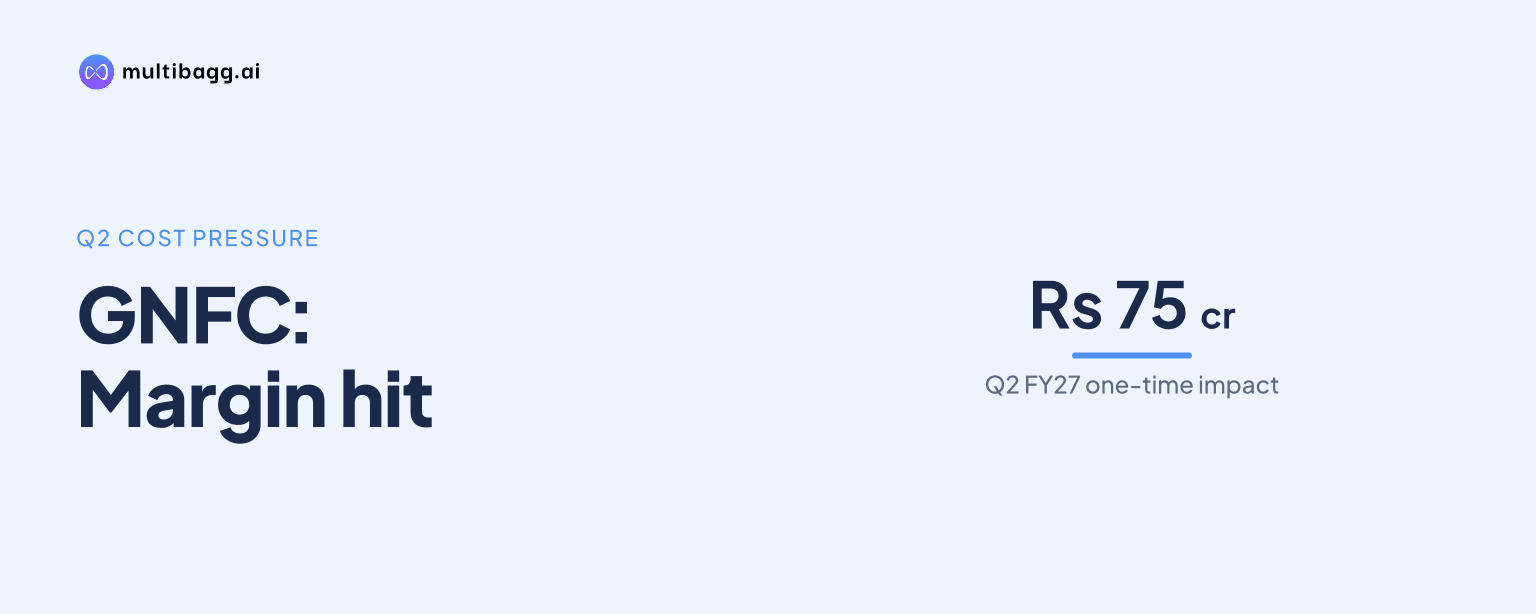
Gujarat Narmada Valley Fertilizers & Chemicals Limited said Q2 FY27 margins were pressured by weaker realisations in technical-grade urea, ammonium nitrate melt and weak nitric acid, higher coal costs and wage provisions, while management estimated that one-time items had a net impact of about Rs 75 crore.
Know Gujarat Narmada Valley Fertilizers & Chemicals inside out
Results, valuation, peers and who's buying, in one view.
Why did GNFC's Q2 FY27 margins decline?
GNFC said sequential Q2 FY27 margin pressure came mainly from lower finished-product margins, higher coal-related fuel costs and provisions tied to a wage settlement effective July 1. Management described year-on-year performance as significantly better, with sales volumes generally improving, but said the quarter-on-quarter comparison reflected a different combination of pricing and cost factors.
Management did not attribute the change to a broad increase in gas or oil prices. Chief Financial Officer D.V. Parikh said gas prices had not changed much quarter on quarter, while oil prices also had not changed much during Q2 FY27. Coal prices, however, raised fuel costs, and lower chemical realisations added to the profitability impact.
An analyst referred to a sequential operating-profit decline of about Rs 200 crore, but GNFC did not confirm or break down that figure. Instead, management identified the three drivers it considered predominant: substantial realisation pressure in weak nitric acid, technical-grade urea and ammonium nitrate melt; coal costs; and employee-benefit provisions associated with the wage settlement.
Which chemical products faced price-realisation pressure at GNFC?
GNFC said weak nitric acid, technical-grade urea and ammonium nitrate melt faced substantial realisation pressure in Q2 FY27. In its opening remarks, management said the Chemicals segment's margin pressure came from these product realisations, whereas the Fertilizer segment's operating result relatively improved through volumes and better energy norms.
GNFC said spread information in its investor presentation reflects only one key input and does not capture every production cost. For toluene diisocyanate, the displayed spread is measured against toluene, but management said other inputs also affect the product's economics. This was its explanation for why headline product spreads may not fully indicate the quarter's margin outcome.
For ammonium nitrate melt, GNFC attributed price erosion to competitive forces rather than one identifiable market event. Management said most of its chemicals are priced on import parity because many are imported into India, while some products also face domestic competition. It did not attribute the Q2 FY27 erosion to a specific crude-price movement or shipment pattern.
How much did wage provisions and one-time items affect GNFC?
GNFC said the wage-related provision produced a Rs 33 crore quarter-on-quarter variance in employee-benefit cost in Q2 FY27. The provision followed four years since the prior settlement and applied from July 1. Management clarified that the item related to a long-term wage settlement, not to a long-term customer or supply contract.
Management said certain employee-benefit accruals would continue because the wage-settlement process takes time to settle. Therefore, GNFC did not present the entire wage impact as fully non-recurring. It said that, by and large, other one-time items would not continue in the same way, except for wage-related accruals.
GNFC estimated the net impact of one-time items at about Rs 75 crore in Q2 FY27. Management said the items included energy norms, freight claims and the wage settlement, and that the effect was across the business rather than solely within Chemicals. It therefore rejected an analyst's suggestion that the entire amount should be added only to Chemicals segment profit.
Got a follow-up? Ask IRIS
What changed between GNFC's Q1 and Q2 FY27 results?
GNFC said the change from Q1 FY27 to Q2 FY27 was driven by lower chemical realisations, coal costs and the new wage provisions, rather than a material move in gas or oil prices. Oil prices were overall lower than in Q1 FY27, according to management, but coal was the energy input that raised fuel cost during Q2.
The Fertilizer segment had a different set of drivers. GNFC confirmed that a revised energy norm created a positive financial impact of about Rs 61 crore in Q2 FY27. Management said the norm changed from 6.20 to 6.37, leading to a revision in the urea concession rate.
GNFC said the revised concession was recorded as subsidy in the profit and loss account and as a subsidy receivable on the balance sheet. This timing also mattered for working capital in H1 FY27: management said subsidy receivables rose because energy prices related to the previous period while concession rates were tied to those periods.
What did GNFC disclose about operations and cost actions after Q2?
GNFC said its captive coal-based plant began generating steam on July 25, 2026, and began catering to power requirements around August. At the November 3, 2026 earnings call, management said the company was taking the steam benefit but using grid power as its main power source because high coal prices made grid power relatively cheaper.
Management said the captive plant's guaranteed test run would occur during the quarter following the November 3 call, after which it would operate at full scale. Steam could already be supplied at the full rate except for certain interruptions, according to GNFC, while power sourcing would remain responsive to relative coal and grid-power costs.
GNFC reported H1 FY27 capital expenditure of about Rs 500 crore and said ongoing projects were broadly on execution schedule despite geopolitical effects. Management also said it was pursuing sourcing and gas-sourcing initiatives to optimise costs, but noted that war-related conditions and market variables remained outside its control.
Conclusion
GNFC's Q2 FY27 explanation identifies a specific mix of pressures rather than a single energy-price shock. Price erosion in weak nitric acid, technical-grade urea and ammonium nitrate melt coincided with higher coal costs and a Rs 33 crore employee-benefit variance, while the Fertilizer segment received a Rs 61 crore benefit from the revised energy norm.
The next disclosed milestone is the captive coal-based plant's guaranteed test run during the quarter after the November 3, 2026 call. Investors can also watch the pace of wage-related accruals, import-parity competition in chemicals, coal and grid-power economics, and the timing of subsidy receivables that increased working capital in H1 FY27.