










Go Digit reports 9.6% equity mix, no 12.5% target
Key highlights
- Go Digit reported a 9.6% equity mix, about three times its IPO-level exposure.
- Go Digit's book-value AUM rose 15.9% to Rs 24,371 crore.
- Go Digit reported about Rs 148 crore of unrealised gains in equities during Q2.
- Go Digit's fixed-income duration was 4.8 in September and 4.9 in October.
powered by IRIS
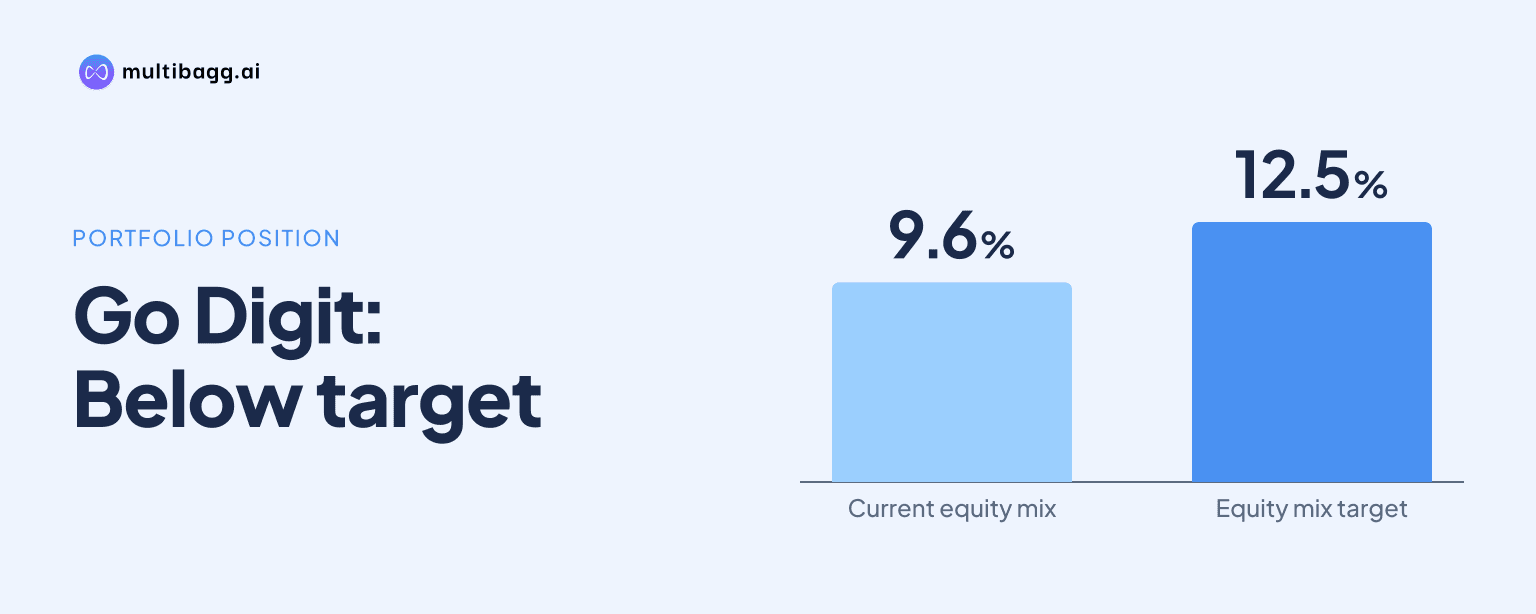
Go Digit reported that equities were 9.6% of its investment mix in the September 2026 quarter, about three times the IPO-level proportion, but the supplied call did not disclose a 12.5% target or any separate real estate investment trust and infrastructure investment trust allocation. Book-value assets under management reached Rs 24,371 crore.
Know Go Digit General Insurance inside out
Results, valuation, peers and who's buying, in one view.
What did Go Digit disclose about its equity allocation?
Go Digit disclosed a 9.6% equity mix in the September 2026 quarter, which management said was about three times the level at its initial public offering. Management also said the equity portfolio had about Rs 148 crore of unrealised capital gains during a volatile quarter for equity markets and interest rates.
The call does not disclose that Go Digit has raised a combined target for equities, real estate investment trusts, or infrastructure investment trusts to 12.5%. It also gives no individual portfolio weight for real estate investment trusts or infrastructure investment trusts. The disclosed investment figure is 9.6% for equities, while management described adding equities when markets fall rather than setting a numerical future allocation target.
Management said that, at market levels prevailing when it spoke, the approximately Rs 148 crore of unrealised equity gains would have been about double. That observation concerns unrealised gains, not realised investment income. Go Digit said its approach since inception has been to focus on core insurance profitability rather than depend on realised capital gains.
How has Go Digit managed its fixed-income portfolio?
Go Digit reported fixed-income duration of 4.8 in September and 4.9 in October, compared with 4.5 in March 2026 and 5.2 in March 2025. Duration measures the sensitivity of a debt portfolio to changes in interest rates, and management said it could take duration back to 5.2 depending on its interest-rate view.
The movement from 4.5 in March 2026 to 4.9 in October represents a 0.4 increase in duration, although it remained below the 5.2 recorded in March 2025. Management linked the position to its assessment of interest rates and said the fixed-income portfolio had been managed consistently over the preceding seven to eight years.
For the April-to-October period, Go Digit said its reinvestment yield was 7.8% in the June quarter, 7.7% in September and about 8% in October. It reported an overall yield of roughly 7.4%, including a small capital-gains contribution. The call did not state the market value or percentage weight of the fixed-income portfolio, so its exact share of assets cannot be calculated from the transcript.
Got a follow-up? Ask IRIS
How do AUM and insurance retention support Go Digit's investments?
Go Digit's book-value assets under management, or AUM, rose 15.9% to Rs 24,371 crore, while premium retention increased to 84.3% from 79.1%. Management said higher retention is a core strategy because retaining more premium contributes to a larger investment pool.
Long-term advance premium was Rs 3,556 crore at September 30, 2026, compared with Rs 3,209 crore in March 2026. The Rs 347 crore increase occurred while Go Digit chose not to renew some government health and inward health reinsurance business, which management said had unattractive pricing.
Investment accounting also shaped reported quarterly earnings. Go Digit recorded Rs 171 crore of insurance-finance expense in Q2 because claims are measured at present value under Indian Accounting Standards. Management said the expense offsets investment income, meaning the benefit from discounting claims should not be viewed separately from the related finance charge.
Mark-to-market losses were Rs 88 crore in Q2, compared with Rs 94 crore in the prior-year Q2. Profit after tax excluding mark-to-market movements was Rs 208 crore, down from Rs 277 crore a year earlier, while profit excluding flood losses was Rs 255 crore against Rs 285 crore. Management compared the Rs 255 crore figure with Rs 239 crore in Q1 excluding mark-to-market movements, indicating sequential growth on that basis.
What underwriting conditions could affect Go Digit's investment pool?
Go Digit reported Q2 net flood losses of Rs 63 crore, compared with Rs 10 crore in the prior-year Q2, increasing losses by Rs 53 crore. Its combined insurance service ratio, or CISR, was 99.8%, versus 94.9% a year earlier; excluding flood losses, the Q2 CISR was 97.4%.
Management said it continues to choose profitability over growth and is not positioning the business around a motor third-party price increase, court interpretations or capital-market outcomes. That stance matters to AUM because insurance underwriting, retained premiums and claims experience influence the funds available for investment.
Motor market share was 5.68% in Q2, up from 5.58% in Q1, and own-damage market share rose to 4.99% from 4.76%. In private-car own damage, the attritional loss ratio improved to 81.1% in Q2 from 85.3% in Q1, although the reported Q2 loss ratio was 93% after flood effects. Management attributed the attritional improvement to actions begun in February and intensified in April and May.
Premium trends remained selective. Gross direct premium income declined 1.2% while industry gross written premium increased 7%, and Go Digit's gross written premium declined 3.6%. Management said its gross written premium would have been broadly flat after excluding inward health reinsurance and government health business that it did not renew.
Conclusion
Go Digit's disclosed allocation change is a 9.6% equity mix, about three times its IPO-level proportion, alongside fixed-income duration of 4.8 in September and an overall investment yield of roughly 7.4%. The supplied call supports management's description of measured equity additions during market declines, but it does not support a disclosed 12.5% target or a stated allocation to real estate investment trusts and infrastructure investment trusts.
The next disclosed markers are Q3 premium trends after the October-November festival season, the private-car own-damage loss-ratio trajectory and any final expense-management guidelines. Management said it had not modelled the discussion paper on expense management and commissions, while retaining the stated ability to move fixed-income duration toward 5.2 depending on interest-rate conditions.