










Go Digit says 80% health and PA mix has repricing scope
Key highlights
- Go Digit estimates employer-employee cover is about 80% of its health and PA portfolio.
- Go Digit estimates retail business is roughly 6% of its health and PA portfolio.
- Management said industry employer-employee group-health loss ratios exceed 100%, versus 65% to 75% for retail health.
- Management said a 5% rise in group-health pricing could support substantially more business growth.
powered by IRIS
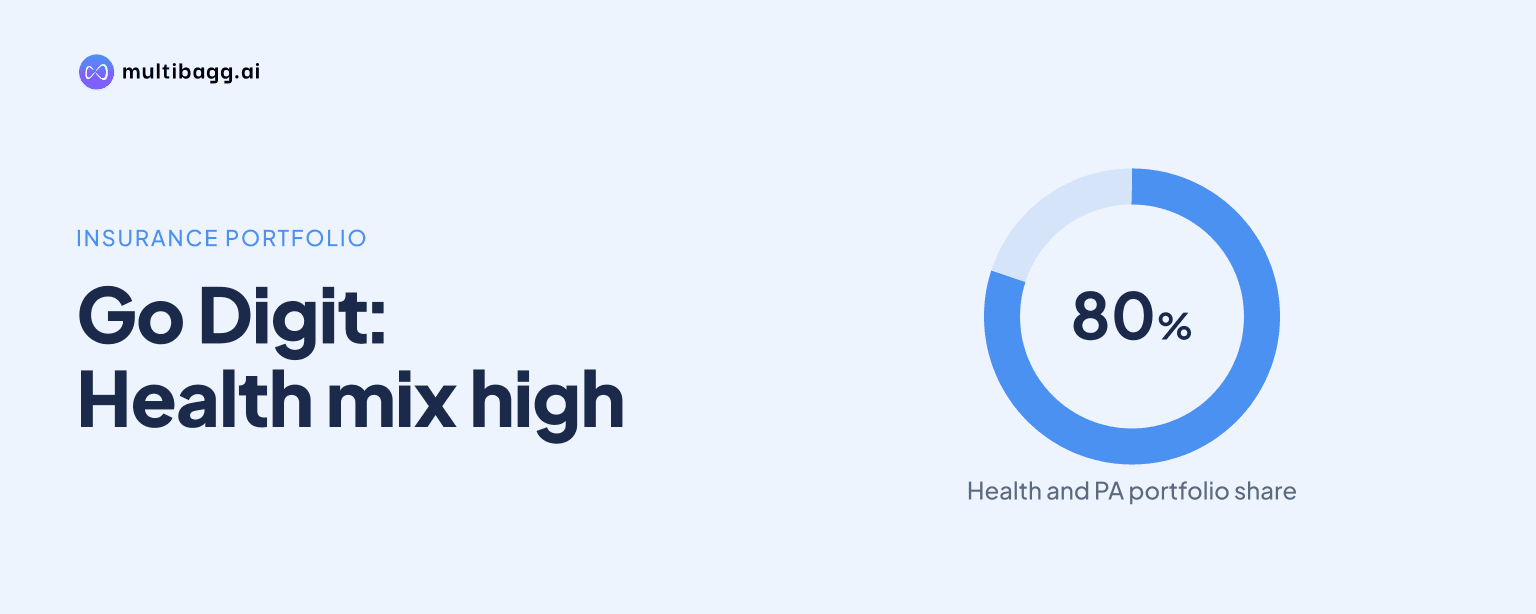
Go Digit General Insurance Limited said employer-employee policies represented about 80% of its health and personal accident, or PA, portfolio in the first half, and management said a 5% increase in group-health pricing could create an opportunity to grow that business substantially more. Management stressed that the portfolio split was an approximate estimate.
Know Go Digit General Insurance inside out
Results, valuation, peers and who's buying, in one view.
What share of Go Digit’s health and PA portfolio is employer-employee cover?
Go Digit estimated that employer-employee cover accounted for about 80% of its health and PA portfolio, while retail business represented about 6%. Management said the remaining share comprised non-employer-employee health and PA business, but it did not have the exact first-half mix available during the call.
The 80% employer-employee estimate makes corporate group business far larger than retail within the stated health and PA mix. Based on management's approximate figures, employer-employee business was more than 13 times the retail share, although management said both figures were recalled from memory rather than presented as an exact disclosure.
An analyst asked whether the improved Indian Accounting Standards, or Ind AS, loss ratio for health, travel and PA in the second quarter and first half was mainly due to employer-employee business. Management replied that group-health loss ratios were more or less similar to previous levels, rather than attributing the broader health, travel and PA trend to a material improvement in group-health claims experience.
Why does Go Digit see a need for group-health repricing?
Go Digit said pricing discipline is needed because management believes employer-employee group-health loss ratios exceed 100% across the industry. Management contrasted this with retail-health loss ratios of 65% to 75%, indicating that claims alone exceed premium in the group employer-employee segment before operating expenses where the loss ratio is above 100%.
Management said the current structure results in retail customers subsidising corporate customers. This was management's assessment based on the industry loss-ratio ranges cited on the call, not a quantified transfer between retail and corporate policyholders. The contrast is material to Go Digit because retail represented only about 6% of its health and PA portfolio, against about 80% for employer-employee cover.
Go Digit connected the issue to the Expense of Management, or EoM, framework. Management said some insurers write employer-employee group health partly to manage EoM, and suggested that a reduction in the EoM weight assigned to this business, potentially to one-third, could improve market pricing. It compared this mechanism with crop insurance, another line management said can be written to manage EoM.
Management did not state that an EoM revision would occur or give a regulatory timetable. It referred to an ongoing debate and a discussion paper that had raised complaints concerning retail health, saying changes may emerge. Whether the EoM treatment changes enough to affect group-health pricing therefore remains unresolved.
Got a follow-up? Ask IRIS
How is Go Digit seeking to improve group-health economics?
Go Digit is building fraud-control and hospital-management capabilities alongside seeking improved pricing. Management said its fraud engines were improving every month and that the company was negotiating and discussing memoranda of understanding, or MoUs, with more hospitals to improve cost efficiency.
These initiatives are aimed at claims leakage and treatment costs, but Go Digit did not quantify savings from fraud controls or hospital MoUs. Management also did not disclose a numerical loss ratio for its employer-employee health book during this exchange, instead saying group-health loss ratios were broadly similar to earlier levels.
Management said a 5% increase in group-health pricing would give Go Digit an opportunity to grow the business substantially more. This was a conditional management view, not a premium-growth target or forecast, and no date was provided for such a price movement.
The proposed 5% pricing increase is directed at the segment that management estimates forms about 80% of the health and PA portfolio. Go Digit's approach therefore combines an external factor, including possible EoM-related market discipline, with internal measures such as fraud engines and hospital MoUs.
What does the 80% mix mean for Go Digit’s health growth?
Go Digit's disclosed health-growth opportunity is closely linked to employer-employee cover because the segment represented about 80% of its health and PA portfolio. Management's 5% pricing illustration indicates that price adequacy is the stated constraint on expanding this business, rather than a disclosed shortage of distribution capacity.
The retail comparison illustrates the portfolio's exposure to corporate group economics. Management cited industry retail-health loss ratios of 65% to 75%, compared with loss ratios above 100% for employer-employee group health, while retail accounted for only about 6% of Go Digit's health and PA mix.
Management did not claim that current group-health profitability had already improved. Its statement that group-health loss ratios were broadly stable differs from the analyst's observation that Ind AS loss ratios had improved for the wider health, travel and PA portfolio in the second quarter and first half. The broader portfolio measure includes multiple lines, while management discussed group health separately.
The disclosed measures to track are the approximate 80% employer-employee share, the roughly 6% retail share and the 5% price increase management cited. Go Digit did not provide an exact first-half composition, a group-health premium-growth target or a date for a possible EoM change.
Conclusion
Go Digit's health and PA strategy is concentrated in employer-employee cover, which management estimated at about 80% of the portfolio. Management sees a material gap between industry group-health loss ratios above 100% and retail-health loss ratios of 65% to 75%, and it identified higher prices, fraud controls and hospital arrangements as ways to address that difference.
The next developments to watch are any EoM change affecting employer-employee health, movement in group-health pricing toward the 5% increase management cited, and a future disclosure of the exact portfolio split. Management also said fraud engines were improving monthly and hospital MoU discussions were continuing, leaving claims-cost execution as a parallel issue to any repricing.