










Go Digit General Insurance Limited finds TP, group health onerous
Key highlights
- Go Digit identified motor third-party and group health as sources of onerous contracts.
- Discounting affects Go Digit motor TP outstanding liabilities plus IBNR by close to 20% overall.
- Go Digit used September discount rates of 6.2% to 6.6% for liabilities up to one year and about 7.5% beyond eight years.
- Management cited Rs 171 crore for Q2 as discounting’s countervailing investment-income effect.
powered by IRIS
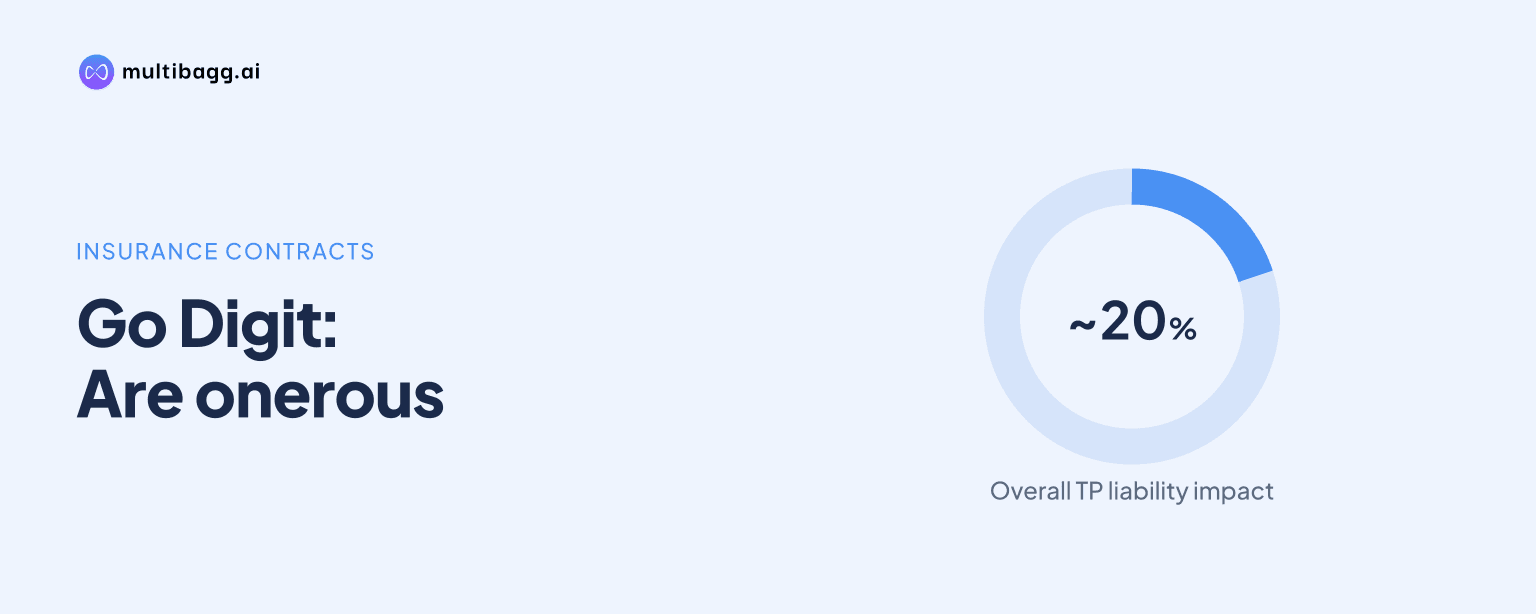
Go Digit General Insurance Limited said in its Q2 earnings call that motor third-party and group health contracts are onerous under Indian Accounting Standards, while discounting affects motor third-party outstanding liabilities plus incurred-but-not-reported claims by close to 20% overall.
Know Go Digit General Insurance inside out
Results, valuation, peers and who's buying, in one view.
Which Go Digit contracts are onerous under Ind AS?
Go Digit identified motor third-party, or motor TP, and group health as the sources of its onerous contracts. Kamesh Goyal gave the answer after an analyst asked whether the classification was concentrated in group health, government health, motor own-damage or another product line.
The disclosure identifies two pressure points rather than the whole portfolio. Go Digit did not disclose an onerous-contract amount, a split between motor TP and group health, or a profitability measure for either line. It also did not say whether motor own-damage and motor TP are assessed together or separately.
Go Digit said it had worked with auditors to make its testing fairly granular across lines of business. The call did not specify the level below those lines, such as vehicle category, accident year, distribution channel or individual group-health arrangement, and it provided no reserve or reversal figure for the identified cohorts.
How does Go Digit test onerous contracts under Ind AS?
Go Digit said its onerous-contract testing is performed at a fairly granular line-of-business level with auditor involvement. Motor TP and group health were the disclosed outputs of that process, but the company did not describe a numerical threshold or the cash-flow assumptions used to classify a contract group as onerous.
Management said it would be willing to follow an industry reporting standard for onerous contracts if analysts and investors developed one alongside other insurers. That statement was not a commitment to publish a specific new table, financial amount or metric in the next quarterly results.
The company placed the disclosure within the broader transition to the Indian accounting system, which management said the industry would move to from 1 April '27. Go Digit intends to explain its accounting approach in greater detail at its annual analyst meet in February, rather than providing further contract-level data on the call.
How does discounting affect Go Digit motor TP liabilities?
Go Digit applies discounting across all lines of business, but management said the effect is larger in motor TP because its claims are longer term. Adarsh Agarwal estimated the impact on motor TP outstanding liabilities plus incurred but not reported claims, or IBNR, at close to 20% overall, varying by reporting period and accident year.
Go Digit uses the risk-free yield curve at each quarter-end and adds an illiquidity premium equal to 25% of the difference between that curve and the AAA-rated corporate-bond yield curve. Management described this as an approximation suggested by International Financial Reporting Standards and Ind AS guidance, rather than a direct match to returns on individual assets.
Go Digit said the Q1 and Q2 discount curves were not significantly different, limiting the effect of curve movement between those quarters. Management also said that a change in the spread between government-bond and AAA corporate-bond yields would change the illiquidity premium, affecting the discounting result.
Got a follow-up? Ask IRIS
What does discounting mean for Go Digit reported results?
Go Digit said discounting does not simply improve its reported loss ratio because it also reduces investment income through investment expense. Goyal cited Rs 171 crore for Q2 as the countervailing investment-income effect, without giving a line-by-line reconciliation during the call.
An analyst referred to motor TP loss ratios of 44.3% for the first half and 45% for Q2, and asked for figures excluding discounting. Go Digit declined to provide a second set of ratios, saying multiple versions could confuse users, but said it may consider comparable disclosures after Q1 results in July if peers report them.
Go Digit said quarterly claims triangles will be published under the new accounting system. Management said those triangles should allow investors to track motor TP claims development and liability movement as discount rates change, particularly because motor TP has a longer settlement pattern than other insurance lines.
Which figures put Go Digit’s disclosure in context?
Go Digit said the accounting change affects the timing of profit recognition rather than the underlying economics of cash flows. Management cited a five-year reinsurance portfolio as an example: reinsurance commission can be booked upfront under Indian Generally Accepted Accounting Principles, while the new Indian accounting system would defer that commission.
For broader comparison, Goyal said Go Digit’s combined ratio was 97.34% last year and about 97.04% in Q1 under International Financial Reporting Standard 17 reporting. He also said the company remained below 100% in a quarter significantly affected by Gujarat flood claims, although those aggregate ratios do not quantify the motor TP or group-health onerous assessments.
Management separately attributed a higher expense ratio to an increasing share of two-wheeler business, where commissions are higher than in other lines. Go Digit did not link that explanation to group health, motor TP onerous contracts or the close to 20% discounting effect on motor TP liabilities.
Conclusion
Go Digit has given a specific indication of where its onerous-contract testing identifies pressure, naming motor TP and group health rather than the portfolio as a whole. The motor TP finding also carries a material present-value element, as discounting affects its outstanding liabilities and IBNR by close to 20% while reducing reported investment income.
The next disclosures to watch are Go Digit’s planned February analyst-meet discussion of the Indian accounting system and the quarterly motor TP claims triangles. Management also said it could consider additional comparable ratio reporting after Q1 results in July if other insurers publish similar measures, while the industry transition is scheduled from 1 April '27.