










Go Digit sees an IDBI bancassurance route if deal closes
Key highlights
- Go Digit said an IDBI Bank corporate-agency relationship would depend on Fairfax’s proposed transaction with the Government of India closing.
- Go Digit reported a roughly 3-4% quarter-on-quarter reduction in private-car motor OD attritional loss ratio in quarter two.
- Management estimated employer-employee business at about 80% of Go Digit’s health and personal-accident portfolio, with retail at about 6%.
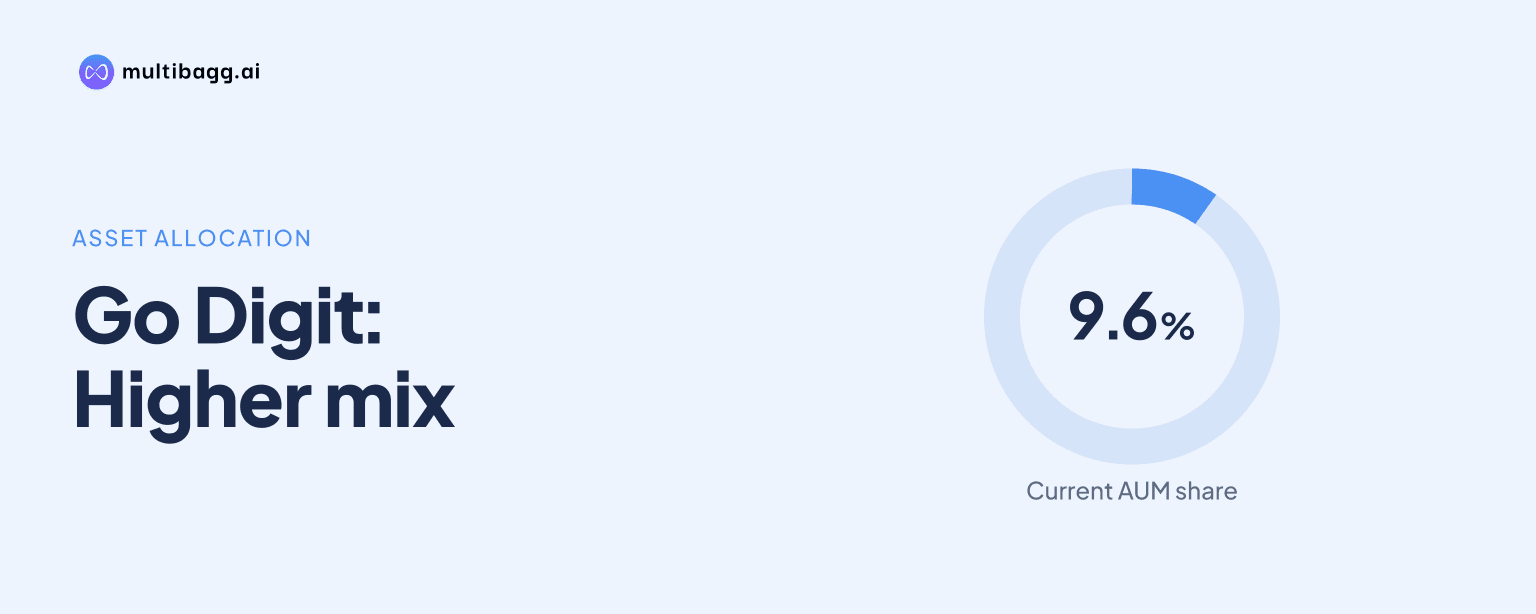
- Go Digit said equity, REITs and InvITs were 9.6% of assets under management on a book-value basis, versus roughly 3.4% to 3.5% 2.5 years earlier.
powered by IRIS
Go Digit General Insurance Limited said an IDBI Bank corporate-agency relationship could add a large-bank bancassurance channel if Fairfax’s proposed transaction with the Government of India closes, while Go Digit reported a roughly 3-4% quarter-on-quarter reduction in private-car motor own-damage attritional loss ratio in quarter two.
Know Go Digit General Insurance inside out
Results, valuation, peers and who's buying, in one view.
What did Go Digit say about IDBI Bank?
Go Digit said an IDBI Bank relationship is a potential distribution opportunity, not an agreed insurance arrangement. Management said the transaction is between Fairfax and the Government of India, that Go Digit is not privy to its status or expected closing date, and that it has no information beyond Fairfax’s public announcement.
Management said Fairfax’s release stated that Fairfax intends to sell its shareholding in Go Digit to IDBI Bank. Go Digit did not disclose the stake size, a transaction timetable, regulatory approvals or a signed distribution contract. The insurer said a bancassurance opportunity would arise only if the transaction closes and IDBI Bank becomes its corporate agent.
How could IDBI Bank change Go Digit’s distribution?
Go Digit said IDBI Bank becoming its corporate agent could provide a large-bank channel within its group, which it currently lacks. Go Digit already works with large private banks, recently started with large public-sector banks, and partners with non-banking financial companies, or NBFCs, for insurance distribution.
Management said bancassurance is typically more profitable than other channels in life, general and health insurance. That was management’s assessment of channel economics rather than a profit forecast for an IDBI Bank arrangement. The mechanism described was a corporate-agency relationship through which a bank could offer Go Digit’s general-insurance products to its customer base.
Go Digit did not identify policies that IDBI Bank could distribute, including whether motor, health, fire or commercial products would be included. The call also disclosed no premium target, policy count, commission structure, market-share goal or launch date. The stated opportunity is therefore access to a channel rather than a quantified revenue plan.
What must happen before Go Digit can pursue this opportunity?
Go Digit said the first condition is the closing of Fairfax’s transaction with the Government of India, an event outside the insurer’s control. Management said it did not know the transaction’s current stage or when it could be completed, limiting what it could say about any subsequent agency relationship.
The second condition is IDBI Bank becoming Go Digit’s corporate agent after the transaction. Management said Go Digit would be happy to try to develop a bancassurance relationship in that scenario, rather than saying the bank had committed to distribute its products. A shareholding transfer, by itself, would not establish product placement, sales volumes or insurance distribution.
The call gave no schedule for integrating a bank channel and no estimate of the related acquisition expense. In a separate discussion, management said employee-linked acquisition expenses would not be expected to exceed 1.5% of premium overall, but it did not connect that estimate to IDBI Bank. The disclosure supports the strategic rationale but not a financial projection.
Got a follow-up? Ask IRIS
What operating trends did Go Digit report alongside the update?
Go Digit said private-car motor own-damage, or OD, attritional loss ratio declined by roughly 3-4% quarter on quarter in quarter two. Management said its motor OD issue was limited to private cars, while two-wheelers had no comparable problem and commercial vehicles, or CVs, had remained consistent.
Management said underwriting actions taken in April and May should improve the loss ratio on business written after those changes. Because premium is earned month by month, Go Digit said the improved underwriting mix should affect results progressively as post-April business forms a larger share of earned premium. Management did not provide forward guidance on the extent of that improvement.
In health and personal accident, management estimated from memory that employer-employee business represented about 80% of the portfolio, retail about 6%, and non-employer-employee group business the remainder. Management said industry employer-employee group-health loss ratios exceed 100%, compared with retail-health loss ratios of 65% to 75%, highlighting the differing economics across product segments.
How is Go Digit addressing underwriting and portfolio mix?
Go Digit said it is improving group-health capabilities through fraud engines that are becoming better each month and discussions for memorandums of understanding with more hospitals. Management said these hospital arrangements are intended to improve cost efficiency, while better fraud controls are part of the claims-management mechanism.
Management said a 5% increase in group-health pricing would create an opportunity to grow that business more. It also argued that employer-employee group-health pricing could improve if the weight assigned to this business under expenses of management, or EoM, were reduced to one-third. Those are management’s views on the factors that could alter group-health growth and underwriting economics.
Go Digit separately said equity, real estate investment trusts, or REITs, and infrastructure investment trusts, or InvITs, accounted for 9.6% of assets under management on a book-value basis. That was up from roughly 3.4% to 3.5% over 2.5 years. Management said it was looking to move to 12.5% of assets under management in equity, including REITs, based on its capital-allocation model rather than the potential IDBI Bank outcome.
Conclusion
Go Digit presented IDBI Bank as a conditional route to a large-bank bancassurance channel, not as a completed partnership. The potential fits alongside existing private-bank, public-sector-bank and NBFC relationships, while the roughly 3-4% quarter-on-quarter decline in private-car OD attritional loss ratio shows management’s simultaneous focus on underwriting actions taken in April and May.
The next issue to watch is whether Fairfax’s proposed transaction with the Government of India closes and whether IDBI Bank subsequently becomes Go Digit’s corporate agent. Management disclosed no completion date, product plan or premium objective for that possibility. It also said the mix of private-car business written after April and May should increasingly influence earned-premium results in coming quarters.