










Go Digit flood losses lift Q2 service ratio to 99.8%
Key highlights
- Go Digit reported about Rs 63 crore of net flood losses in Q2 FY2027, versus Rs 10 crore in Q2 FY2026.
- Go Digit’s Q2 FY2027 CISR was 99.8%, or 97.4% excluding flood losses.
- Go Digit’s Q2 FY2027 gross earned loss ratios were 59.0% in fire, 62.4% in engineering and 25.7% in liability.
- Go Digit’s private-car own-damage attritional loss ratio fell to 81.1% in Q2 FY2027 from 85.3% in Q1 FY2027.
powered by IRIS
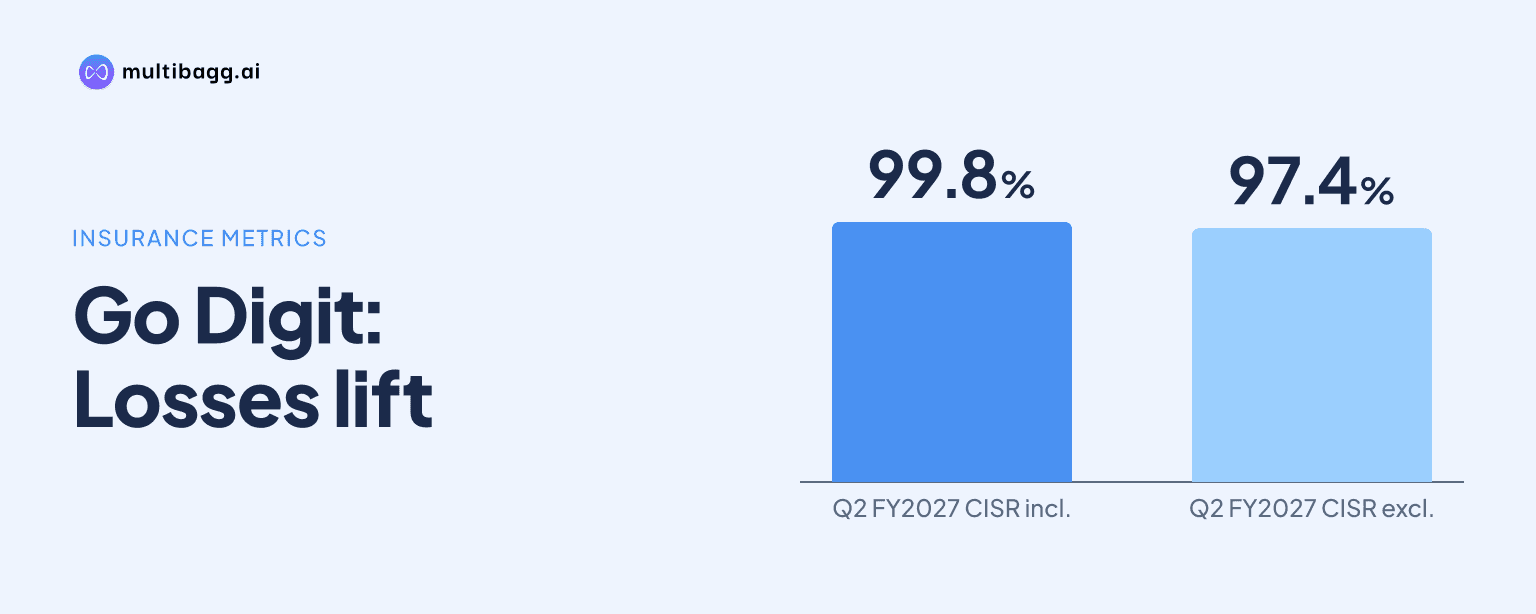
In Q2 FY2027, Go Digit General Insurance Limited recorded about Rs 63 crore of net Gujarat flood losses, which took its combined insurance-service ratio (CISR) to 99.8%, from 94.9% a year earlier. Excluding floods, the CISR was 97.4%, while management said profit after tax before mark-to-market movements would have been Rs 255 crore.
Know Go Digit General Insurance inside out
Results, valuation, peers and who's buying, in one view.
How much did Go Digit lose in the Gujarat floods?
Go Digit reported about Rs 63 crore of net flood losses in Q2 FY2027, compared with about Rs 10 crore in Q2 FY2026, an increase of Rs 53 crore. Management also cited a smaller Northeast event as contributing to higher claims costs, but identified the Gujarat floods as the principal disclosed catastrophe loss in the quarter.
The Rs 63 crore figure is net of reinsurance rather than the gross claims amount. Go Digit said profit after tax excluding mark-to-market movements was Rs 208 crore in Q2 FY2027, compared with Rs 277 crore a year earlier. Without flood losses, management said that profit measure would have been Rs 255 crore, versus Rs 285 crore in Q2 FY2026.
Go Digit also pointed to a sequential comparison. Profit after tax excluding mark-to-market movements was Rs 239 crore in Q1 FY2027, while the Q2 FY2027 figure excluding flood losses was Rs 255 crore. Management said this showed quarter-on-quarter growth in profit before the flood impact.
Why did Go Digit’s CISR reach 99.8%?
Go Digit’s CISR reached 99.8% in Q2 FY2027 because flood claims and the reinsurance outcome affected underwriting costs, compared with 94.9% in Q2 FY2026. Excluding flood losses, management said the ratio was 97.4%, compared with 94.5% on the prior-year basis it cited, a difference of about 2.9 percentage points.
CISR includes the net cost of reinsurance contracts, alongside claims, expenses and commissions. Go Digit reported a claims ratio of 62.4% in Q2 FY2027, versus 48.2% a year earlier, while its gross combined ratio was 95.9%, versus 79.7%. The gross ratios exclude reinsurance and are presented in the format used by the Insurance Regulatory and Development Authority of India.
The net reinsurance cost was Rs 70 crore in Q2 FY2027, versus Rs 382 crore in Q2 FY2026. Management said the earlier period included a one-time release of reinsurers’ shares of incurred-but-not-reported claims after a profit-commission review. It also said Q2 FY2027 included reinsurance commission deferred from treaties written in the second half of FY2026, while flood recoveries affected the result.
Go Digit recorded Rs 171 crore of insurance finance expense in Q2 FY2027 because claims are booked at present value under the new accounting presentation. Management said the related interest charge offsets investment income, so the effect of claims discounting should be assessed with the associated investment-income effect.
Got a follow-up? Ask IRIS
Did the floods disrupt Go Digit’s commercial treaties?
Go Digit said its commercial treaties continued to show favourable results despite Q2 FY2027 flood losses. On a gross earned premium basis, its fire loss ratio was 59.0%, engineering was 62.4%, and liability was 25.7% in the quarter. Management said it uses gross measures for these lines because commercial underwriting depends on reinsurance capacity and pricing flexibility.
For H1 FY2027, fire’s gross earned loss ratio was 61.5%, engineering’s was 56.1%, and liability’s was 45.0%. Compared with Q2 alone, the H1 figure was higher for fire but lower for engineering and liability. Management said it remained focused on protecting treaty performance across commercial lines.
Go Digit’s fire gross written premium declined 29.9% year on year in Q2 FY2027. Management said pricing discipline had begun to appear in property from mid-September and reiterated its preference for profitability over growth. Premium retention increased to 84.3% from 79.1%, while assets under management reached Rs 24,371 crore, up 15.9% on the book-value measure used by the company.
Is Go Digit’s motor underwriting improving after the floods?
Go Digit said private-car own-damage underwriting improved on an attritional basis in Q2 FY2027, although floods lifted the reported loss ratio to 93.0%. The attritional loss ratio fell to 81.1% from 85.3% in Q1 FY2027. Management said claim frequency declined in August and September while claim severity remained stable.
Management attributed the attritional improvement to pricing actions begun in February and intensified in April and May. Standalone private-car own-damage premium fell 40.0% year on year in Q2 FY2027, while private-car premium overall declined 10.7%. Management said the pricing changes were helping the own-damage loss-ratio trend turn for the better.
Motor gross written premium declined 4.1% year on year, with two-wheeler business growing 18.6% and commercial-vehicle premium falling 20.0%. Go Digit said it had reduced school-bus and auto-rickshaw business for roughly three quarters because commission levels did not make economic sense. Motor market share rose to 5.68% in Q2 from 5.58% in Q1, while own-damage share increased to 4.99% from 4.76%.
Long-term advance premium stood at Rs 3,556 crore on September 30, 2026, compared with Rs 3,209 crore in March 2026. New two-wheeler business grew 15.0% in Q2 FY2027 on a collected-premium basis. Management said it would assess Q3 growth month by month through the October-November festival period after total gross written premium declined 3.6% in Q2.
Conclusion
The Gujarat floods removed a substantial part of Go Digit’s Q2 FY2027 underwriting buffer, increasing net flood losses by Rs 53 crore year on year and taking CISR to 99.8%. However, the 97.4% CISR excluding floods, Rs 255 crore profit measure excluding floods and mark-to-market movements, and disclosed commercial-line loss ratios indicate the catastrophe event was a distinct contributor to the quarter’s reported outcome.
The next indicators are whether private-car own-damage attritional losses continue to improve after reaching 81.1% in Q2 from 85.3% in Q1, and whether property-market pricing discipline persists after management observed movement from mid-September. Management also plans to track Q3 premium growth month by month through the October-November festival period.