










Godavari Biorefineries Limited gains grain route in policy reset
Key highlights
- Godavari commissioned its 800 KLPD grain-based unit at Sameerwadi in June 2026.
- ESY 2026–27 tenders exclude ethanol made from sugarcane juice, sugar or syrup, and B-heavy molasses.
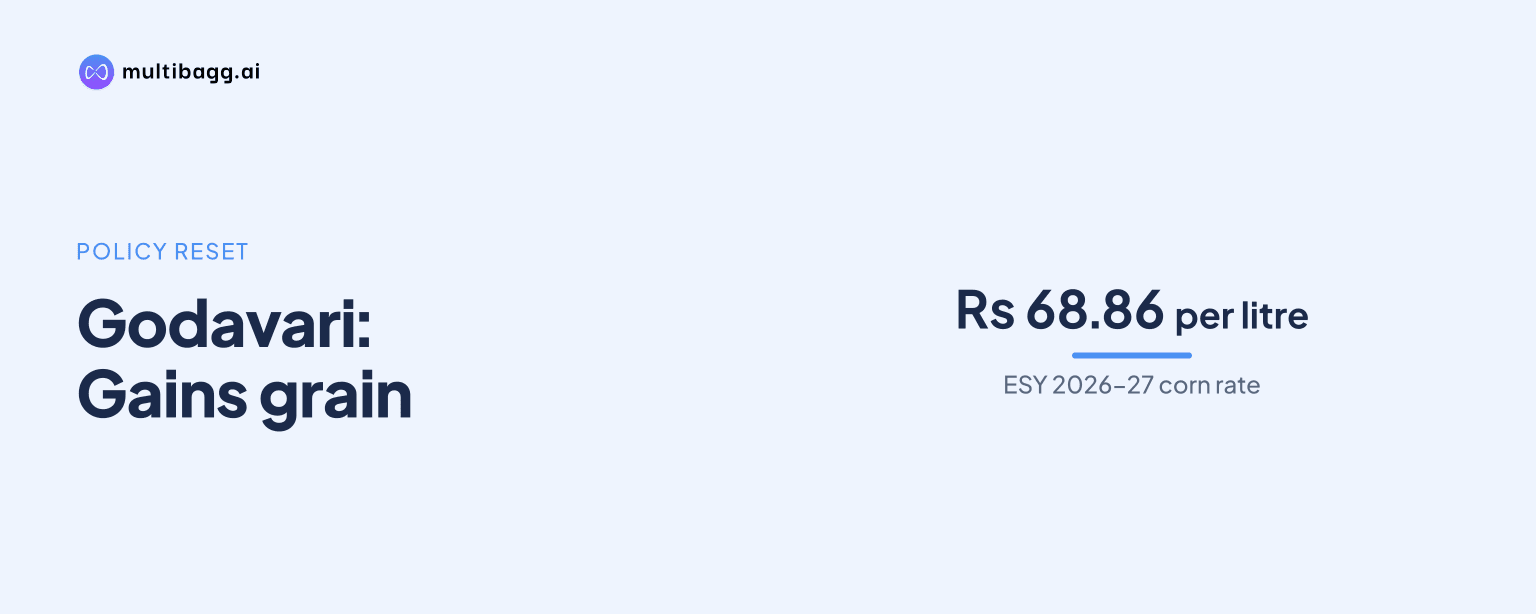
- The reported corn-ethanol procurement rate fell Rs 3 per litre to Rs 68.86 per litre for ESY 2026–27.
- Godavari plans to improve yields, energy efficiency and plant utilisation across its integrated platform.
powered by IRIS
Godavari Biorefineries Limited has an 800 kilolitres-per-day (KLPD) grain-based distillery commissioned at Sameerwadi in June 2026, providing an alternative production route after oil marketing company (OMC) tenders for Ethanol Supply Year (ESY) 2026–27 excluded ethanol made from sugarcane juice, sugar or syrup, and B-heavy molasses.
Know Godavari Biorefineries inside out
Results, valuation, peers and who's buying, in one view.
What changed in ethanol procurement for ESY 2026–27?
For ESY 2026–27, OMC tenders exclude ethanol produced from sugarcane juice, sugar or syrup, and B-heavy molasses. Godavari describes the change as a zero sugar-diversion policy reset, altering the feedstocks that can be used for supply through these tenders.
Procurement is shifting towards maize, surplus rice from the Food Corporation of India (FCI), damaged grains and C-heavy molasses. The distinction is material because the presentation does not describe a universal exclusion of molasses-derived ethanol: C-heavy molasses is among the feedstocks towards which procurement is shifting, while B-heavy molasses is specifically excluded.
For Godavari, the disclosed immediate effect is on eligible production routes and feedstock choices rather than reported ethanol output. The presentation gives no tender award, contracted volume, ethanol production volume or revenue for ESY 2026–27, so it establishes a policy change but not incremental business secured by the company.
How does Godavari's grain distillery address the policy change?
Godavari's grain-based unit at Sameerwadi provides an 800 KLPD alternative production route aligned with the grain-led feedstocks named in the ESY 2026–27 procurement shift. The unit was commissioned in June 2026, giving the company installed capacity as the new supply-year tender framework takes effect.
The 800 KLPD figure is installed distillation-platform capacity, not a measure of actual production, capacity utilisation or tender supply. It nevertheless gives Godavari a route beyond the sugarcane juice, sugar or syrup, and B-heavy molasses pathways that the OMC tender rules exclude for the period.
Godavari characterises this capability as feedstock optionality. Its stated approach is to compare grain, molasses and sugar economics where permitted, rather than commit in the presentation to a single feedstock mix or a stated volume of grain-based ethanol.
The company’s priorities slide lists ethanol flexibility as a focus and explicitly links it to leveraging 800 KLPD capacity to navigate policy and feedstock shifts. That stated objective is operational flexibility, while the presentation leaves open how much of the platform may be directed to OMC tenders rather than other products or markets.
Got a follow-up? Ask IRIS
Are grain-based ethanol economics certain for Godavari?
No, Godavari says grain procurement economics remain uncertain despite the 800 KLPD unit providing an alternative route. It cites monsoon-led variability in domestic maize availability and changing supply-demand dynamics as factors affecting grain prices and procurement economics.
A reduction in the reported corn-ethanol procurement rate adds a direct realisation variable to the supply decision. The rate cited for ESY 2026–27 is Rs 68.86 per litre, down Rs 3 per litre from the earlier reported rate of Rs 71.86 per litre.
Godavari says the lower reported rate creates uncertainty around the economic viability of participating in upcoming tenders. The presentation does not disclose the company’s grain purchase price, ethanol production cost, expected margin or break-even rate, so it does not establish the profitability of participation at Rs 68.86 per litre.
The company also identifies relative margin dynamics across its integrated sugar, co-generation and ethanol operations. Potentially favourable sugar economics, alongside pressure on ethanol quantities and realisations, may influence feedstock allocation decisions and conversion spreads.
What actions does management plan to take under the new policy?
Management plans to use feedstock optionality to compare grain, molasses and sugar economics where each route is permitted. This is Godavari’s disclosed response to tenders that exclude three sugar-derived feedstocks while shifting procurement towards maize, FCI surplus rice, damaged grains and C-heavy molasses.
Godavari also identifies yield improvement, energy efficiency and plant utilisation as operational levers for its integrated sugar, co-generation and ethanol segment. These measures concern the conversion side of economics, including output from available feedstock and the operating efficiency of the distillation platform.
The presentation also retains extra-neutral alcohol (ENA) and other product-market options where they are commercially attractive. This means Godavari does not present OMC ethanol tenders as its only possible outlet for alcohol production, although it does not disclose ENA volumes, realised prices or allocation criteria.
Management’s ethanol-flexibility priority is therefore a response framework rather than a quantified forecast. The 800 KLPD capacity establishes physical capability, but the presentation provides no target for grain usage, tender volumes, utilisation, ethanol revenue or margins in ESY 2026–27.
Conclusion
The ESY 2026–27 policy reset increases the relevance of Godavari’s grain-based Sameerwadi distillery because OMC tenders exclude ethanol from sugarcane juice, sugar or syrup, and B-heavy molasses. The 800 KLPD platform provides an alternative route, while C-heavy molasses and ENA remain within the company’s broader feedstock and product-market options.
What to watch next is domestic maize availability, grain procurement economics and the reported Rs 68.86-per-litre corn-ethanol rate. Management’s disclosed plan is to compare permitted feedstock economics, improve yields, energy efficiency and utilisation, and retain ENA or other options when commercially attractive.