










Godavari expects higher sugar output and prices this year
Key highlights
- Godavari expects more sugar and less cane-based ethanol this year after restrictions on B-heavy molasses and sugarcane-juice diversion.
- The grain-based distillery was commissioned at the end of June in Q1 FY27 and is operating at capacity for contracted ethanol orders.
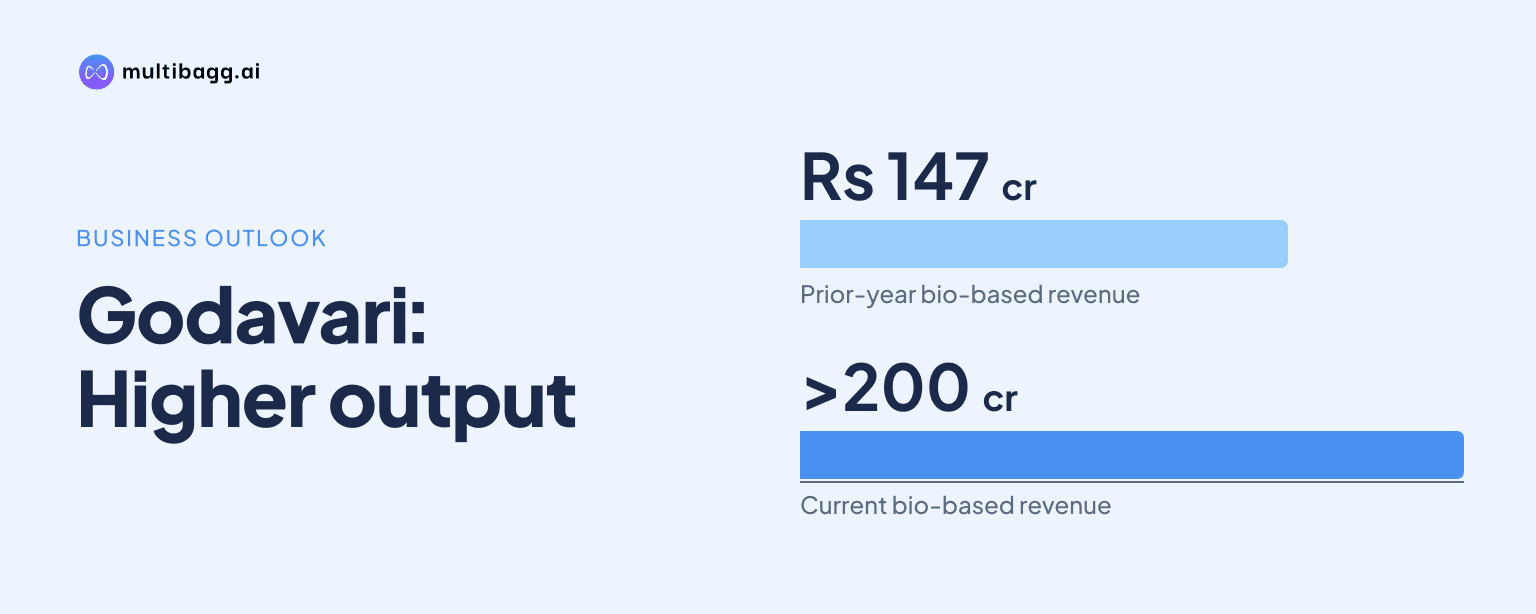
- Bio-based chemicals revenue rose from Rs 147 crore in the comparable prior-year quarter to more than Rs 200 crore.
- Godavari plans Rs 25 crore of specialty-chemicals debottlenecking to support business in Q3 FY28.
powered by IRIS
In November 2026, Godavari Biorefineries Limited said it expects to produce more sugar and less cane-based ethanol this year after restrictions on B-heavy molasses and sugarcane-juice diversion, while its grain-based facility commissioned at the end of June in Q1 FY27 was operating at capacity for contracted orders.
Know Godavari Biorefineries inside out
Results, valuation, peers and who's buying, in one view.
Why does Godavari expect higher sugar output and prices?
Godavari expects policy restrictions on B-heavy molasses and sugarcane juice for ethanol to direct more processed cane into sugar production. Management said Godavari will reduce diversion of sugarcane to ethanol after the policy change, produce more sugar than last year and continue making C-molasses-based ethanol. It did not quantify the expected increase in sugar output or reduction in cane-based ethanol.
Management also expects sugar prices to be better than last year, although it said the economics must be assessed as the year progresses. Its view is that lower diversion of cane into ethanol, combined with reduced cane availability when rainfall is below expectations, could tighten the sugar market. This is management's expectation rather than a disclosed sugar-price target.
Cane availability remains a risk in this approach. Management said India had experienced 7-8 good monsoons and that a difficult monsoon should be expected periodically. In such conditions, ethanol capacity utilisation based on sugarcane juice or B-heavy molasses can be affected, while directing available cane to sugar can raise utilisation at the sugar operation during the crushing season.
How will grain feedstocks change Godavari's ethanol strategy?
Godavari's grain-based distillery is intended to replace some ethanol capacity that would otherwise be lost when cane-based feedstocks are restricted. The facility was commissioned at the end of June in Q1 FY27 and was operating at capacity to meet orders under the ethanol programme, according to management. Godavari had contracts with oil marketing companies, or OMCs, and was producing ethanol against those delivery commitments.
Godavari describes its distillery as multi-feedstock because it can use cane, maize and rice supplied through Food Corporation of India, or FCI, allocations of surplus food grain. Management said it may apply for surplus rice if it receives the relevant tender allocation. It considered rice-to-ethanol potentially more workable than maize-to-ethanol for the blending programme because maize prices were high.
That flexibility does not mean each feedstock will be used at all times. Management said it was reluctant to lock in high maize costs against prevailing ethanol prices and would assess economics before acting. It also said ethanol can serve the blending programme, extra-neutral alcohol, or ENA, chemical uses and Godavari's own operations, reducing dependence on a single feedstock.
At the industry level, management said bids submitted to the ethanol programme indicated sufficient ethanol availability to meet E20, or 20% ethanol blending. It said this showed that the government's feedstock-diversification policy had broadly worked. The comment does not establish Godavari's own allocation or margins, but it explains why management considers grain-processing capability useful when cane-based output is constrained.
Got a follow-up? Ask IRIS
What does seasonality mean for Godavari's sugar and ethanol earnings?
Godavari said the integrated sugar, co-generation and ethanol business is structurally more profitable in the second half of each financial year than in the first half. The sugar facility does not process cane in Q1 and Q2, while cane intake begins in Q3 and continues into Q4. Management said the previous two second halves had been profitable and expected the same seasonal pattern this year.
The first half nonetheless improved from the prior-year first half because of slightly better sugar realisations, management said. An analyst cited a Q2 segment EBITDA loss of Rs 8.7 crore, compared with a loss of Rs 18.4 crore a year earlier. Management did not give a separate numerical explanation for the Q2 comparison, but said operating activity rises when crushing starts in Q3 and Q4.
Management said Godavari was profit after tax, or PAT, positive in the previous year and hoped the next two quarters would be very good. This was an expectation, not formal earnings guidance. Results will depend on cane processing, sugar economics, the extent of cane-based ethanol diversion and whether the grain plant can profitably fulfil its OMC contracts.
How is Godavari allocating capital beyond ethanol?
Godavari said its large ethanol investment was the move to multi-feedstock capability, and future larger capital allocation would focus on bio-based specialty chemicals. It may make minor investments to optimise the ethanol facility, but management said the main growth effort will be specialty chemicals developed with customers in India and abroad. Larger projects remain subject to greater visibility on customer offtake agreements.
The immediate programme is Rs 25 crore of debottlenecking across a range of products. Godavari makes more than 20-25 bio-based specialty chemicals, and management said the investment would support business in Q3 FY28. It had previously projected quarterly bio-based chemicals revenue of Rs 190 crore for the quarter just completed and Rs 240 crore in Q3 FY28, with that growth planned around specialty chemicals.
The chemicals business contrasts with the seasonal sugar operation. Management said revenue rose from Rs 147 crore in the comparable prior-year quarter to more than Rs 200 crore in the latest quarter. It attributed the increase to existing chemicals, including higher ethyl acetate business, and products introduced after earlier debottlenecking; management said ethyl acetate opportunities could be temporary while specialty chemicals remain its long-term priority.
Conclusion
Godavari's response to cane and ethanol policy risk is to direct more cane into sugar, retain C-molasses ethanol production and use its grain-based plant when feedstock economics permit. The approach combines management's expectation of better sugar prices than last year with feedstock flexibility across cane, rice and maize, while chemicals revenue increased from Rs 147 crore to more than Rs 200 crore year on year.
The next developments to watch are Q3 and Q4, when cane crushing resumes and management expects improvement in the integrated sugar, co-generation and ethanol operation. Management also plans Rs 25 crore of specialty-chemicals debottlenecking for Q3 FY28 business, while surplus-rice allocations, maize prices and sugar economics remain unresolved variables.