










Godavari Biorefineries Limited Raises Ethanol Capacity to 800 KLPD
Key highlights
- Godavari Biorefineries commissioned a 200 KLPD dual-feedstock distillery at Sameerwadi, Karnataka.
- The new distillery adds 60 million litres of annual ethanol capacity, taking total capacity to 800 KLPD.
- Q1 FY27 total income rose 4.9% year-on-year to ₹559.9 crore from ₹534.0 crore.
- Bio-based chemicals EBITDA grew 53% year-on-year and margin improved to 11.4% from 8.9%.
powered by IRIS
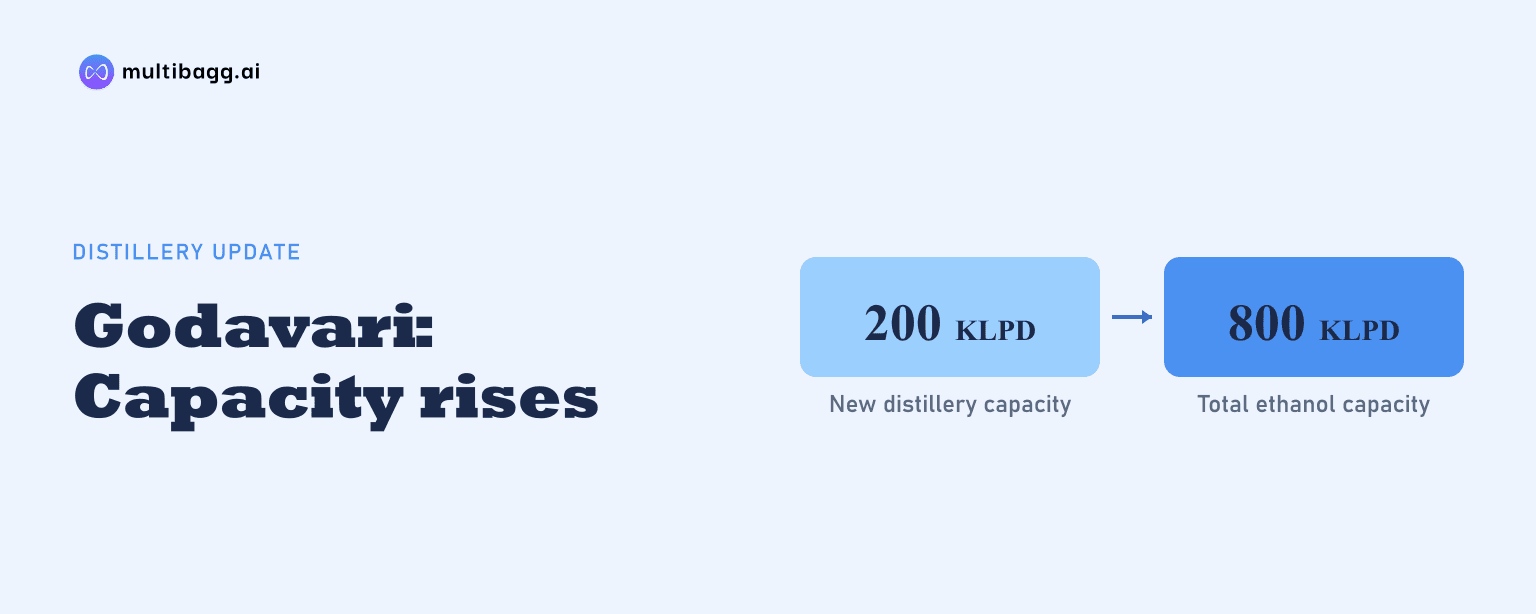
Godavari Biorefineries Limited has commissioned a 200 KLPD dual-feedstock grain distillery at Sameerwadi, Karnataka, raising its total ethanol capacity to 800 KLPD and adding 60 million litres of annual capacity. The project broadens its feedstock options while Q1 FY27 total income increased 4.9% year-on-year to ₹559.9 crore.
Know Godavari Biorefineries inside out
Results, valuation, peers and who's buying, in one view.
What has Godavari Biorefineries commissioned at Sameerwadi?
Godavari Biorefineries has commenced operations at a 200 KLPD corn and grain-based distillery at Sameerwadi in Karnataka. The facility is designed as a dual-feedstock plant, operating alongside the company's existing sugarcane juice-based ethanol operations.
The new unit enables the company to process corn and grain as well as sugarcane juice, allowing it to shift between feedstocks according to seasonal availability. The company said the commissioning adds 60 million litres of annual ethanol capacity and takes its overall installed ethanol capacity to 800 KLPD.
The project had been discussed in the company's earlier investor material as a fungible grain and maize distillery. At that stage, Godavari Biorefineries had indicated that commercial production was expected by the end of calendar year 2025. Its Q1 FY27 presentation now identifies the 200 KLPD facility as commissioned.
How did Godavari Biorefineries perform in Q1 FY27?
Godavari Biorefineries reported total income of ₹559.9 crore in Q1 FY27, compared with ₹534.0 crore in Q1 FY26, representing growth of 4.9% year-on-year. The presentation highlighted stronger profitability in the bio-based chemicals business during the quarter.
Bio-based chemicals EBITDA rose 53% year-on-year, while the segment's EBITDA margin expanded to 11.4% from 8.9% in Q1 FY26. The company attributed the improvement in its investor material to the performance of its bio-based chemicals operations, though the supplied presentation extract does not give the segment's absolute revenue or EBITDA amount.
The latest quarterly figures follow an improvement in Q1 FY26, when the company reported consolidated EBITDA of ₹6.5 crore and a loss after tax of ₹16.0 crore. Godavari Biorefineries had then said that the restoration of the Ethanol Blending Program, specialty-chemicals debottlenecking and lower finance costs supported improvement in EBITDA and profit-before-tax margins.
Why does the dual-feedstock ethanol plant matter?
The dual-feedstock configuration matters because sugarcane-based production is seasonal. A plant that can use corn and grain in addition to sugarcane juice can help maintain operations across differing raw-material availability periods. This flexibility is central to the company's stated strategy of improving sugarcane valorisation through an integrated biorefinery model.
Godavari Biorefineries operates across sugar, branded sugar, ethanol, bio-based chemicals and power. The additional distillery capacity therefore increases the ethanol component of an integrated operating model that uses agricultural feedstocks across several product categories.
The company's FY26 presentation also linked the capacity addition to India's ethanol policy environment. It referred to draft standards notified for fuel blends beyond E20 and described a policy push to examine higher ethanol blends. The presentation did not provide a definitive demand forecast, but it positioned the new capacity against the prospect of a larger domestic blending market.
Got a follow-up? Ask IRIS
What other business developments did the presentation disclose?
Godavari Biorefineries disclosed progress in drug discovery alongside its ethanol and chemicals operations. The company said it has received a Japanese patent for a novel anti-cancer molecule and has filed an application with the Central Drugs Standard Control Organisation for preliminary efficacy trials of its lead novel anti-cancer molecule.
These disclosures relate to the company's intellectual-property and research activity rather than current segment financial performance. The presentation does not state the expected timing of regulatory review, trial commencement or commercialisation for the molecule.
The company has also outlined a longer-term FY29 objective to achieve three times EBITDA compared with FY25. Its earlier presentation identified an estimated investment of ₹325 crore for its strategic levers across the bio-based chemicals and ethanol divisions. That target is a company outlook and not a reported financial result.
How could the update affect investors and industry operations?
For investors, the most measurable operational change is the rise in ethanol capacity to 800 KLPD. The additional 60 million litres of annual capacity and the ability to use grain or sugarcane juice provide more operational options than a single-feedstock facility, particularly when agricultural raw-material availability changes through the year.
The Q1 FY27 income increase was moderate at 4.9%, while the 53% rise in bio-based chemicals EBITDA and margin expansion to 11.4% indicate that profitability in that segment improved faster than consolidated income. The presentation also shows that ethanol, chemicals and research initiatives are being developed simultaneously, making segment-level execution relevant to the company's overall performance.
Industry conditions remain important because ethanol operations are linked to feedstock availability and blending-policy implementation. Godavari Biorefineries has identified both as relevant to its strategy, but the presentation does not provide a financial contribution from the new distillery or a specific sales outlook from the added capacity.
Conclusion
Godavari Biorefineries has expanded its ethanol platform with a 200 KLPD dual-feedstock distillery that raises total capacity to 800 KLPD. The operational update coincides with Q1 FY27 total income of ₹559.9 crore and stronger bio-based chemicals profitability, with EBITDA margin in that segment increasing to 11.4%.
The next disclosed items to watch are the operational contribution of the Sameerwadi facility, the CDSCO application's progress for preliminary efficacy trials, and execution against the company's FY29 goal of tripling EBITDA from FY25 with estimated investment of ₹325 crore across its ethanol and bio-based chemicals divisions.