










Godavari Biorefineries Limited advances TNBC candidate after Phase I
Key highlights
- Godavari Biorefineries completed Phase I MSP008-22 safety studies in healthy individuals and patients with advanced solid tumours.
- Godavari Biorefineries targets Q3 FY27 for next-stage trial commencement, subject to regulatory approval.
- Godavari Biorefineries lists Q2 FY28 for preliminary MSP008-22 results and Q2 2030 for estimated trial completion.
- Godavari Biorefineries reports more than 40 oncology compounds, 7 secured patents and 48 patent registrations.
powered by IRIS
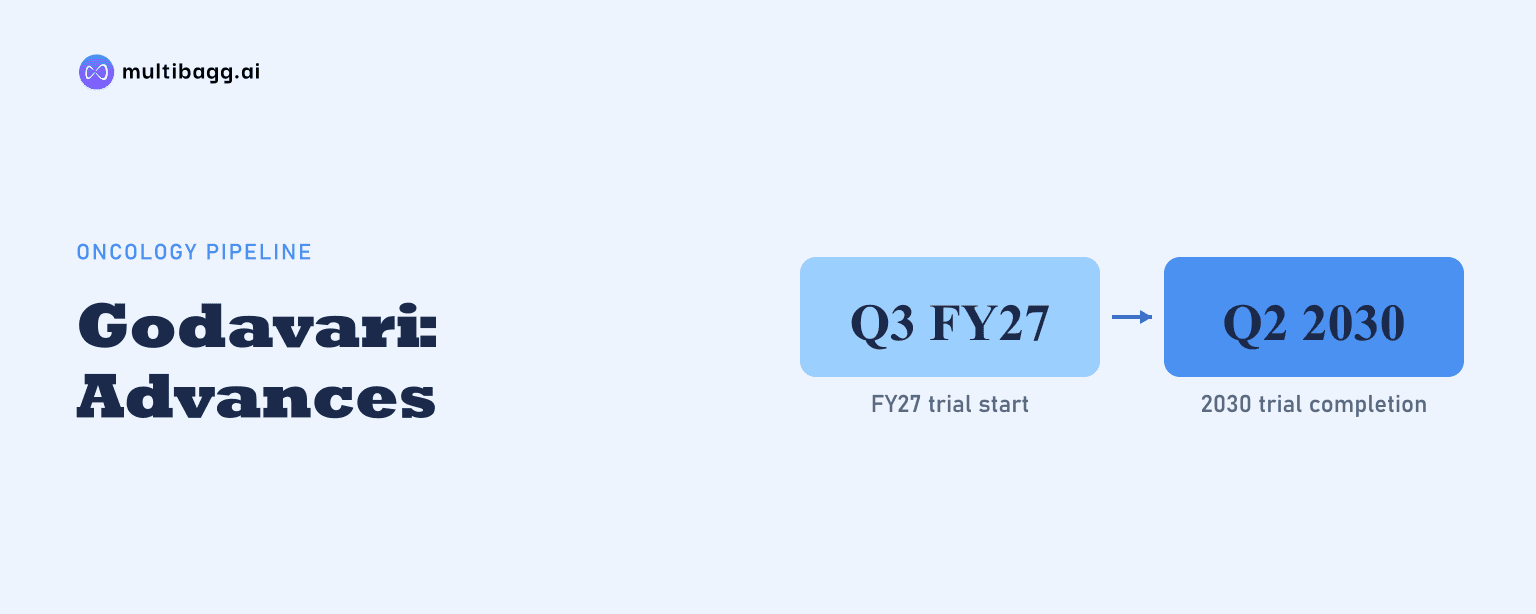
Godavari Biorefineries Limited has advanced its TNBC candidate MSP008-22 by completing Phase I safety studies and filing for the next trial stage, subject to approval; it targets a Q3 FY27 start, Q2 FY28 preliminary results and estimated Q2 2030 completion.
Know Godavari Biorefineries inside out
Results, valuation, peers and who's buying, in one view.
What does Godavari Biorefineries’ MSP008-22 target?
MSP008-22 targets triple-negative breast cancer, or TNBC, which Godavari Biorefineries describes as an aggressive breast-cancer subtype accounting for approximately 15% of breast-cancer cases. The company identifies significant unmet medical need in TNBC and presents the programme as a science-led growth opportunity adjacent to its core biorefinery activities.
Godavari Biorefineries describes MSP008-22 as a first-in-class oral small-molecule inhibitor. The presentation identifies the product format and mechanism category, but does not disclose the molecular target, dosage, trial design, safety observations or efficacy findings for the candidate.
The drug-discovery programme is separate from the company’s bio-based chemicals, integrated sugar, co-generation and ethanol activities. In its next-phase priorities, Godavari Biorefineries includes research and innovation in bio-based specialty chemicals, regenerative agriculture and drug discovery, while MSP008-22 is identified as its lead molecule.
TNBC is the only stated indication for MSP008-22 on the drug-discovery page. Godavari Biorefineries also reports an oncology pipeline covering breast, prostate, oral, liver, cervical, colon and lung cancers, as well as glioblastoma, but does not assign the lead molecule to those other cancer areas.
Has Godavari Biorefineries completed Phase I studies for MSP008-22?
Yes, Godavari Biorefineries says it has completed Phase I safety studies in healthy individuals and patients with advanced solid tumours. The presentation does not provide the number of participants, dosing details, study duration, adverse events or clinical outcomes from those completed studies.
Godavari Biorefineries has submitted the Clinical Study Report from the Phase I work and filed an application with CDSCO for the next stage of trials. That next stage is intended to assess preliminary efficacy and remains subject to approval, according to the company’s stated development status.
The disclosed position is therefore different from a programme that has already begun efficacy testing. Phase I safety studies in healthy individuals and advanced-solid-tumour patients are complete, while the preliminary-efficacy trial is planned for Q3 FY27 and requires the approval cited by Godavari Biorefineries.
The company has not reported whether MSP008-22 reduced tumours or improved patient outcomes. Instead, Godavari Biorefineries identifies preliminary efficacy as the purpose of the next stage and sets Q2 FY28 as the milestone for preliminary results.
Got a follow-up? Ask IRIS
When could Godavari Biorefineries report MSP008-22 results?
Godavari Biorefineries targets Q3 FY27 for next-stage trial commencement and Q2 FY28 for preliminary results. Its development timeline then refers to an advanced phase only subject to positive results, followed by estimated trial completion in Q2 2030.
The schedule separates the expected initial readout from the later trial-completion estimate. From planned commencement in Q3 FY27 to preliminary results in Q2 FY28, Godavari Biorefineries anticipates an earlier data milestone before any potential progression to the advanced phase.
Godavari Biorefineries does not state what result would qualify as positive for progression beyond preliminary efficacy. The Q2 2030 completion date is also an estimate, not confirmation that the programme will enter an advanced phase or complete all trials by that date.
How broad are Godavari Biorefineries’ oncology pipeline and patent base?
Godavari Biorefineries reports more than 40 compounds in its diversified oncology pipeline. The pipeline spans breast, prostate, oral, liver, cervical, colon and lung cancers, plus glioblastoma, while MSP008-22 is separately identified as the lead molecule for TNBC.
The company reports 7 secured patents across products and processes, alongside 48 patent registrations across multiple geographies. These are separately stated intellectual-property measures, and the presentation does not provide a country-by-country, product-by-product or compound-by-compound breakdown.
The pipeline’s more than 40 compounds contrast with the level of detail supplied for MSP008-22. Godavari Biorefineries provides a Q3 FY27 start milestone, Q2 FY28 preliminary-results milestone and Q2 2030 estimated completion date for the lead candidate, but gives no comparable clinical timetable for the remaining compounds.
The patent disclosures establish the reported scale of the company’s intellectual-property portfolio, but do not indicate commercialisation of MSP008-22. Godavari Biorefineries does not disclose a licensing partner, manufacturing arrangement, drug revenue or launch schedule for the candidate.
Conclusion
Godavari Biorefineries has moved MSP008-22 from completed Phase I safety studies toward a proposed preliminary-efficacy trial for TNBC. The key disclosed change is the submission of the Clinical Study Report and the CDSCO application, within an oncology pipeline of more than 40 compounds and 7 secured patents.
The next stated milestone is Q3 FY27 trial commencement, subject to approval, followed by preliminary results in Q2 FY28. The subsequent advanced phase depends on positive results not defined in the presentation, and the Q2 2030 trial-completion date remains an estimate.