










Godavari Biorefineries Limited beats Q2 guide by Rs 14.2 crore
Key highlights
- Godavari Biorefineries reported Rs 204 crore of bio-based chemicals revenue in Q2 FY27, versus earlier guidance of Rs 190 crore.
- Godavari Biorefineries has set a Rs 240 crore bio-based chemicals revenue target for Q3 FY28.
- Specialty products represented 61% of Godavari Biorefineries' bio-based chemicals revenue in FY26, up from 53% in FY24.
- Godavari Biorefineries cites about Rs 25 crore of incremental capital expenditure for further debottlenecking.
powered by IRIS
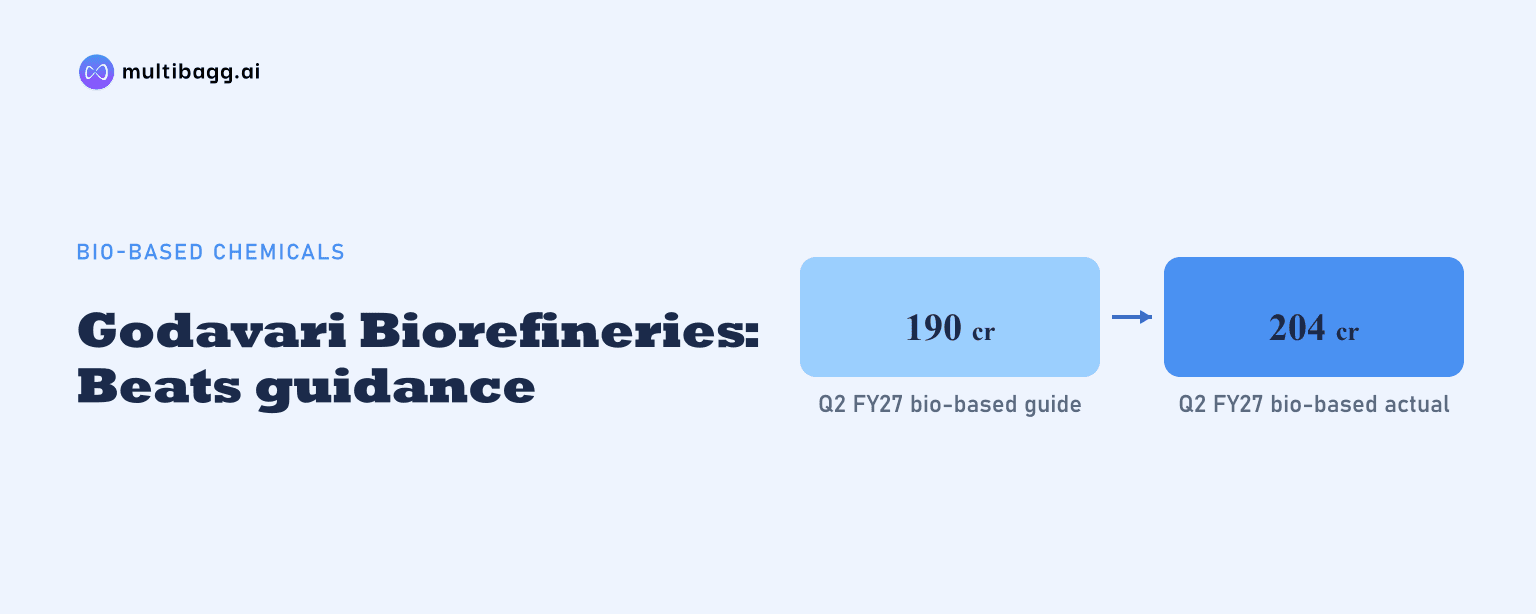
Godavari Biorefineries Limited reported Rs 204 crore of bio-based chemicals revenue in Q2 FY27, exceeding its earlier Rs 190 crore guidance by the stated Rs 14.2 crore. Godavari Biorefineries has also set a Rs 240 crore quarterly revenue target for Q3 FY28, supported by customer qualification, debottlenecking and capacity additions linked to demand and offtake.
Know Godavari Biorefineries inside out
Results, valuation, peers and who's buying, in one view.
How did Godavari Biorefineries beat its Q2 FY27 chemicals guidance?
Godavari Biorefineries delivered Rs 204 crore of bio-based chemicals revenue in Q2 FY27, against earlier guidance of Rs 190 crore for the quarter. The presentation describes the result as Rs 14.2 crore above the prior forecast and shows 7.5% outperformance in its quarterly revenue trajectory. This provides a direct comparison between management's near-term expectation and the reported outcome.
The Q2 FY27 result was also above the two earlier actual quarterly figures displayed in the presentation: Rs 169 crore in Q1 FY27 and Rs 141 crore in Q1 FY26. Revenue increased by Rs 35 crore from Q1 FY27 to Q2 FY27, while Q1 FY27 was Rs 28 crore higher than Q1 FY26. The source does not provide Q2 FY26 chemicals revenue, product-level revenue or margin data, so it does not establish a year-on-year Q2 comparison or individual drivers of the result.
What is Godavari Biorefineries' next chemicals revenue target?
Godavari Biorefineries targets Rs 240 crore of quarterly bio-based chemicals revenue in Q3 FY28. The target is Rs 36 crore above the Rs 204 crore reported in Q2 FY27. It is labelled as a target, rather than reported revenue or formal guidance, and depends on the commercial and operating actions management has outlined.
Management says it plans to develop and qualify bio-based solutions with customers, then scale them through debottlenecking and capacity additions aligned with demand and offtake. The presentation identifies customer demand for renewable feedstocks, improved end-product performance and drop-in alternatives to fossil-based inputs with a lower carbon footprint. Godavari Biorefineries intends to work with customers in India and overseas on molecule development, application validation and longer-term relationships.
Godavari Biorefineries cites incremental capital expenditure of about Rs 25 crore for further debottlenecking. It says further capacity additions will follow customer demand and offtake visibility rather than a fixed expansion schedule. Its development platform includes three Department of Scientific and Industrial Research, or DSIR, registered research and development centres and more than 50 scientists.
Which products are intended to support Godavari Biorefineries' growth plan?
Godavari Biorefineries is shifting its chemicals mix toward differentiated specialty products, whose share of bio-based chemicals revenue rose to 61% in FY26 from 58% in FY25 and 53% in FY24. The comparison represents an 8-percentage-point increase between FY24 and FY26. Management describes this as a strategic pivot from a broader bio-based chemicals portfolio toward a higher contribution from specialty products.
The specialty and bio-based product range includes bio-based ethyl acetate sold as NaturoEA®, natural 1,3-butylene glycol sold as NaturoBG®, MPC, bio-acetic acid and paraldehyde. Godavari Biorefineries associates these products with personal care, cosmetics, flavours and fragrances, food and beverage applications. Its commodity list includes ethyl acetate for solvents, coatings, adhesives, agrochemical and pharmaceutical uses, while butanol, EVE and other downstream derivatives are identified as emerging products.
Got a follow-up? Ask IRIS
What partnerships and milestones could affect Godavari Biorefineries' scale-up?
Godavari Biorefineries says its collaboration with CATALYXX strengthens technology readiness for ethanol-to-bio-butanol production, while its downstream partnership with Synthomer expands the reach of bio-based monomers and specialty chemicals into global markets. It is also exploring additional prospective bio-butanol partners to broaden commercial opportunities and routes to market. The source presents these as commercialisation initiatives, not as reported revenue contributors.
A separate industry-academia programme with ICT Mumbai is developing renewable dimethyl ether, or DME, from carbon dioxide and green hydrogen. Management expects to complete pilot-scale validation by Q4 FY27. The presentation does not quantify the project's capital requirement, commercial sales potential or contribution to the Rs 240 crore Q3 FY28 chemicals target.
Godavari Biorefineries' integrated model can use sugarcane and grain or maize feedstocks across sugar operations, distillation and co-generation. These assets produce sugar, ethanol or extra-neutral alcohol, renewable power and bio-based chemicals. The company says this arrangement permits changes in feedstock and product routes in response to economics, demand and policy conditions, but does not quantify a chemicals-volume benefit from the integration.
How do feedstock conditions affect Godavari Biorefineries' operating choices?
Godavari Biorefineries faces a changed ethanol procurement setting in Ethanol Supply Year 2026–27, because oil marketing company tenders exclude ethanol made from sugarcane juice, sugar or syrup, and B-heavy molasses. The presentation says procurement has shifted towards maize, surplus Food Corporation of India rice, damaged grains and C-heavy molasses. The company commissioned a grain-based unit at Sameerwadi in June 2026, providing an alternative route within its 800 kilolitres-per-day distillation platform.
Management also flags uncertainty in grain procurement economics after the reported corn-ethanol procurement rate for Ethanol Supply Year 2026–27 declined to Rs 68.86 per litre from Rs 71.86 per litre. Monsoon-led variation in domestic maize availability and changing supply-demand conditions add uncertainty around grain prices, according to the presentation. Godavari Biorefineries says it will compare grain, molasses and sugar economics where permitted, improve yields and energy efficiency, and retain extra-neutral alcohol and other product-market options where commercially attractive.
Conclusion
Godavari Biorefineries' Rs 204 crore Q2 FY27 bio-based chemicals revenue exceeded its earlier Rs 190 crore forecast, while the Rs 240 crore Q3 FY28 target sets the next disclosed delivery benchmark. The plan combines customer qualification, specialty-product development and about Rs 25 crore of further debottlenecking, alongside a specialty revenue mix that increased from 53% in FY24 to 61% in FY26.
The next developments to watch are management's expected Q4 FY27 pilot-scale validation of renewable DME with ICT Mumbai, progress in bio-butanol partnerships and implementation of the disclosed debottlenecking expenditure. Feedstock economics also remain relevant because the Ethanol Supply Year 2026–27 policy reset and Rs 3 per litre reduction in the reported corn-ethanol procurement rate may affect allocation choices across grain, molasses, sugar and extra-neutral alcohol.