










Godavari Biorefineries’ sugar-ethanol loss continues in H1 FY27
Key highlights
- Godavari Biorefineries’ integrated segment reported a Rs 23.3 crore EBITDA loss in H1 FY27, versus a Rs 22.7 crore loss in H1 FY26.
- Integrated segment revenue rose 8% to Rs 712.1 crore in H1 FY27.
- Q2 FY27 integrated-segment EBITDA loss narrowed to Rs 8.7 crore from Rs 18.4 crore a year earlier.
- Bio-based Chemicals generated Rs 41.2 crore of EBITDA at an 11.1% margin in H1 FY27.
powered by IRIS
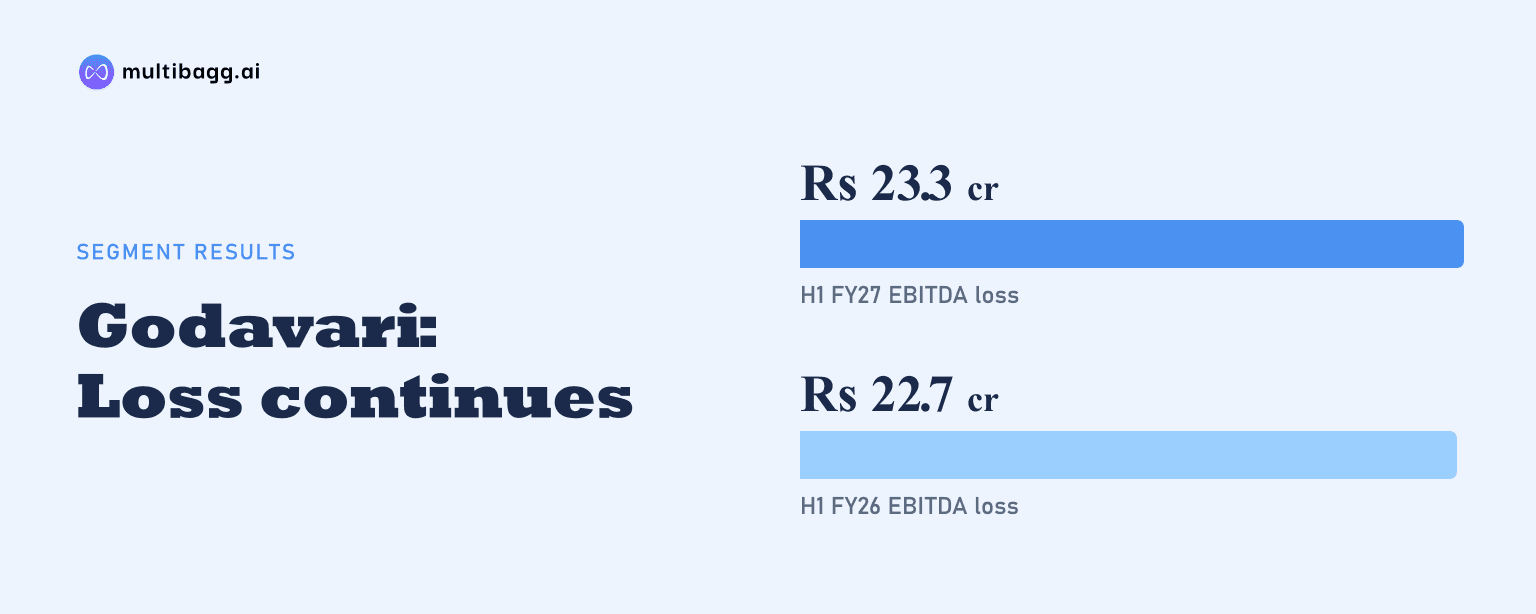
Godavari Biorefineries Limited’s Integrated Sugar, Co-generation & Ethanol segment posted an EBITDA, or earnings before interest, tax, depreciation and amortisation, loss of Rs 23.3 crore in H1 FY27, Rs 0.6 crore wider than in H1 FY26, despite revenue rising 8% to Rs 712.1 crore. Management cited feedstock conditions, manufacturing costs and lower ethanol tender allotments.
Know Godavari Biorefineries inside out
Results, valuation, peers and who's buying, in one view.
Why did Godavari Biorefineries’ integrated segment remain loss-making?
Godavari Biorefineries’ integrated segment remained loss-making because management attributed its H1 FY27 performance to challenging feedstock conditions, higher manufacturing costs and lower ethanol tender allotments. EBITDA was negative Rs 23.3 crore in H1 FY27, compared with negative Rs 22.7 crore in H1 FY26, while the reported EBITDA margin was negative 3.3% against negative 3.4% a year earlier.
Revenue growth did not translate into a positive operating result. Segment revenue increased by Rs 53.5 crore to Rs 712.1 crore in H1 FY27 from Rs 658.6 crore in H1 FY26, but the EBITDA loss increased by Rs 0.6 crore. Management said the cited operating pressures resulted in margin shrinkage during the first half.
The reported margin improved by 0.1 percentage point, although EBITDA remained negative and the absolute loss was higher. The difference reflects the larger revenue base in H1 FY27 rather than a return to segment-level operating profitability. Godavari Biorefineries reported no separate financial measure quantifying the impact of feedstock costs or ethanol allotments.
Did Godavari Biorefineries’ integrated segment improve in Q2 FY27?
Godavari Biorefineries’ integrated segment improved year on year in Q2 FY27 but did not turn profitable. Revenue rose 21% to Rs 334.2 crore from Rs 275.7 crore in Q2 FY26, while the EBITDA loss narrowed to Rs 8.7 crore from Rs 18.4 crore.
The quarterly EBITDA margin improved to negative 2.6% in Q2 FY27 from negative 6.7% a year earlier, a 4.1-percentage-point change. The Rs 9.7 crore reduction in the quarterly loss contrasts with the H1 comparison, in which the segment’s EBITDA loss increased by Rs 0.6 crore, indicating that losses in the other quarter of H1 FY27 were larger.
The Q2 result also differed from the group’s consolidated operating result. Consolidated EBITDA turned positive at Rs 10.9 crore in Q2 FY27, compared with a negative Rs 4.4 crore result in Q2 FY26, while the integrated segment still recorded negative EBITDA of Rs 8.7 crore. This shows that other operations supported the reported consolidated quarterly EBITDA.
Got a follow-up? Ask IRIS
How did Godavari Biorefineries’ bio-based chemicals business compare?
Godavari Biorefineries’ Bio-based Chemicals segment delivered positive EBITDA growth in H1 FY27 while the integrated segment remained loss-making. Bio-based Chemicals reported EBITDA of Rs 41.2 crore on revenue of Rs 372.9 crore, compared with EBITDA of Rs 27.6 crore on revenue of Rs 288.3 crore in H1 FY26.
Bio-based Chemicals’ EBITDA margin increased to 11.1% in H1 FY27 from 9.6% in H1 FY26, while the integrated segment reported a negative 3.3% margin. EBITDA in the chemicals business increased by Rs 13.6 crore, whereas the integrated segment’s loss widened by Rs 0.6 crore despite its Rs 712.1 crore revenue base being larger than chemicals revenue.
Revenue mix moved toward Bio-based Chemicals during the half year. The integrated segment represented 64% of revenue from operations in H1 FY27, down from 68% in H1 FY26, while Bio-based Chemicals increased to 34% from 30%; unallocated revenue remained 2% in both periods. Total revenue from operations increased to Rs 1,107.1 crore from Rs 964.0 crore.
In Q2 FY27, Bio-based Chemicals generated EBITDA of Rs 22.1 crore at a 10.8% margin on revenue of Rs 204.2 crore. The integrated segment generated higher Q2 revenue of Rs 334.2 crore but recorded an EBITDA loss of Rs 8.7 crore. The segment figures show that the larger revenue business was not the contributor to positive operating profit in that quarter.
What were Godavari Biorefineries’ consolidated H1 FY27 earnings?
Godavari Biorefineries reported consolidated EBITDA of Rs 13.4 crore in H1 FY27, up from Rs 2.1 crore in H1 FY26, as total income rose 14.6% to Rs 1,109.7 crore. The consolidated EBITDA margin increased to 1.2% from 0.2%, while loss after tax narrowed to Rs 34.6 crore from Rs 57.6 crore.
Gross profit increased to Rs 220.8 crore from Rs 193.8 crore, but gross-profit margin was 19.9% in H1 FY27 versus 20.0% in H1 FY26. Depreciation and amortisation rose to Rs 29.7 crore from Rs 27.0 crore, and finance costs increased to Rs 29.3 crore from Rs 27.6 crore. As a result, earnings before interest and tax remained negative at Rs 16.3 crore, although the loss narrowed from Rs 24.9 crore.
At September 2026, total equity stood at Rs 753.1 crore, down from Rs 788.3 crore at March 2026. Total borrowings were Rs 545.7 crore, comprising Rs 324.4 crore of non-current borrowings and Rs 221.3 crore of current borrowings, compared with Rs 530.1 crore at March 2026. The increase occurred alongside the consolidated H1 FY27 loss after tax of Rs 34.6 crore.
Conclusion
Godavari Biorefineries’ H1 FY27 results show revenue expansion alongside sharply different segment outcomes. The Integrated Sugar, Co-generation & Ethanol segment increased revenue to Rs 712.1 crore but remained loss-making at the EBITDA level, whereas Bio-based Chemicals generated Rs 41.2 crore of EBITDA and helped lift consolidated EBITDA to Rs 13.4 crore.
The next reported period will show whether the management-identified constraints of feedstock conditions, manufacturing costs and ethanol tender allotments change. Investors can track whether the integrated segment builds on its Q2 FY27 EBITDA loss of Rs 8.7 crore, as well as whether consolidated EBITDA margin holds above the 1.2% reported for H1 FY27.