










Godavari Biorefineries targets Rs 240 crore after Q2 beat
Key highlights
- Godavari Biorefineries reported Rs 204.2 crore of bio-based chemicals revenue in Q2 FY27, 38.8% higher year on year.
- Bio-based chemicals EBITDA rose 47% to Rs 22.1 crore in Q2 FY27, and margin increased to 10.8%.
- Management targets Rs 240 crore of quarterly bio-based chemicals revenue by Q3 FY28 through a Rs 25 crore debottlenecking programme.
- Consolidated Q2 FY27 net loss narrowed to Rs 15.2 crore from Rs 41.6 crore a year earlier.
powered by IRIS
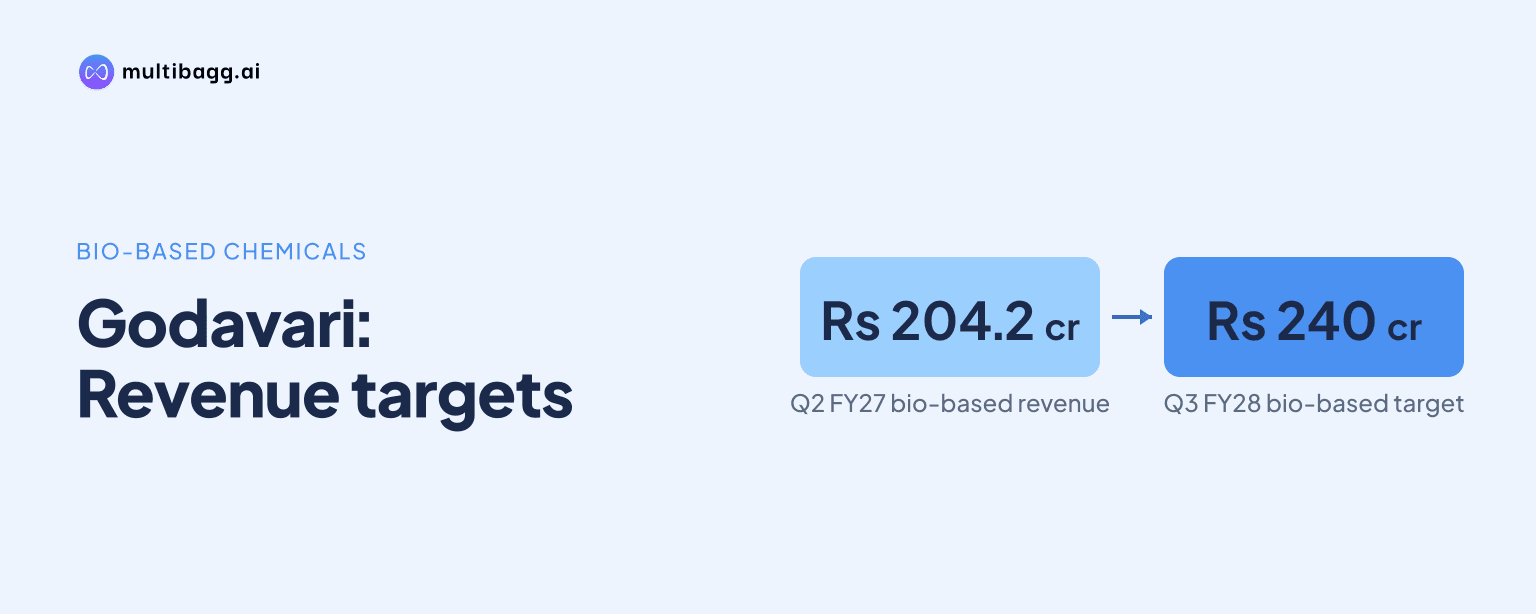
Godavari Biorefineries Limited reported Rs 204.2 crore of bio-based chemicals revenue in Q2 FY27, above its Rs 190 crore expectation, and management is targeting Rs 240 crore of quarterly revenue by Q3 FY28 through a further Rs 25 crore debottlenecking programme. The company said market entry after commissioning will affect the timing of the increase.
Know Godavari Biorefineries inside out
Results, valuation, peers and who's buying, in one view.
How did Godavari Biorefineries exceed its Q2 chemicals expectation?
Godavari Biorefineries exceeded its Rs 190 crore Q2 FY27 expectation through earlier debottlenecking investments, higher volumes and price increases in certain products, management said. It attributed part of the performance above the expectation to disruption in the Hormuz area, which it said created additional volume opportunities and increased prices for some products. Management did not quantify the respective contribution of volumes, pricing or product mix.
Bio-based chemicals revenue increased 38.8% year on year to Rs 204.2 crore in Q2 FY27 from Rs 147 crore in Q2 FY26, based on the corrected prior-year figure in the call transcript. The Q2 outcome was Rs 14.2 crore above management’s earlier expectation, while the Rs 240 crore Q3 FY28 target is Rs 35.8 crore above the reported Q2 FY27 revenue.
The revenue comparison shows that the next planned increase exceeds the Q2 FY27 beat over the Rs 190 crore expectation. However, management described the Rs 204.2 crore result as a combination of benefits from prior operational work and external market conditions, rather than a recurring outcome attributable to one factor.
What must happen for Godavari Biorefineries to reach Rs 240 crore quarterly revenue?
Godavari Biorefineries says reaching Rs 240 crore of quarterly bio-based chemicals revenue in Q3 FY28 depends on a further Rs 25 crore debottlenecking investment. Management said the investment is intended to expand bio-based specialty chemicals and follows prior debottlenecking that supported the move from Rs 147 crore of Q2 FY26 revenue to the Rs 190 crore expectation for Q2 FY27.
Management hopes the new programme will start by April 2027, although it said commercial market entry will take time after operations begin. During the call, management initially referred to Q3 FY27, then corrected the target timing to Q3 FY28. The Rs 240 crore figure is management’s stated target, without a disclosed product-level schedule for volume, utilisation or realisation.
The stated mechanism is process and capacity improvement at existing chemicals operations rather than a large new plant. Management also said it may increase ethyl acetate sales when market conditions provide an opportunity, but described bio-based specialty chemicals as the portfolio’s structural direction. The entire additional Rs 25 crore debottlenecking investment is intended to increase specialty chemicals, according to management.
Got a follow-up? Ask IRIS
How did bio-based chemicals affect Godavari Biorefineries profitability?
Godavari Biorefineries’ bio-based chemicals segment generated earnings before interest, tax, depreciation and amortisation, or EBITDA, of Rs 22.1 crore in Q2 FY27, up 47% from Rs 15.0 crore a year earlier. Segment EBITDA margin increased to 10.8% from 10.2%, while revenue rose 38.8% to Rs 204.2 crore. Management attributed the improvement to earlier debottlenecking and operating efficiency.
At the consolidated level, Q2 FY27 EBITDA was Rs 10.9 crore, compared with an EBITDA loss of Rs 4.4 crore in Q2 FY26, as revenue from operations increased 27.5% to Rs 549.2 crore. Consolidated net loss narrowed to Rs 15.2 crore from Rs 41.6 crore, although the sugar and co-generation segment recorded an EBITDA loss of Rs 19.3 crore.
The first-half comparison also showed a larger chemicals contribution. Bio-based chemicals revenue grew 29.3% to Rs 372.9 crore in H1 FY27 and segment EBITDA rose 50% to Rs 41.2 crore, increasing margin to 11.1% from 9.6% in H1 FY26. Management said H1 FY27 chemicals EBITDA represented 86% of the division’s full-year FY26 EBITDA, while consolidated H1 EBITDA rose to Rs 13.4 crore from Rs 2.1 crore.
How do specialty chemicals and ethanol conditions shape the plan?
Godavari Biorefineries said bio-based specialty chemicals represented 52% of its chemicals business in H1 FY27, correcting an initially stated 62% figure during the call. Management said its structural objective is to increase specialty chemicals, while retaining the ability to raise ethyl acetate sales when market conditions support that decision. The Rs 25 crore debottlenecking programme is directed to specialty chemicals.
The integrated sugar, co-generation and ethanol business faces separate feedstock constraints. Godavari Biorefineries has total distillery capacity of 800 kilolitres per day, but management said drought in Maharashtra and Karnataka and restrictions on diversion of sugarcane juice and B-heavy molasses to ethanol affect available feedstock. The company can use C-heavy molasses and permitted grain feedstocks.
Ethanol EBITDA improved to Rs 10.6 crore in Q2 FY27 from Rs 4.7 crore a year earlier, while combined sugar, co-generation and ethanol revenue increased to Rs 334.2 crore from Rs 275.7 crore. Management said maize, rice and other food-grain economics will determine grain-based production choices, while ethanol can be directed to fuel blending, extra-neutral alcohol or the chemicals business depending on demand and realisation.
Conclusion
Godavari Biorefineries’ Q2 FY27 chemicals performance exceeded its Rs 190 crore expectation, with revenue of Rs 204.2 crore and segment EBITDA of Rs 22.1 crore. Revenue growth from Rs 147 crore in Q2 FY26 and the margin increase to 10.8% coincide with the earlier debottlenecking programme, while losses in sugar and co-generation continued to offset part of the chemicals segment’s contribution.
The next disclosed milestone is management’s hoped-for April 2027 start of the Rs 25 crore debottlenecking programme and its Rs 240 crore quarterly chemicals revenue target for Q3 FY28. Progress will depend on commissioning and market entry, the specialty chemicals share beyond the 52% reported in H1 FY27, and feedstock and grain-cost conditions affecting the 800-kilolitre-per-day distillery network.