










Godavari specialty mix reaches 61% of bio-based revenue
Key highlights
- Godavari’s specialty and bio-based products accounted for 61% of bio-based chemicals revenue in FY26, up from 53% in FY24.
- Godavari reported Rs 204 crore of bio-based chemicals revenue in Q2 FY27, Rs 14.2 crore above earlier guidance.
- Godavari reports 800 KLPD of installed distillery capacity, more than 20 bio-based products and service to more than 35 countries.
- Godavari has identified about Rs 25 crore of incremental capital expenditure for further debottlenecking.
powered by IRIS
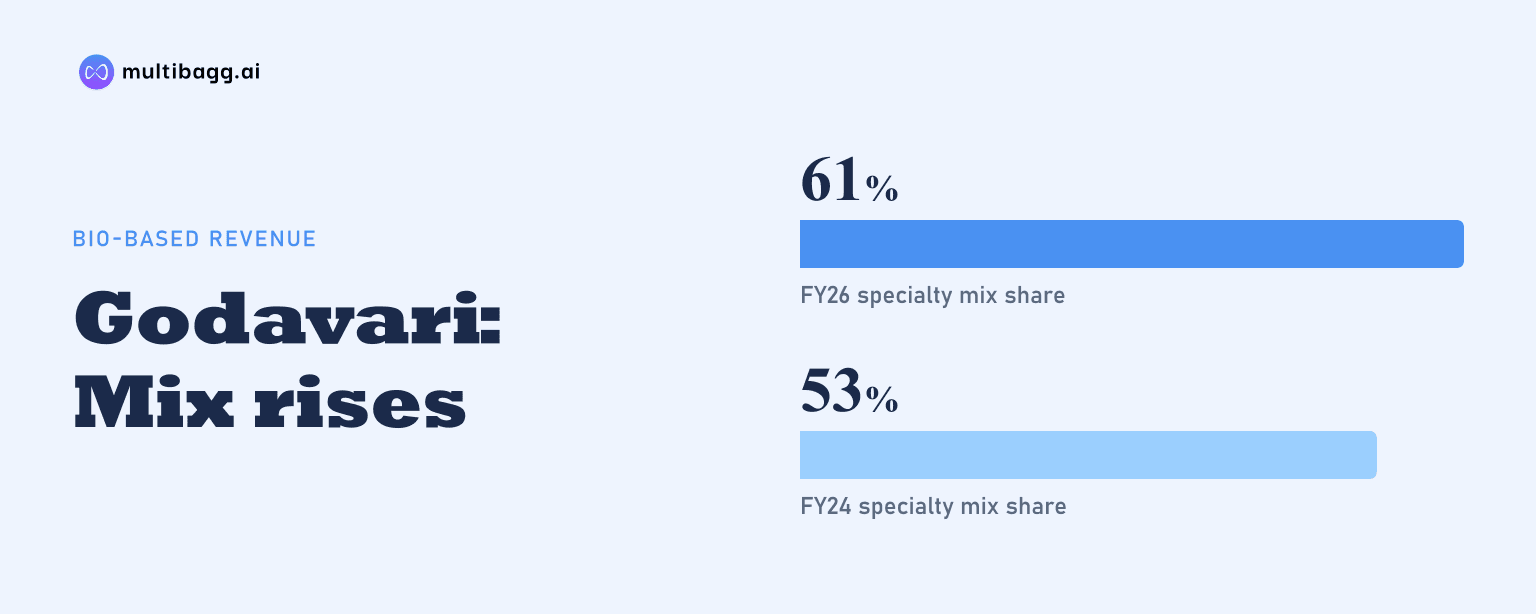
Godavari Biorefineries Limited raised specialty and bio-based products to 61% of bio-based chemicals revenue in FY26, from 53% in FY24, marking an eight-percentage-point move toward differentiated products. The FY26 share was also above FY25’s 58%, according to the company’s three-year revenue-mix disclosure.
Know Godavari Biorefineries inside out
Results, valuation, peers and who's buying, in one view.
How has Godavari changed its specialty chemicals mix?
Godavari increased specialty and bio-based products’ share of bio-based chemicals revenue to 61% in FY26, compared with 58% in FY25 and 53% in FY24. The result shows a cumulative eight-percentage-point increase over two financial years and a three-percentage-point increase in FY26 alone. Godavari describes the direction as a pivot toward a higher contribution from differentiated specialty products.
The measure is a revenue-mix indicator rather than a disclosure of specialty chemicals revenue in rupees. Godavari does not provide revenue, volume or margin figures by molecule for FY24, FY25 or FY26. The progression nevertheless places specialty and bio-based products ahead of commodity chemicals within the bio-based chemicals revenue mix.
Godavari presents the strategy as a progression from an integrated ethanol platform to chemical intermediates, then specialty and bio-based products, and finally diverse customer applications. Its 2016 start of specialty bio-based chemical production at Sakarwadi included MPO and 1,3-butylene glycol, while its corporate name changed to Godavari Biorefineries Limited in 2008 to reflect its integrated biorefinery model.
Which products does Godavari classify as specialty and bio-based?
Godavari lists bio-based ethyl acetate marketed as NaturoEA, natural 1,3-butylene glycol marketed as NaturoBG, MPC, bio-acetic acid and paraldehyde in its specialty and bio-based category. The company links these products to personal care, cosmetics, flavours and fragrances, and food and beverage applications. These applications differ from commodity ethyl acetate, which Godavari associates with solvents, coatings, adhesives, agrochemicals and pharmaceuticals.
The product classification separates specialty and bio-based products from both commodity and emerging categories. Godavari places butanol, EVE and other downstream derivatives in the emerging category, aimed at industrial and application-specific chemical value chains. The presentation does not identify which of NaturoEA, NaturoBG, MPC, bio-acetic acid or paraldehyde accounted for the change from 53% in FY24 to 61% in FY26.
Godavari says it has more than 20 bio-based products and serves more than 35 countries, alongside 800 KLPD of installed distillery capacity. KLPD means kilolitres per day. The company does not state how much of that distillery capacity supplies chemical production, ethanol or extra-neutral alcohol, known as ENA.
Got a follow-up? Ask IRIS
How does Godavari’s integrated model support chemicals growth?
Godavari says its integrated model provides routes for sugarcane and grain or maize through sugar operations, distillation and co-generation. The resulting value streams include sugar, ethanol or ENA, renewable power and bio-based chemicals. By-products and intermediate streams can be channelled into productive uses, while feedstock and product routes can be adjusted for market demand, economics and policy conditions.
Godavari commissioned a grain-based distillery in 2026, adding a feedstock route alongside sugarcane-based operations. The company says grain-based distillation supports feedstock flexibility when crop conditions vary. It also says shared infrastructure and integrated processes improve resource efficiency, though it provides no capacity figure for the new grain-based distillery or quantified cost benefit.
The stated objective is to create more value from every tonne of renewable feedstock across energy, chemicals, power and consumer products. The rise in specialty mix from 53% in FY24 to 61% in FY26 is consistent with the chemicals portion of that model. However, the presentation does not quantify changes in feedstock allocation among sugar, ethanol, ENA, power and chemicals over the same period.
What execution and expansion plans has Godavari disclosed?
Godavari reported Rs 204 crore of Q2 FY27 bio-based chemicals revenue, which was Rs 14.2 crore above its earlier guidance of Rs 190 crore. The company’s quarterly trajectory also shows Rs 169 crore in Q1 FY27 and Rs 141 crore in Q1 FY26. Q2 FY27 revenue was therefore Rs 35 crore above Q1 FY27, although the presentation does not provide seasonal or product-mix data for a like-for-like quarterly assessment.
Godavari says it will develop and qualify bio-based solutions with customers, then scale through debottlenecking and capacity additions aligned with demand and offtake. It has identified about Rs 25 crore of incremental capital expenditure for further debottlenecking. The company also reports three Department of Scientific and Industrial Research, or DSIR, registered research and development centres and more than 50 scientists.
Godavari’s collaboration with CATALYXX is intended to strengthen readiness for ethanol-to-bio-butanol production, while its partnership with Synthomer is intended to expand global market access for bio-based monomers and specialty chemicals. The company is exploring further bio-butanol partnerships. For renewable dimethyl ether, or DME, developed with ICT Mumbai using carbon dioxide and green hydrogen, management expects pilot-scale validation by Q4 FY27.
Conclusion
Godavari’s move from a 53% specialty and bio-based share of chemicals revenue in FY24 to 61% in FY26 is the presentation’s clearest evidence of a shift toward differentiated chemical products. The strategy combines customer applications for NaturoEA, NaturoBG and other products with an integrated system spanning sugarcane, grain, distillation and co-generation.
The next disclosed markers are management’s Rs 240 crore Q3 FY28 bio-based chemicals revenue target, about Rs 25 crore of further debottlenecking capital expenditure, and expected DME pilot-scale validation by Q4 FY27. Progress will depend on customer qualification, offtake visibility and the scale-up of bio-butanol and other downstream chemical routes.