










Godavari Biorefineries Limited returns to positive Q2 EBITDA
Key highlights
- Godavari Biorefineries reported Q2 FY27 EBITDA of Rs 10.9 crore versus a Rs 4.4 crore loss in Q2 FY26.
- Q2 FY27 consolidated revenue increased 26.6% year on year to Rs 549.8 crore.
- Bio Based Chemicals revenue rose to Rs 204.2 crore in Q2 FY27 from Rs 147.1 crore a year earlier.
- Integrated Sugar, Co-gen & Ethanol reduced its Q2 FY27 EBITDA loss to Rs 8.7 crore from Rs 18.4 crore.
powered by IRIS
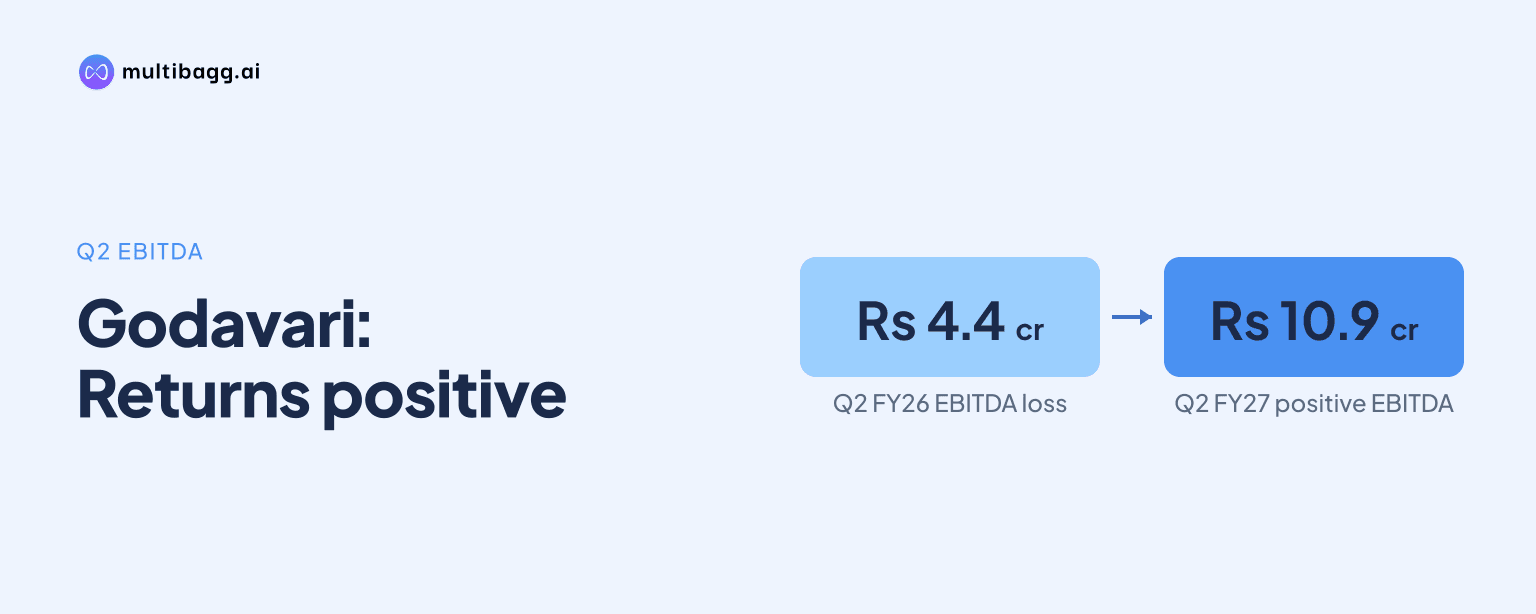
Godavari Biorefineries Limited reported EBITDA of Rs 10.9 crore in Q2 FY27, reversing a Rs 4.4 crore loss in Q2 FY26 as Bio Based Chemicals revenue rose 39% to Rs 204.2 crore. Consolidated revenue increased 26.6% to Rs 549.8 crore, although profit after tax remained a Rs 15.2 crore loss.
Know Godavari Biorefineries inside out
Results, valuation, peers and who's buying, in one view.
How did Godavari Biorefineries return to positive EBITDA?
Godavari Biorefineries returned to EBITDA, or earnings before interest, tax, depreciation and amortisation, of Rs 10.9 crore in the second quarter of FY27, compared with a Rs 4.4 crore EBITDA loss in Q2 FY26 and EBITDA of Rs 2.6 crore in Q1 FY27. EBITDA, which includes other income, produced a 2.0% margin in Q2 FY27, against negative 1.0% a year earlier and 0.5% in the preceding quarter.
Total revenue rose to Rs 549.8 crore in Q2 FY27 from Rs 434.3 crore in Q2 FY26, while it was below Rs 559.9 crore in Q1 FY27. The year-on-year revenue increase was 26.6%, and the movement from an EBITDA loss to positive EBITDA coincided with higher revenue in both reported operating segments.
Godavari Biorefineries nevertheless recorded a profit after tax, or PAT, loss of Rs 15.2 crore in Q2 FY27. The loss narrowed from Rs 41.6 crore in Q2 FY26 and Rs 19.3 crore in Q1 FY27, while the PAT margin improved to negative 2.8% from negative 9.6% a year earlier. The results therefore show an operating turnaround during the quarter without a return to net profit.
Which segment drove Godavari Biorefineries' Q2 growth?
Godavari Biorefineries' Bio Based Chemicals segment drove the Q2 FY27 operating result, reporting revenue of Rs 204.2 crore and EBITDA of Rs 22.1 crore. Revenue rose from Rs 147.1 crore in Q2 FY26, while EBITDA increased from Rs 15.0 crore, matching management's statement that segment revenue grew by approximately 39% and EBITDA by approximately 47% year on year.
The Bio Based Chemicals EBITDA margin increased to 10.8% in Q2 FY27 from 10.2% in Q2 FY26, but was below the 11.4% reported in Q1 FY27. Revenue, however, rose from Rs 168.7 crore in Q1 FY27, indicating that the segment delivered both year-on-year and sequential sales growth in the September quarter.
For the first half of FY27, Bio Based Chemicals revenue reached Rs 372.9 crore, compared with Rs 288.3 crore in H1 FY26, and EBITDA rose to Rs 41.2 crore from Rs 27.6 crore. Management attributed the commercial and profitability improvement to earlier debottlenecking initiatives, and said it would continue capacity optimisation, process improvements and product development for domestic and international markets.
Got a follow-up? Ask IRIS
Why did Godavari Biorefineries' sugar and ethanol loss narrow?
Godavari Biorefineries' Integrated Sugar, Co-gen & Ethanol segment reduced its Q2 FY27 EBITDA loss to Rs 8.7 crore from Rs 18.4 crore in Q2 FY26. Segment revenue increased to Rs 334.2 crore from Rs 275.7 crore, and the EBITDA margin improved to negative 2.6% from negative 6.7%, though the segment remained loss-making at the operating level.
The Q2 FY27 loss was also lower than the Rs 14.6 crore EBITDA loss reported in Q1 FY27, when segment revenue was Rs 377.9 crore. This means the segment's revenue declined sequentially by Rs 43.7 crore, while its EBITDA loss narrowed by Rs 5.9 crore and its margin improved from negative 3.9%.
Management cited weather-related uncertainty, sugarcane availability and rising feedstock costs as continuing pressures on the sugar and ethanol business. It also said restrictions on diversion of sugarcane juice and B-heavy molasses towards ethanol had added industry pressure, while expanded grain-based distillery capacity offered flexibility to optimise operations according to market conditions.
What do Godavari Biorefineries' H1 FY27 results show?
Godavari Biorefineries reported H1 FY27 revenue of Rs 1,109.7 crore, up from Rs 968.2 crore in H1 FY26, while EBITDA increased to Rs 13.4 crore from Rs 2.1 crore. The half-year EBITDA margin rose to 1.2% from 0.2%, with the Q2 FY27 EBITDA of Rs 10.9 crore accounting for most of the Rs 13.4 crore first-half result.
The H1 FY27 PAT loss narrowed to Rs 34.6 crore from Rs 57.6 crore in H1 FY26, and the PAT margin improved to negative 3.1% from negative 5.9%. Bio Based Chemicals generated Rs 41.2 crore of H1 EBITDA, while Integrated Sugar, Co-gen & Ethanol recorded a Rs 23.3 crore EBITDA loss, slightly wider than the Rs 22.7 crore loss in H1 FY26.
Management said its priorities include scaling Bio Based Chemicals, strengthening ethanol operations in line with India's Biofuel Programme, improving operating efficiency and enhancing feedstock flexibility. It also disclosed a US patent for a novel anti-cancer molecule, European patents for anti-cancer pharmaceutical compositions and bio-based rubber reinforcement technology, and patents in China and Mexico for antiviral compounds.
Conclusion
Godavari Biorefineries' Q2 FY27 result marked a return to positive EBITDA, with Rs 10.9 crore after a Rs 4.4 crore loss a year earlier. Bio Based Chemicals generated Rs 22.1 crore of EBITDA on Rs 204.2 crore of revenue, while the Integrated Sugar, Co-gen & Ethanol loss narrowed to Rs 8.7 crore. Consolidated PAT remained negative at Rs 15.2 crore.
The next reported results will indicate whether further debottlenecking, capacity optimisation, process improvements and product development can sustain the H1 FY27 EBITDA margin of 1.2%. Management has also identified unresolved variables in sugarcane availability, feedstock costs and restrictions on diversion of sugarcane juice and B-heavy molasses toward ethanol, alongside its plan to use grain-based distillery capacity for flexibility.