










Hi-Green Carbon EBITDA rises 69% as margin reaches 20.65%
Key highlights
- Hi-Green Carbon’s consolidated total income rose 41.53% year-on-year to Rs 99.78 crore in H1 FY27.
- Consolidated gross profit increased 53.69% to Rs 35.38 crore, lifting the gross margin to 35.46%.
- Consolidated EBITDA grew 69.27% to Rs 20.60 crore, while the EBITDA margin reached 20.65%.
- Consolidated PAT was Rs 6.69 crore in H1 FY27, compared with a Rs 1.29 crore loss in H2 FY26.
powered by IRIS
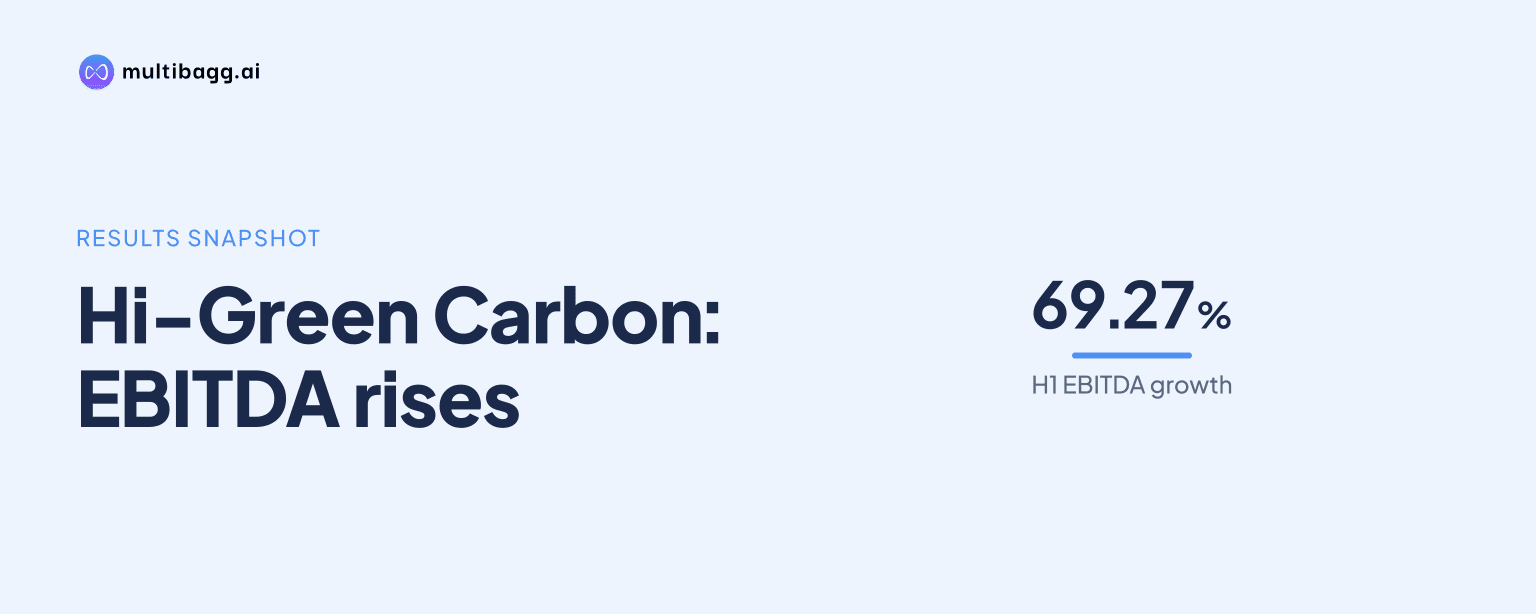
Hi-Green Carbon Limited reported consolidated earnings before interest, tax, depreciation and amortisation (EBITDA) of Rs 20.60 crore in H1 FY27, up 69.27% from Rs 12.17 crore in H1 FY26. Total income increased 41.53% to Rs 99.78 crore, while the EBITDA margin rose to 20.65% from 17.26% a year earlier.
Know Hi-Green Carbon inside out
Results, valuation, peers and who's buying, in one view.
How did Hi-Green Carbon perform in H1 FY27?
Hi-Green Carbon increased consolidated income, gross profit and EBITDA in H1 FY27 compared with both H1 FY26 and H2 FY26. Total income reached Rs 99.78 crore, against Rs 70.50 crore in H1 FY26 and Rs 70.84 crore in H2 FY26. The company therefore reported income growth of 41.53% year-on-year and 40.86% against the preceding half-year.
Cost of goods sold (COGS) rose 35.64% year-on-year to Rs 64.40 crore from Rs 47.48 crore, below the increase in income. Gross profit consequently rose 53.69% to Rs 35.38 crore from Rs 23.02 crore, and gross profit margin increased to 35.46% from 32.65%. Against H2 FY26, gross profit was up 46.92% from Rs 24.08 crore and margin improved from 34.00%.
Total expenses increased 35.74% to Rs 79.18 crore in H1 FY27 from Rs 58.33 crore a year earlier, and were 38.37% above Rs 57.22 crore in H2 FY26. Employee benefit expense rose 96.28% year-on-year to Rs 3.69 crore, while other expenses increased 23.63% to Rs 11.09 crore. In both comparisons, expense growth was below income growth.
Why did Hi-Green Carbon’s EBITDA margin increase?
Hi-Green Carbon’s EBITDA margin increased because gross profit grew faster than income and total expenses grew more slowly than income. EBITDA reached Rs 20.60 crore, producing a 20.65% margin that was 3.39 percentage points above H1 FY26’s 17.26%. The margin was also 1.43 percentage points above H2 FY26’s 19.22%.
The movement was visible in gross profit. H1 FY27 gross profit of Rs 35.38 crore was 35.46% of income, compared with Rs 23.02 crore and 32.65% in H1 FY26. The Rs 12.36 crore year-on-year rise in gross profit exceeded the combined Rs 3.93 crore increase in employee benefit expense and other expenses, which rose to Rs 14.78 crore from Rs 10.85 crore.
EBITDA growth of 69.27% outpaced total-income growth of 41.53% on a year-on-year basis. Against H2 FY26, EBITDA increased by Rs 6.99 crore from Rs 13.61 crore, while total income increased by Rs 28.94 crore. The presentation defines the measure through its placement before financial cost and depreciation.
Financial cost rose to Rs 2.30 crore in H1 FY27 from Rs 0.84 crore in H1 FY26, while depreciation increased to Rs 8.73 crore from Rs 5.34 crore. Together, these charges were Rs 11.03 crore, compared with Rs 6.18 crore a year earlier. Profit before tax before exceptional item nevertheless increased 59.77% to Rs 9.57 crore from Rs 5.99 crore.
Got a follow-up? Ask IRIS
Did Hi-Green Carbon return to profit in H1 FY27?
Hi-Green Carbon returned to consolidated profit after tax (PAT) of Rs 6.69 crore in H1 FY27 after a Rs 1.29 crore loss in H2 FY26. PAT margin was 6.70%, compared with negative 1.82% in the preceding half-year. Earnings per share (EPS) were Rs 2.68, compared with negative Rs 0.52 in H2 FY26.
The H2 FY26 result included an exceptional item of Rs 5.82 crore. Profit before tax before exceptional item was Rs 7.40 crore in that period, but reported profit before tax was Rs 1.58 crore. The presentation does not identify the nature of the exceptional item or state whether it could recur.
The H1 FY27 consolidated table does not show an exceptional-item amount. Reported profit before tax was Rs 9.57 crore, compared with Rs 1.58 crore in H2 FY26 and Rs 5.99 crore in H1 FY26. Tax expense was Rs 2.88 crore, close to Rs 2.87 crore in H2 FY26, resulting in PAT of Rs 6.69 crore.
The year-on-year comparison was less pronounced at the PAT level. PAT increased 41.44% from Rs 4.73 crore in H1 FY26, while PAT margin was 6.70%, marginally below 6.71% a year earlier. The 617.68% stated sequential change reflects the swing from the H2 FY26 loss to profit in H1 FY27.
How does H1 FY27 compare with Hi-Green Carbon’s FY26?
Hi-Green Carbon’s H1 FY27 total income of Rs 99.78 crore was about 70.60% of its Rs 141.33 crore total income in FY26, without establishing a full-year FY27 outcome. H1 FY27 EBITDA of Rs 20.60 crore was Rs 5.18 crore below FY26 EBITDA of Rs 25.78 crore, but the half-year EBITDA margin of 20.65% exceeded FY26’s 18.24%.
Gross profit in H1 FY27 was Rs 35.38 crore, below the Rs 47.10 crore reported for all of FY26, while its 35.46% gross margin exceeded FY26’s 33.32%. COGS was Rs 64.40 crore in the first half, compared with Rs 94.24 crore for FY26. The comparison shows higher first-half margins but not a complete annual result.
PAT in H1 FY27 was Rs 6.69 crore, compared with Rs 3.43 crore in FY26, and PAT margin was 6.70% against 2.43%. FY26 included the Rs 5.82 crore exceptional item shown in the consolidated table. The presentation provides no segment income, volume, product mix or capacity data for recovered carbon black, tyre pyrolysis oil or sodium silicate, so their individual contribution cannot be determined.
Conclusion
Hi-Green Carbon’s H1 FY27 consolidated results showed income growth of 41.53%, gross-profit growth of 53.69% and EBITDA growth of 69.27% to Rs 20.60 crore. Gross margin rose to 35.46% and EBITDA margin reached 20.65%, while PAT returned to Rs 6.69 crore after the Rs 1.29 crore loss reported in H2 FY26.
The unresolved matter to watch is the Rs 5.82 crore exceptional item recorded in H2 FY26 and FY26. The presentation does not explain its nature or recurrence, while H1 FY27 shows no exceptional-item amount, leaving future disclosures to clarify how comparable reported PAT will be across periods.