








Intellect Finds None of 64 AI Blockers Is the AI Model Itself
MAX Plan at ₹4,999/yr

Find your next multibaggerBe a Pro Investor
Research stocks and track your picks on the go. Download the app.
Key highlights
- Intellect says 215 CXO conversations during 2024-2026 produced 64 enterprise-AI frictions consolidated into 14 root concerns.
- Intellect rated 6 of 64 frictions as critical and says 0 concerned the AI model itself.
- Intellect's illustration shows a 73% outcome today, 77% with a perfect model and approximately 94% needed for regulated work.
- Intellect places MSOCK in an AI-native phase from 2026 onward after Purple Fabric in 2024-26.
powered by IRIS
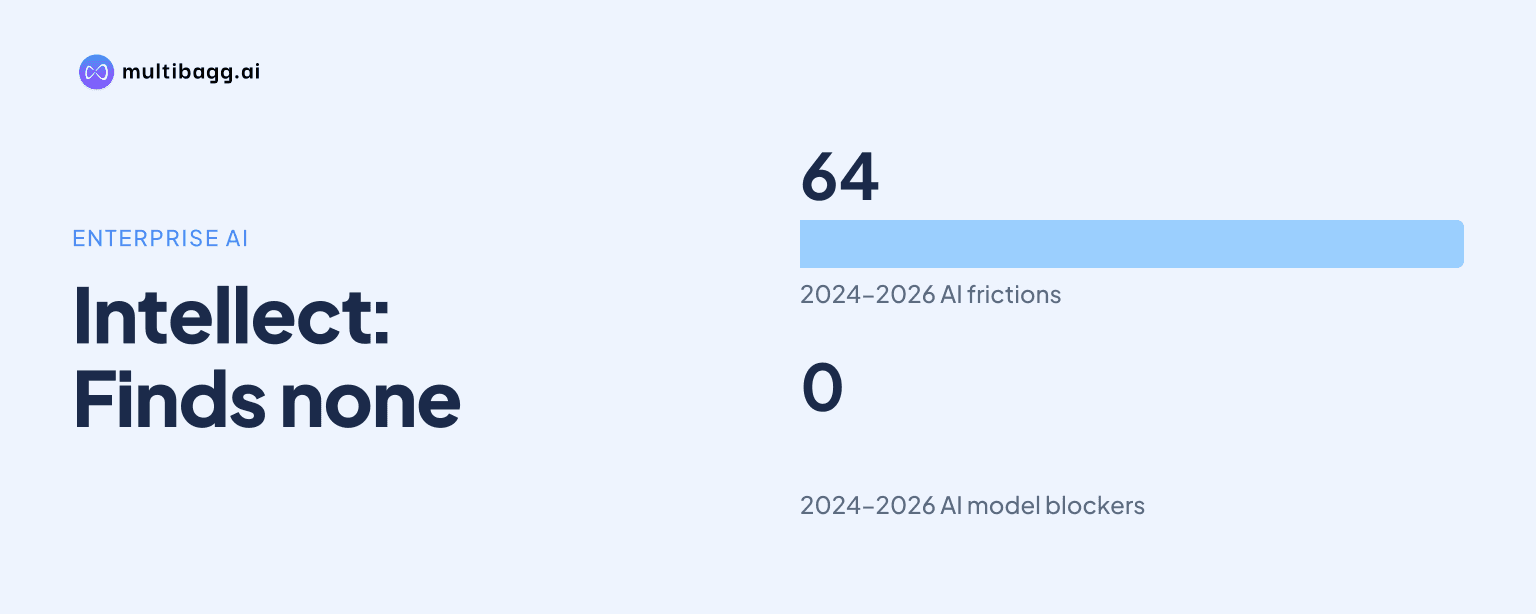
Intellect Design Arena Ltd. found that none of the 64 enterprise-AI frictions identified in 215 CXO conversations during 2024-2026 concerned the AI model itself; six were rated critical, spanning value proof, controlled scale, vendor lock-in, knowledge debt, identity and guardrails, and control and audit in regulated industries.
Know Intellect Design Arena inside out
Results, valuation, peers and who's buying, in one view.
What did Intellect find in 215 CXO conversations?
Intellect found 64 distinct enterprise-AI frictions in 215 conversations with chief information officers, chief technology officers, chief risk officers and chief executive officers across regulated industries between 2024 and 2026. It says those frictions were consolidated into 14 root concerns, creating a catalogue of obstacles faced as enterprises seek to move AI initiatives into operational use.
Intellect places the findings against a gap between AI investment and reported returns. Its presentation cites 37% of enterprises seeing any profit impact from AI, flat over one year, while 56% of chief executive officers see no revenue or cost benefit. It also cites expectations that more than 50% of generative-AI projects will overrun budget, framing the challenge as delivery of business outcomes rather than access to models.
The friction catalogue includes enterprise scaling, strategy-to-outcome alignment, use-case prioritisation, investment convergence, proof-of-concept-to-production transition, pilot purgatory, return-on-investment proof and return-on-investment baselines. These mechanisms show why Intellect characterises the barriers as operational and organisational issues inside regulated institutions, where projects must demonstrate value as well as reach production.
Which AI blockers did Intellect rate as critical?
Intellect rated six of its 64 frictions as critical and classified zero as being about the AI model itself. The six issues span the intelligence, governance and knowledge categories, with the chief executive officer assigned two critical concerns and four other executive roles assigned one each.
Intellect uses four severity labels: none, moderate, high and critical. The distribution of the six critical issues changed the focus from model selection to enterprise constraints: the chief information officer's critical issue is vendor lock-in, the chief data officer's is knowledge debt, and the chief risk officer's is control and audit.
The wider map lists specific control mechanisms including agent identity, agent entitlements, tool and application programming interface risk, activity monitoring, runtime policy, model and agent risk, decision traceability, evidence packs, decision provenance, human-in-the-loop review, pause-review-resume and maker-checker controls. Intellect's presentation therefore links regulated deployment to accountability mechanisms around agents and decisions, not solely to generated output.
Got a follow-up? Ask IRIS
Why does Intellect say better AI models are insufficient?
Intellect says an enterprise outcome depends on knowledge, reasoning and context, with AI labs supplying reasoning while enterprises supply knowledge and context. Its illustrative calculation uses 85% knowledge, 95% reasoning and 90% context, producing a 73% outcome when the three inputs are multiplied.
The presentation estimates that a perfect model would raise the illustrated result from 73% today to 77%, while approximately 94% is needed for regulated work. That comparison implies a 4-percentage-point gain from a perfect model, versus a roughly 17-percentage-point gap between the perfect-model scenario and the stated requirement for regulated work.
Intellect traces this view to a six-wave production history. It identifies sentiment-analysis experiments in 2015-18, document-extraction solutions in 2018-21, insurance-intake and accounts-payable-automation products in 2021-22, the Intellect AI Platform in 2022-24, Purple Fabric in 2024-26, and MSOCK from 2026 onward.
According to Intellect, a review of every product in that timeline found the same gap: knowledge and context. This is consistent with its critical classification of knowledge debt and with the listed governance requirements for decision traceability and evidence packs, which address how an enterprise establishes the basis and control of an AI-enabled decision.
How does Intellect position MSOCK in its AI plan?
Intellect positions MSOCK as its AI-native phase from 2026 onward, after the Purple Fabric ecosystem phase in 2024-26. The supplied presentation does not disclose an MSOCK revenue target, customer count, deployment timetable or financial contribution, but identifies it as the current focus for changing enterprise technology.
The presentation separates AI-agent work into two roles. Purple Fabric is presented as digital experts that run enterprise operations, including underwriting, trade documents and payment reconciliation, while MSOCK is associated with requirements, code and tests, and release work needed to change enterprise technology.
Intellect cites 40% of large organisations scaling AI agents for operational work and 31% scaling coding agents. It says both uses depend on what the institution knows, but directs the presentation's focus to MSOCK and the task of grounding enterprise-system changes in institutional knowledge.
The company also sets the MSOCK positioning against banking-system pressures. Its cited market context says about 70% of bank information-technology budgets go to maintaining old systems, 51% of bank executives missed cost-saving targets, and 23% of corporate clients say their bank's digital service meets their needs. Intellect labels those figures market data rather than MSOCK performance benchmarks.
Conclusion
Intellect's central finding is that its 215 executive conversations identified enterprise-AI adoption as a value, knowledge and control issue rather than an AI-model issue. Of 64 frictions, six were critical and none concerned the model itself; its 73% illustrative outcome also shows why improving reasoning alone does not close the stated approximately 94% requirement for regulated work.
The disclosed next step to watch is Intellect's MSOCK AI-native phase from 2026 onward, following Purple Fabric in 2024-26. Management positions MSOCK around enterprise technology change, but the presentation leaves unresolved its production deployment scale, customer adoption, financial contribution and evidence that it addresses the six critical blockers.

