








Intellect Design Arena Ltd. says AI coding yields under 10% lift
MAX Plan at ₹4,999/yr

Find your next multibaggerBe a Pro Investor
Research stocks and track your picks on the go. Download the app.
Key highlights
- Intellect says AI agents make coding 30–40% faster but improve end-to-end enterprise change by less than 10%.
- Intellect identifies four manual stages around coding: planning, system understanding, testing, and release governance.
- Intellect’s lending example covers 5 million lines of code connected to 80 other systems, or 81 systems in total.
- Intellect’s accuracy framework shows a 73% outcome from 85% knowledge, 95% reasoning and 90% context.
powered by IRIS
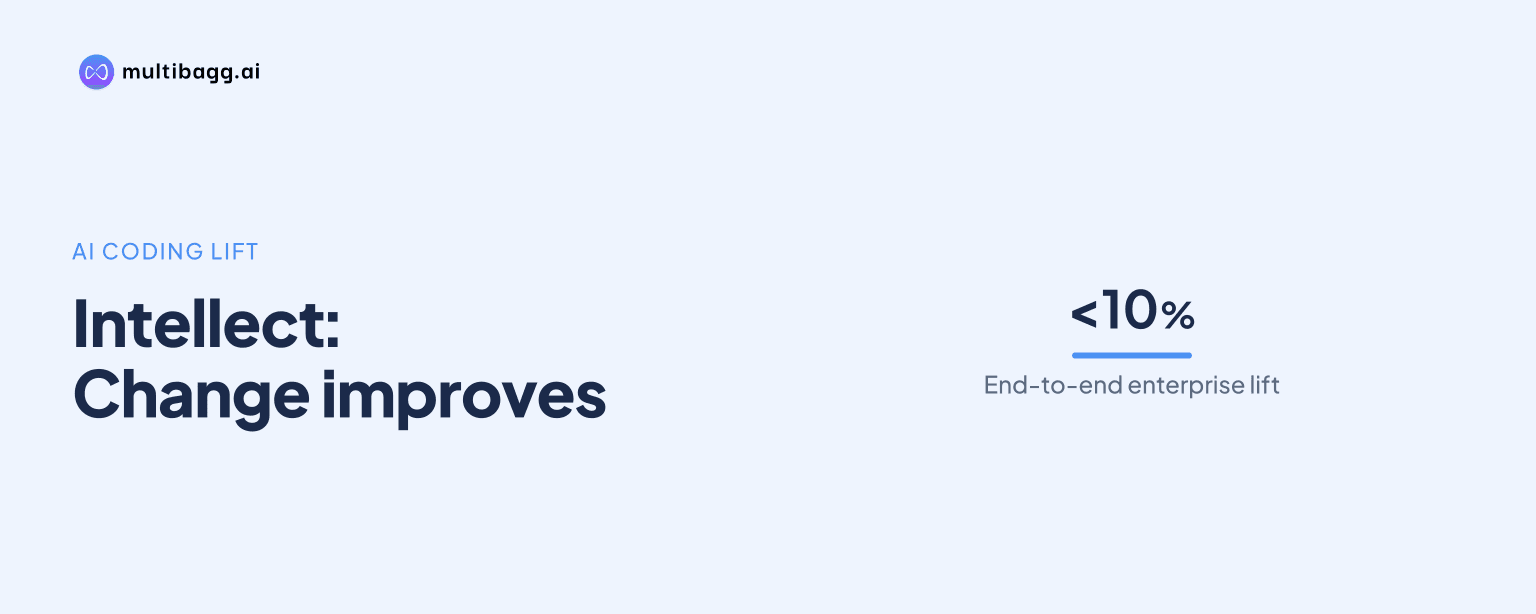
In its 2026 presentation, Intellect says artificial intelligence (AI) coding agents can make coding 30–40% faster but lift total enterprise change by less than 10% when planning, testing and release remain manual. Intellect’s thesis is that technology-change speed depends on institutional knowledge, not code generation alone.
Know Intellect Design Arena inside out
Results, valuation, peers and who's buying, in one view.
Why do AI coding gains not speed up enterprise change?
AI coding gains do not speed up enterprise change because coding is only one of five stages in the change process. Intellect identifies planning the change, understanding the system, writing code, testing the change, and release and governance as the sequence. In its framing, only the coding stage is AI-accelerated, while the other four stages remain manual.
The resulting gap is substantial in Intellect’s presentation: AI agents improve coding speed by 30–40%, yet the business receives less than 10% overall improvement. The comparison separates a developer-level productivity measure from end-to-end delivery, where requirements, impact assessment, validation, approvals and release controls still determine the timing of a production change.
Intellect also places the productivity issue alongside spending pressure. Its presentation cites a figure that 93% of enterprises are over their AI budget while expenditure continues to rise. That figure is a market observation cited by Intellect, rather than an MSOCK performance measure, but it supports the company’s argument that faster code alone may not produce a proportionate operational outcome.
What work remains manual in an AI-led technology change?
Planning, system understanding, testing, and release governance remain manual in Intellect’s five-stage model. Before a coding agent produces a change, teams must establish what business rule is changing, which systems it affects and which controls apply. After code is written, teams must test the change and govern the release into a regulated production environment.
The distinction matters particularly in financial services, where Intellect lists five simultaneous pressures ending in system changes: competition, regulation, legacy technology, cost and customer demands. Its presentation says about 70% of bank information-technology budgets go to keeping older systems running, while only 45% of firms say they handle regulatory change well, down from 59%. Those cited market figures describe why the non-coding stages can consume time.
Intellect’s analysis is not that coding agents lack value. Rather, it says their value is constrained when the change workflow retains manual handoffs around requirements, system mapping, testing and governance. The company contrasts 40% of large organisations scaling AI agents for operating work, such as underwriting and payment reconciliation, with 31% scaling coding agents for engineering work including requirements, code, tests and release.
How does Intellect say system knowledge changes AI engineering?
Intellect says system knowledge changes AI engineering by grounding each change in the institution’s connected products, processes, rules, controls and technology. It calls this approach MSOCK, or System of Connected Knowledge, and positions it as a record of how a financial institution’s knowledge connects across the enterprise rather than a repository containing code alone.
The company illustrates the distinction with a home-loan loan-to-value cap. A relational database can hold each loan’s current loan-to-value ratio, and a code repository can hold the code enforcing an 80% cap. MSOCK, according to Intellect, is intended to identify every product and control touched by the cap, together with the relevant policies and rules.
This argument follows Intellect’s broader accuracy framework. The presentation assigns 85% to enterprise knowledge, 95% to model reasoning and 90% to enterprise context, producing a 73% outcome. It says even a perfect model would raise that result only to 77%, compared with roughly 94% said to be needed for regulated work, making knowledge and context the larger stated gap.
Got a follow-up? Ask IRIS
What are Intellect’s four levels of AI in software?
Intellect divides AI in software into four levels, with only the fourth level intended to operate with enterprise-wide knowledge. Level 1 is AI-assisted coding, such as autocomplete, whose scope is a file. Level 2 is agentic coding across a codebase, while Level 3 is agentic engineering across a project with human sign-off.
Level 4 is MSOCK-based knowledge-grounded engineering, which Intellect says has enterprise scope. The company says MSOCK works with Levels 2 and 3 rather than replacing them: coding and engineering agents can execute tasks, while the connected knowledge model supplies information about systems, rules and dependencies outside a single project.
Intellect uses a lending-platform illustration to show the scope difference. The example has 5 million lines of code and connections to 80 other systems, or 81 systems in total. A Level 2 coding agent and a Level 3 engineering approach are described as having one of 81 systems in view, whereas MSOCK is described as having all 81 systems and their connections available before a lending-rule change.
Why does Intellect link knowledge to speed, cost and safety?
Intellect links knowledge to delivery outcomes because it says dependency visibility should reveal knock-on effects before a change is made. In the 81-system lending illustration, it characterises agentic coding as fast but risky because effects may surface later, and agentic engineering as safer but slower because steps wait for expert review and remembered knowledge.
For MSOCK, Intellect’s illustration labels the outcome as 40% faster and 60% lower cost. These are presented within the company’s example of knowledge-grounded engineering, not as a separately documented market benchmark. The mechanism claimed is that a connected model makes the effects of a rule change known before implementation, reducing the manual search for affected systems and controls.
The company’s comparison is therefore between different scopes of information, not simply between different language models. A Level 1 tool sees a file, Level 2 sees a codebase, Level 3 sees a project, and Level 4 is intended to see the enterprise. Intellect’s central claim is that the missing information includes business, operations, risk and technology dimensions, each with multiple layers that change together.
Conclusion
Intellect’s stated conclusion is that the enterprise bottleneck has shifted beyond writing code. Its 30–40% coding-speed figure and less-than-10% enterprise-wide improvement figure imply that planning, system understanding, testing and governance determine whether AI changes the pace of financial-services technology delivery. The company positions MSOCK as the mechanism for carrying institutional knowledge into those stages.
What to watch next is Intellect’s planned live demonstration of MSOCK on a real banking system, listed in its 2026 presentation agenda. That demonstration is relevant because the company’s thesis depends on showing that a connected knowledge model can identify dependencies across systems, policies, rules and controls before a change is released.

